Una de las preguntas más frecuentes que recibimos de proyectistas, desarrolladores y propietarios es también la más legítima: "¿Cuál es el mejor sistema de aislamiento sísmico?" La respuesta honesta es que no existe un sistema universalmente mejor. Lo que existe es el sistema adecuado para cada proyecto.
La elección correcta depende de varios factores simultáneos: la carga de la estructura, el tipo y condición del suelo, el espacio físico disponible para el desplazamiento, el nivel de amortiguamiento que requiere el análisis dinámico, el nivel de importancia de la estructura y, por supuesto, el presupuesto. Este artículo explica cómo funciona el aislamiento sísmico y compara en detalle los sistemas que fabrica VELATOPH® para que puedas orientar mejor la conversación con tu equipo de ingeniería.
Cómo funciona el aislamiento sísmico
Antes de comparar sistemas, es útil entender el principio que todos comparten. En un edificio convencional, la energía sísmica entra por la cimentación y viaja hacia arriba amplificándose en cada piso. La respuesta típica del diseño convencional es hacer la estructura más rígida y fuerte para que resista esa energía.
El aislamiento sísmico opera de forma completamente diferente: en lugar de resistir la energía, la intercepta antes de que llegue a la superestructura. Esto se logra insertando un nivel de dispositivos de baja rigidez horizontal —los aisladores— entre la cimentación y el edificio. Al hacerlo, el período natural de la estructura se alarga significativamente, desacoplándola del movimiento del suelo. La reducción de fuerza sísmica transmitida puede alcanzar el 90%.
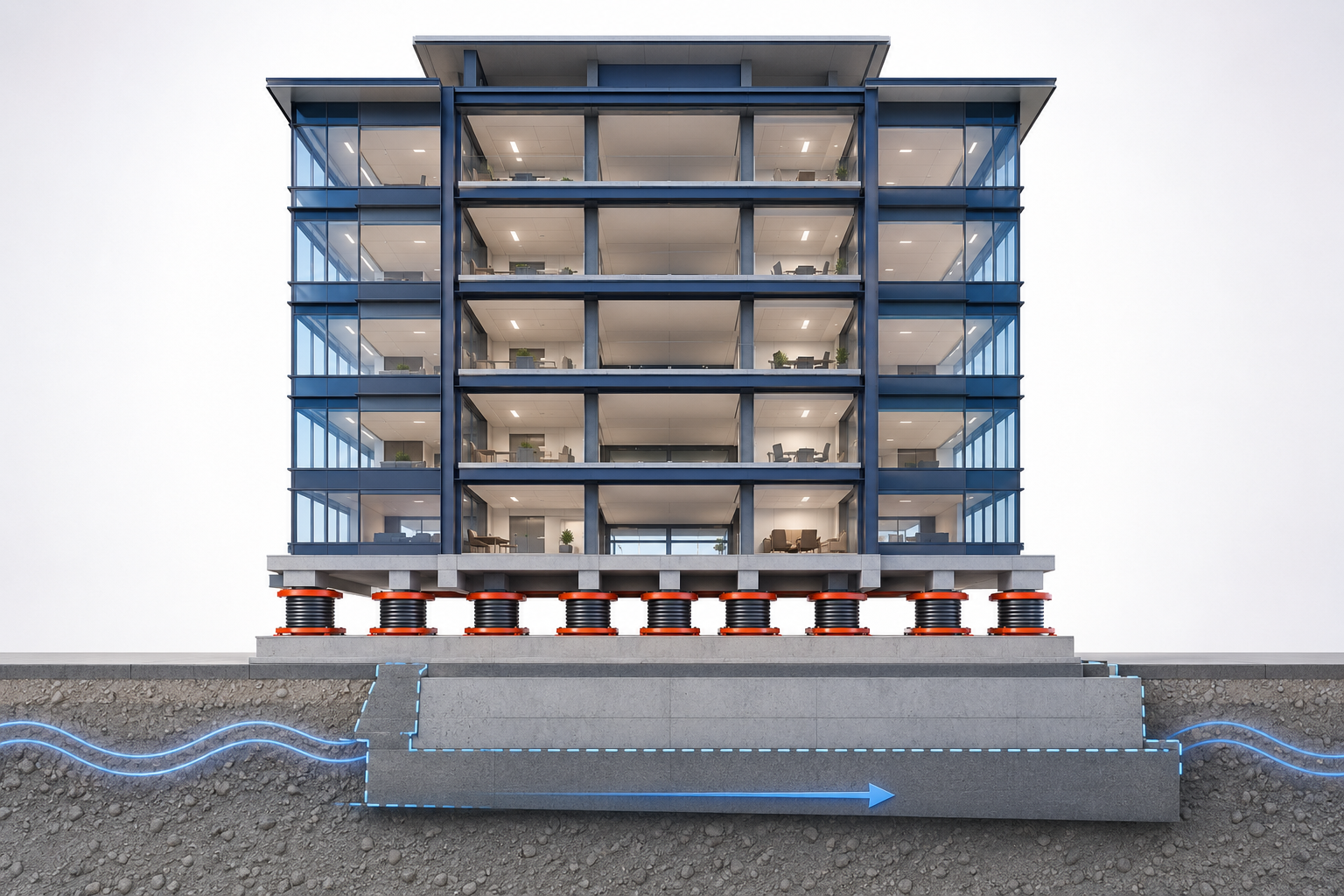
Todos los sistemas de aislamiento de VELATOPH® comparten este principio. Lo que los diferencia es cómo logran la flexibilidad horizontal, cómo disipan la energía, qué tipo de cargas pueden manejar y qué período de aislamiento alcanzan. Conocer esas diferencias es clave para elegir correctamente.
Los sistemas, uno por uno
LRB — Aislador elastomérico con núcleo de plomo
El LRB (Lead Rubber Bearing) es el sistema de aislamiento más utilizado en infraestructura crítica a nivel mundial. Está compuesto por capas alternadas de caucho natural de alta calidad y láminas de acero vulcanizadas en caliente, con un núcleo de plomo central que es su elemento diferenciador. El núcleo de plomo trabaja en fluencia cíclica durante el sismo, disipando energía en cada ciclo de carga.
Esto le da al LRB la característica más valorada para estructuras de alta importancia: combina aislamiento y disipación de energía en un solo dispositivo, sin necesidad de añadir disipadores separados. Los parámetros de fabricación son:
- Diámetros: 500 a 1,000 mm
- Desplazamientos de diseño: 150 a 400 mm
- Amortiguamiento efectivo: ξ ≈ 23–44%, según el módulo G del caucho (0.4–1.0 MPa)
Es el sistema ideal para hospitales, puentes, edificios gubernamentales y cualquier estructura esencial donde la interrupción de operación no es aceptable. En los Puentes El Quelite 1 y 2 en Sinaloa (2022), VELATOPH® instaló 70 + 70 aisladores LRB que protegen uno de los tramos carreteros más importantes del Pacífico mexicano.
LDRB — Aislador elastomérico de bajo amortiguamiento
El LDRB (Low Damping Rubber Bearing) comparte la arquitectura de capas de neopreno y láminas de acero A-36 del LRB, pero con una diferencia técnica fundamental que se confunde con frecuencia: el LDRB no lleva núcleo de plomo. Su amortiguamiento efectivo es menor (ξ ≈ 15%), lo que simplifica su fabricación y reduce su costo unitario de forma significativa.
Esta diferencia lo convierte en el sistema óptimo para aplicaciones donde el análisis dinámico no requiere alto amortiguamiento: vivienda, edificios pequeños y estructuras de menor importancia sísmica. VELATOPH® fabrica dos modelos para uso habitacional:
- LDRB300 (300 × 300 mm): para casas de 1 y 2 niveles
- LDRB400 (400 × 400 mm): para edificios de hasta 4 niveles
El LDRB es el primer sistema de aislamiento sísmico diseñado específicamente para vivienda en México, desarrollado por VELATOPH® a partir de 2010. También se utiliza para aislamiento de vibración de maquinaria industrial, donde su bajo amortiguamiento y alta rigidez vertical lo hacen adecuado para cargas cíclicas no sísmicas.
FPS / FP3 — Aislador de péndulo de fricción (triple péndulo)
El FPS (Friction Pendulum System) opera sobre un principio completamente distinto a los elastoméricos. En lugar de caucho, utiliza un plato cóncavo de acero inoxidable 316L y un deslizador con recubrimiento de PTFE (teflón). Cuando el edificio se mueve, el deslizador asciende por la superficie cóncava —igual que un péndulo— y la gravedad lo devuelve al centro: re-centrado gravitacional automático, sin necesidad del caucho.
La propiedad más importante del FPS es que su período de aislamiento depende únicamente de la geometría del plato (el radio de curvatura), no de la masa de la estructura. Esto lo hace altamente predecible ante variaciones de carga vertical, que es exactamente el escenario de un hospital con variación de ocupación entre pisos. Los parámetros son:
- Cargas: 100 a 1,500 toneladas por dispositivo
- Período de aislamiento: 2.0 a 4.5 s
- Reducción de fuerza sísmica: más del 90%
La versión de triple péndulo (FP3) incorpora tres superficies cóncavas concéntricas, lo que le permite una respuesta multiescalón: comportamiento diferente ante sismos pequeños, moderados y extremos. Para el Hospital de Bahía de Caráquez, Ecuador (2021), VELATOPH® fabricó e instaló 64 dispositivos de péndulo de fricción en uno de los proyectos de infraestructura de salud más importantes de la región andina.
DFP — Aislador de doble péndulo de fricción
El DFP (Double Friction Pendulum) es la versión de dos superficies cóncavas del FPS. Al distribuir el desplazamiento entre dos platos, logra el mismo período de aislamiento que un FPS simple pero con una planta aproximadamente 30% más compacta. Esta característica lo hace especialmente valioso en proyectos donde el espacio en planta del foso de aislamiento es restringido.
Además, al poder diseñar coeficientes de fricción diferentes en cada superficie, el DFP también tiene respuesta multiescalón ante sismos de diferente intensidad. Cargas de diseño: 100 a 1,500 toneladas por dispositivo. Es adecuado para hospitales, puentes de longitud media y edificios de alta importancia con restricción de espacio.
DEF y DVF — Disipadores complementarios
Aunque no son sistemas de aislamiento en sentido estricto, el DEF (Disipador de Energía por Fricción) y el DVF (Disipador de Fluido Viscoso) son elementos complementarios que se integran con el sistema de aislamiento o se emplean de forma independiente para disipar energía adicional en la superestructura.
El DEF ofrece un amortiguamiento equivalente de hasta ξ_eq ≈ 63.7%, con la ventaja de que no sufre daño durante el sismo y es reutilizable. El DVF trabaja con la velocidad de deformación, por lo que es especialmente eficaz para reducir aceleraciones de piso en estructuras esbeltas como puentes, torres y edificios altos. Ninguno de estos dos dispositivos aísla por sí solo; su función es complementar el sistema de aislamiento o usarse en combinación con refuerzo estructural.
Tabla comparativa de sistemas
| Sistema | Principio | Carga / aplicación típica | Amortiguamiento | Ideal para |
|---|---|---|---|---|
| LRB | Elastomérico con núcleo de plomo | Cargas altas · Ø 500–1000 mm | ξ ≈ 23–44% | Hospitales, puentes, edificios esenciales |
| LDRB | Elastomérico sin núcleo de plomo | Cargas bajas–medias · 300–400 mm | ξ ≈ 15% | Vivienda, edificios 1–4 niveles, patrimonio |
| FPS / FP3 | Péndulo cóncavo de fricción (simple / triple) | 100–1500 ton · Período 2.0–4.5 s | Fricción variable | Estructuras con carga variable, hospitales, puentes |
| DFP | Doble péndulo cóncavo de fricción | 100–1500 ton · Planta compacta | Fricción variable | Espacio restringido, hospitales, puentes |
¿Cómo elegir el sistema correcto?
A partir de la comparación anterior, algunas orientaciones prácticas para guiar la conversación con el equipo de ingeniería:
- ¿Vivienda o edificio pequeño con presupuesto acotado? El LDRB es la opción natural: bajo costo, instalación sencilla y rendimiento suficiente para estructuras de hasta 4 niveles.
- ¿Hospital, puente o edificio esencial que no puede dejar de operar? El LRB o el FPS son la primera línea: alto amortiguamiento, largo historial de proyectos críticos y período de aislamiento largo.
- ¿El espacio en planta para el foso de aislamiento es reducido? El DFP ofrece el mismo período que el FPS en un diámetro ~30% menor.
- ¿La carga vertical varía significativamente de un punto a otro de la planta? El FPS o DFP tienen período independiente de la masa: la respuesta dinámica es predecible aunque cambien las cargas de ocupación.
- ¿Se necesita disipación adicional o reducción de aceleraciones en la superestructura? Complementar el sistema de aislamiento con DEF o DVF permite afinar el desempeño del conjunto.
El respaldo de VELATOPH®
VELATOPH® es una empresa mexicana fundada en 2010, primera en México en desarrollar y fabricar dispositivos sismorresistentes para distintos tipos de estructura. Con una planta de producción de 1,000 m² en Manzanillo, Colima, y laboratorio de ensayo propio en la Universidad de Colima, cada dispositivo —LRB, LDRB, FPS, DFP, DEF o DVF— se certifica individualmente bajo los procedimientos de prueba exigidos por los códigos UBC, ASCE 7 y AASHTO.
Con más de 60 proyectos ejecutados en 5 países —México, Guatemala, Ecuador, República Dominicana y Puerto Rico— el equipo de VELATOPH® ha trabajado con puentes, hospitales, vivienda, edificios universitarios e inmuebles históricos. Todos los sistemas se diseñan bajo ASCE 7-22, AASHTO, ISO 22762, NTC-Sismo y MDOC-CFE.
One of the most frequent questions we receive from designers, developers and owners is also the most legitimate one: "Which is the best seismic isolation system?" The honest answer is that there is no universally best system. What does exist is the right system for each project.
The correct choice depends on several simultaneous factors: the load of the structure, the type and condition of the soil, the physical space available for displacement, the level of damping required by the dynamic analysis, the importance level of the structure and, of course, the budget. This article explains how seismic isolation works and compares in detail the systems manufactured by VELATOPH® so you can better guide the conversation with your engineering team.
How seismic isolation works
Before comparing systems, it is useful to understand the principle they all share. In a conventional building, seismic energy enters through the foundation and travels upward, amplifying on each floor. The typical response of conventional design is to make the structure stiffer and stronger so it can resist that energy.
Seismic isolation operates in a completely different way: instead of resisting the energy, it intercepts it before it reaches the superstructure. This is achieved by inserting a level of devices with low horizontal stiffness —the isolators— between the foundation and the building. By doing so, the natural period of the structure is significantly lengthened, decoupling it from the ground motion. The reduction of transmitted seismic force can reach 90%.
All VELATOPH® isolation systems share this principle. What differentiates them is how they achieve horizontal flexibility, how they dissipate energy, what type of loads they can handle and what isolation period they reach. Knowing those differences is key to choosing correctly.
The systems, one by one
LRB — Lead-rubber bearing
The LRB (Lead Rubber Bearing) is the most widely used isolation system in critical infrastructure worldwide. It is made of alternating layers of high-quality natural rubber and steel shims hot-vulcanized together, with a central lead core as its distinguishing element. The lead core works in cyclic yielding during the earthquake, dissipating energy in each load cycle.
This gives the LRB the most valued feature for high-importance structures: it combines isolation and energy dissipation in a single device, without the need to add separate dampers. The manufacturing parameters are:
- Diameters: 500 to 1,000 mm
- Design displacements: 150 to 400 mm
- Effective damping: ξ ≈ 23–44%, depending on the shear modulus G of the rubber (0.4–1.0 MPa)
It is the ideal system for hospitals, bridges, government buildings and any essential structure where interruption of operation is not acceptable. On the El Quelite 1 and 2 Bridges in Sinaloa (2022), VELATOPH® installed 70 + 70 LRB isolators that protect one of the most important road sections of the Mexican Pacific.
LDRB — Low damping rubber bearing
The LDRB (Low Damping Rubber Bearing) shares the layered architecture of neoprene and A-36 steel shims of the LRB, but with a fundamental technical difference that is frequently confused: the LDRB has no lead core. Its effective damping is lower (ξ ≈ 15%), which simplifies its manufacturing and significantly reduces its unit cost.
This difference makes it the optimal system for applications where the dynamic analysis does not require high damping: housing, small buildings and structures of lower seismic importance. VELATOPH® manufactures two models for residential use:
- LDRB300 (300 × 300 mm): for 1- and 2-story houses
- LDRB400 (400 × 400 mm): for buildings up to 4 stories
The LDRB is the first seismic isolation system designed specifically for housing in Mexico, developed by VELATOPH® starting in 2010. It is also used for vibration isolation of industrial machinery, where its low damping and high vertical stiffness make it suitable for non-seismic cyclic loads.
FPS / FP3 — Friction pendulum isolator (triple pendulum)
The FPS (Friction Pendulum System) operates on a completely different principle from elastomeric bearings. Instead of rubber, it uses a concave plate of 316L stainless steel and a slider with a PTFE (Teflon) coating. When the building moves, the slider rises along the concave surface —just like a pendulum— and gravity returns it to the center: automatic gravitational re-centering, without the need for rubber.
The most important property of the FPS is that its isolation period depends solely on the geometry of the plate (the radius of curvature), not on the mass of the structure. This makes it highly predictable under variations of vertical load, which is exactly the scenario of a hospital with occupancy variation between floors. The parameters are:
- Loads: 100 to 1,500 tons per device
- Isolation period: 2.0 to 4.5 s
- Seismic force reduction: more than 90%
The triple pendulum (FP3) version incorporates three concentric concave surfaces, which allows a multi-stage response: different behavior under small, moderate and extreme earthquakes. For the Bahía de Caráquez Hospital, Ecuador (2021), VELATOPH® manufactured and installed 64 friction pendulum devices in one of the most important healthcare infrastructure projects of the Andean region.
DFP — Double friction pendulum isolator
The DFP (Double Friction Pendulum) is the two-concave-surface version of the FPS. By distributing the displacement between two plates, it achieves the same isolation period as a single FPS but with an approximately 30% more compact footprint. This feature makes it especially valuable in projects where the plan space of the isolation pit is restricted.
In addition, by being able to design different friction coefficients on each surface, the DFP also has a multi-stage response under earthquakes of different intensity. Design loads: 100 to 1,500 tons per device. It is suitable for hospitals, medium-span bridges and high-importance buildings with space restrictions.
DEF and DVF — Complementary dampers
Although they are not isolation systems in the strict sense, the DEF (Friction Energy Damper) and the DVF (Viscous Fluid Damper) are complementary elements that integrate with the isolation system or are used independently to dissipate additional energy in the superstructure.
The DEF offers an equivalent damping of up to ξ_eq ≈ 63.7%, with the advantage that it suffers no damage during the earthquake and is reusable. The DVF works with the strain rate, which makes it especially effective at reducing floor accelerations in slender structures such as bridges, towers and tall buildings. Neither of these two devices isolates on its own; their function is to complement the isolation system or to be used in combination with structural reinforcement.
Systems comparison table
| System | Principle | Typical load / application | Damping | Ideal for |
|---|---|---|---|---|
| LRB | Elastomeric with lead core | High loads · Ø 500–1000 mm | ξ ≈ 23–44% | Hospitals, bridges, essential buildings |
| LDRB | Elastomeric without lead core | Low–medium loads · 300–400 mm | ξ ≈ 15% | Housing, 1–4 story buildings, heritage |
| FPS / FP3 | Concave friction pendulum (single / triple) | 100–1500 ton · Period 2.0–4.5 s | Variable friction | Structures with variable load, hospitals, bridges |
| DFP | Double concave friction pendulum | 100–1500 ton · Compact footprint | Variable friction | Restricted space, hospitals, bridges |
How to choose the right system?
Based on the comparison above, here are some practical guidelines to steer the conversation with the engineering team:
- Housing or a small building with a tight budget? The LDRB is the natural choice: low cost, simple installation and sufficient performance for structures up to 4 stories.
- A hospital, bridge or essential building that cannot stop operating? The LRB or the FPS are the first line: high damping, a long track record on critical projects and a long isolation period.
- Is the plan space for the isolation pit reduced? The DFP offers the same period as the FPS in a diameter ~30% smaller.
- Does the vertical load vary significantly from one point of the plan to another? The FPS or DFP have a mass-independent period: the dynamic response is predictable even when occupancy loads change.
- Do you need additional dissipation or reduction of accelerations in the superstructure? Complementing the isolation system with DEF or DVF allows fine-tuning the performance of the assembly.
The backing of VELATOPH®
VELATOPH® is a Mexican company founded in 2010, the first in Mexico to develop and manufacture earthquake-resistant devices for different types of structure. With a 1,000 m² production plant in Manzanillo, Colima, and its own testing laboratory at the University of Colima, each device —LRB, LDRB, FPS, DFP, DEF or DVF— is individually certified under the testing procedures required by the UBC, ASCE 7 and AASHTO codes.
With more than 60 projects executed in 5 countries —Mexico, Guatemala, Ecuador, the Dominican Republic and Puerto Rico— the VELATOPH® team has worked with bridges, hospitals, housing, university buildings and historic properties. All systems are designed under ASCE 7-22, AASHTO, ISO 22762, NTC-Sismo and MDOC-CFE.