Los contravientos —las diagonales de acero que rigidizan un marco— son una de las formas más antiguas, económicas y eficaces de dar resistencia lateral a una estructura frente al sismo y el viento. Una diagonal bien colocada convierte un marco flexible en una estructura rígida y estable. Pero tienen un talón de Aquiles que se vuelve crítico justo cuando más se les necesita: el pandeo.
Cuando un sismo sacude un edificio, sus diagonales trabajan alternadamente en tensión y en compresión, ciclo tras ciclo. En tensión, una diagonal esbelta responde bien. En compresión, en cambio, se pandea: se flexiona lateralmente y pierde de golpe gran parte de su capacidad. El comportamiento se vuelve asimétrico —fuerte en un sentido, débil en el otro— y, al repetirse los ciclos, la diagonal se degrada con rapidez. En un diagrama de fuerza contra desplazamiento, esto produce lazos de histéresis "pellizcados" (el fenómeno de pinching): estrechos, asimétricos y con poca área. Y como el área de ese lazo es, literalmente, la energía que el dispositivo disipa, un contraviento que se pandea disipa poco.
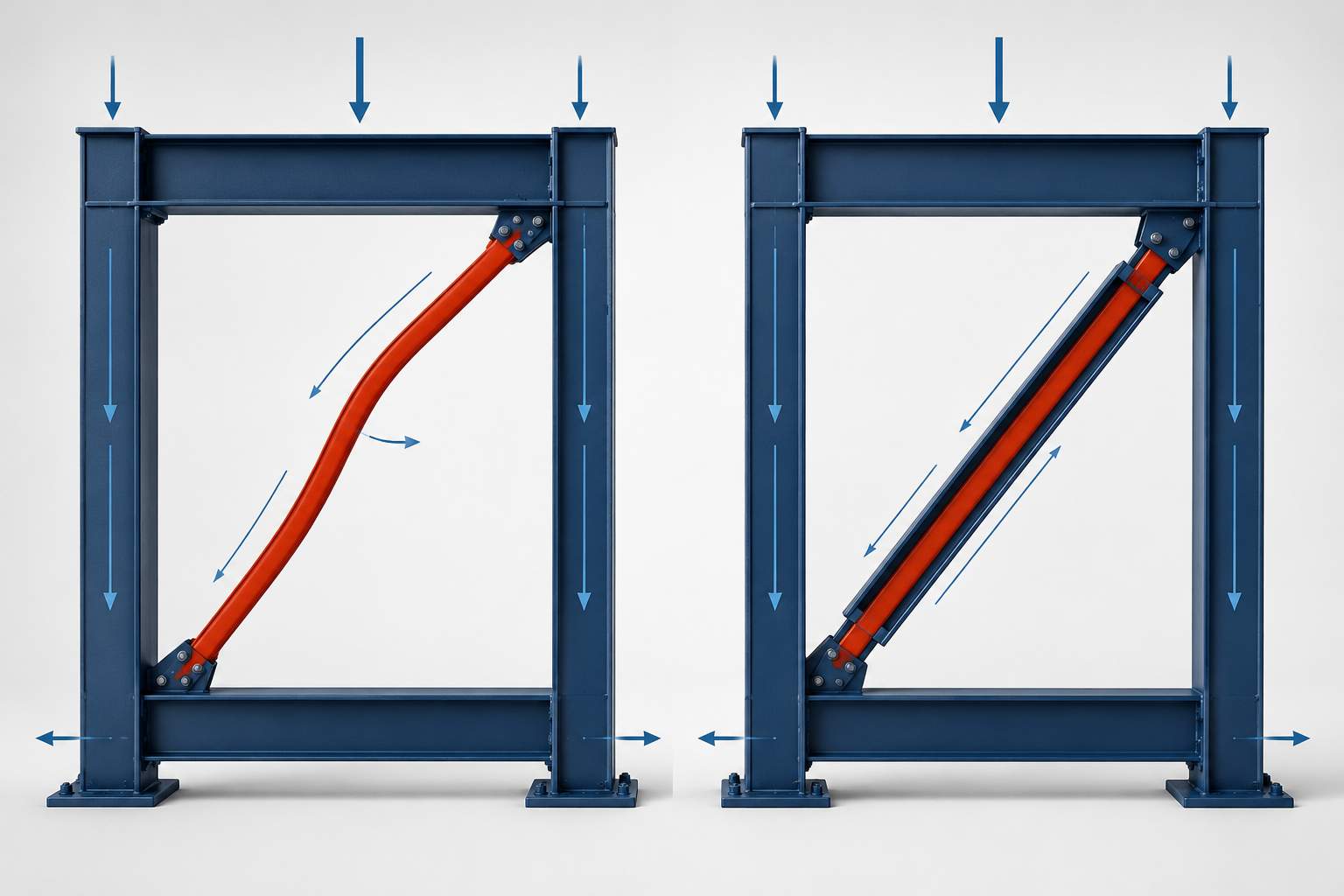
El contraventeo de pandeo restringido nace precisamente para eliminar ese talón de Aquiles.
Qué es un contraventeo de pandeo restringido (BRB)
Un BRB (del inglés Buckling-Restrained Brace) es una diagonal de acero diseñada para fluir por igual en tensión y en compresión, sin pandearse nunca. Lo consigue separando dos funciones que en un contraviento convencional recaen sobre el mismo elemento: resistir la carga axial y evitar el pandeo.
Un BRB se compone de tres partes:
- Un núcleo de acero: la sección que realmente resiste la carga, diseñada para entrar en fluencia tanto en tensión como en compresión. Es el corazón del dispositivo.
- Una capa desadherente que envuelve el núcleo: una delgada interfaz deslizante que impide que el núcleo se pegue al relleno y le permite alargarse y acortarse libremente.
- Una camisa de confinamiento: típicamente un tubo de acero relleno de mortero o concreto que rodea al núcleo y le impide pandearse, sin tomar carga axial significativa.
El reparto de tareas es la clave: el núcleo toma toda la carga axial y fluye; la camisa solo impide el pandeo. Gracias a la capa desadherente, la camisa no se "lleva" parte de la fuerza axial, sino que se limita a sujetar lateralmente al núcleo. El resultado es un acero que fluye de forma estable, simétrica y repetible.
Cómo funciona
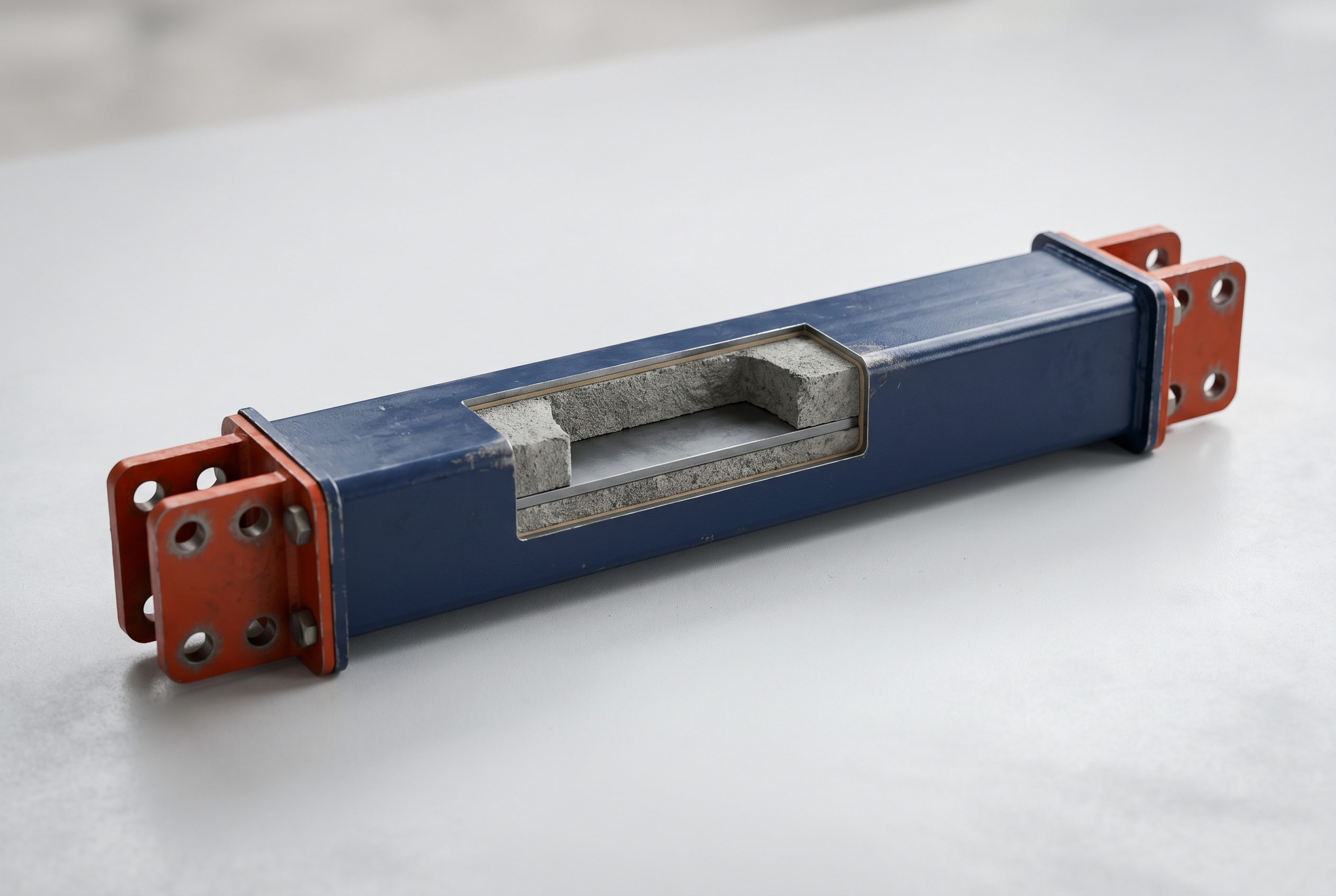
Bajo carga axial, el núcleo de acero del BRB entra en fluencia controlada: se deforma plásticamente de manera estable, absorbiendo y disipando la energía del sismo en forma de calor. Funciona como un fusible estructural: concentra el daño en un elemento previsto para ello —el núcleo— y, al hacerlo, protege las vigas, columnas y conexiones del marco, que permanecen esencialmente elásticas.
Mientras el núcleo fluye, la camisa de mortero confinado cumple una única misión: restringir el pandeo. Toma la flexión que tendería a doblar el núcleo, pero —gracias a la capa desadherente que los separa— no toma carga axial. Por eso el núcleo puede acortarse en compresión exactamente igual que se alarga en tensión, sin flexionarse.
Esa simetría es lo que distingue al BRB. En lugar de los lazos pellizcados del contraviento convencional, el BRB produce lazos de histéresis anchos, llenos y simétricos: mucha área, mucha energía disipada, ciclo tras ciclo y sin degradación apreciable.
BRB frente al contraviento convencional
La diferencia entre ambos no es de grado, sino de naturaleza. Esta tabla resume el contraste:
| Característica | Contraviento convencional | Contraventeo de pandeo restringido (BRB) |
|---|---|---|
| Comportamiento en compresión | Se pandea | No se pandea |
| Simetría tensión-compresión | Asimétrico | Simétrico |
| Forma del lazo histerético | Pellizcado (pinching) | Estable y lleno |
| Capacidad de disipación | Baja | Alta |
| Daño a la estructura principal | Mayor | Menor: concentrado en el fusible |
| Post-sismo | Difícil de evaluar | Inspección y reemplazo del núcleo |
Beneficios prácticos
- Más amortiguamiento, menos respuesta: al disipar gran cantidad de energía, el BRB reduce los desplazamientos y las fuerzas que el sismo impone a la estructura.
- Protege lo importante: concentra el daño en un componente diseñado para fluir, manteniendo vigas, columnas y conexiones dentro del rango elástico.
- Predecible: su comportamiento es estable y está bien caracterizado por la normativa y por ensayos, lo que da confianza al diseño.
- Reparable: tras un sismo severo se puede inspeccionar y, si procede, reemplazar el núcleo dañado, devolviendo la estructura a su condición original.
- Eficiente en acero: logra el desempeño buscado sin sobredimensionar vigas y columnas, una alternativa más esbelta que engrosarlo todo.
Aplicaciones
El BRB es versátil y encaja en escenarios muy distintos:
- Edificios nuevos de acero (y de concreto con marcos de acero) en zona sísmica, como sistema de marcos arriostrados con pandeo restringido.
- Reforzamiento sísmico de estructuras existentes —una de sus aplicaciones más valiosas—: permite añadir capacidad de disipación a un edificio ya construido con una intervención relativamente acotada.
- Hospitales, edificios esenciales, naves industriales y estructuras de media y gran altura, donde la continuidad de operación y la protección de la inversión son prioritarias.
Qué dice la normativa
El diseño con BRB no es experimental: está respaldado por normativa internacional de marcos arriostrados con pandeo restringido (los sistemas tipo BRBF, Buckling-Restrained Braced Frames, recogidos en lineamientos como AISC 341 y los criterios de la ASCE 7) y se integra con los criterios sísmicos aplicables en México (NTC-Sismo, MDOC-CFE). Un rasgo característico del BRB es que cada dispositivo se califica por ensayo: su desempeño se demuestra en laboratorio mediante protocolos de carga cíclica antes de confiarle una estructura.
VELATOPH® y los contraventeos de pandeo restringido
VELATOPH® fabrica e integra contraventeos de pandeo restringido dentro de su línea de sistemas de protección sísmica, junto a los aisladores (LRB, LDRB, FPS, DFP) y los disipadores (DEF, DVF). Cada dispositivo se diseña a la medida del proyecto —según la demanda estructural y los objetivos de desempeño— y se ensaya y certifica en laboratorio, en colaboración con la Universidad de Colima.
Detrás hay una empresa mexicana fundada en 2010, con una planta de 1,000 m² en Colima, más de 60 proyectos ejecutados en 5 países y diseños que citan las normas ASCE, AASHTO, ISO, NTC y CFE.
Braces —the steel diagonals that stiffen a frame— are one of the oldest, most economical and most effective ways to give a structure lateral resistance against earthquakes and wind. A well-placed diagonal turns a flexible frame into a rigid, stable structure. But they have an Achilles' heel that becomes critical precisely when they are needed most: buckling.
When an earthquake shakes a building, its diagonals work alternately in tension and compression, cycle after cycle. In tension, a slender diagonal responds well. In compression, however, it buckles: it bends laterally and suddenly loses much of its capacity. The behavior becomes asymmetric —strong in one direction, weak in the other— and, as the cycles repeat, the diagonal degrades quickly. On a force-versus-displacement diagram, this produces "pinched" hysteresis loops (the pinching phenomenon): narrow, asymmetric and with little area. And since the area of that loop is, literally, the energy the device dissipates, a brace that buckles dissipates little.
The buckling-restrained brace was created precisely to eliminate that Achilles' heel.
What is a buckling-restrained brace (BRB)
A BRB (Buckling-Restrained Brace) is a steel diagonal designed to yield equally in tension and compression, without ever buckling. It achieves this by separating two functions that in a conventional brace fall on the same element: resisting the axial load and preventing buckling.
A BRB is made up of three parts:
- A steel core: the section that actually resists the load, designed to yield in both tension and compression. It is the heart of the device.
- An unbonding layer that wraps the core: a thin sliding interface that prevents the core from bonding to the infill and allows it to lengthen and shorten freely.
- A confining casing: typically a steel tube filled with mortar or concrete that surrounds the core and prevents it from buckling, without taking significant axial load.
The division of tasks is the key: the core takes all the axial load and yields; the casing only prevents buckling. Thanks to the unbonding layer, the casing does not "take" part of the axial force, but limits itself to laterally restraining the core. The result is steel that yields in a stable, symmetric and repeatable way.
How it works
Under axial load, the steel core of the BRB enters controlled yielding: it deforms plastically in a stable manner, absorbing and dissipating the earthquake's energy as heat. It works like a structural fuse: it concentrates the damage in an element intended for it —the core— and, in doing so, protects the beams, columns and connections of the frame, which remain essentially elastic.
While the core yields, the confined-mortar casing fulfills a single mission: restraining buckling. It takes the bending that would tend to bend the core but —thanks to the unbonding layer that separates them— it does not take axial load. That is why the core can shorten in compression exactly as it lengthens in tension, without bending.
That symmetry is what sets the BRB apart. Instead of the pinched loops of the conventional brace, the BRB produces wide, full and symmetric hysteresis loops: lots of area, lots of dissipated energy, cycle after cycle and with no appreciable degradation.
BRB versus the conventional brace
The difference between the two is not one of degree, but of nature. This table summarizes the contrast:
| Feature | Conventional brace | Buckling-restrained brace (BRB) |
|---|---|---|
| Behavior in compression | Buckles | Does not buckle |
| Tension-compression symmetry | Asymmetric | Symmetric |
| Hysteresis loop shape | Pinched (pinching) | Stable and full |
| Dissipation capacity | Low | High |
| Damage to the main structure | Greater | Lower: concentrated in the fuse |
| Post-earthquake | Hard to assess | Inspect and replace the core |
Practical benefits
- More damping, less response: by dissipating a large amount of energy, the BRB reduces the displacements and forces that the earthquake imposes on the structure.
- Protects what matters: it concentrates the damage in a component designed to yield, keeping beams, columns and connections within the elastic range.
- Predictable: its behavior is stable and well characterized by codes and by testing, which gives confidence to the design.
- Repairable: after a severe earthquake the damaged core can be inspected and, if appropriate, replaced, returning the structure to its original condition.
- Steel-efficient: it achieves the desired performance without oversizing beams and columns, a slenderer alternative to beefing up everything.
Applications
The BRB is versatile and fits very different scenarios:
- New steel buildings (and concrete buildings with steel frames) in seismic zones, as a buckling-restrained braced frame system.
- Seismic retrofit of existing structures —one of its most valuable applications—: it makes it possible to add dissipation capacity to an already-built building with a relatively limited intervention.
- Hospitals, essential buildings, industrial halls and mid- and high-rise structures, where continuity of operation and protection of the investment are priorities.
What the codes say
Design with BRBs is not experimental: it is backed by international codes for buckling-restrained braced frames (the BRBF systems, Buckling-Restrained Braced Frames, covered in guidelines such as AISC 341 and the criteria of ASCE 7) and integrates with the seismic criteria applicable in Mexico (NTC-Sismo, MDOC-CFE). A distinctive feature of the BRB is that each device is qualified by testing: its performance is demonstrated in the laboratory through cyclic loading protocols before a structure is entrusted to it.
VELATOPH® and buckling-restrained braces
VELATOPH® manufactures and integrates buckling-restrained braces within its line of seismic protection systems, alongside the isolators (LRB, LDRB, FPS, DFP) and the dampers (DEF, DVF). Each device is designed to the measure of the project —according to the structural demand and the performance objectives— and is tested and certified in the laboratory, in collaboration with the Universidad de Colima.
Behind it is a Mexican company founded in 2010, with a 1,000 m² plant in Colima, more than 60 projects executed in 5 countries and designs that cite the ASCE, AASHTO, ISO, NTC and CFE standards.