Los puentes son infraestructura crítica: deben seguir operativos justo después de un sismo, cuando más se necesitan para la respuesta y el rescate. El aislamiento sísmico —con aisladores LRB, apoyos de hule de alto amortiguamiento (HDR) o péndulos de fricción— protege el puente al desacoplar el tablero de las pilas y los estribos, reduciendo drásticamente la fuerza que el sismo transmite a la estructura.
Pero hay una pregunta constructiva que define buena parte del costo y del plazo de la obra: ¿cómo y cuándo se instalan los aisladores durante la construcción del puente? La respuesta tradicional es más cara, más lenta y más riesgosa de lo que muchos suponen. En VELATOPH® aplicamos un método distinto que cambia esa ecuación.
El método convencional (y lo que cuesta)
En la práctica habitual, los aisladores no se colocan al principio, sino casi al final. La secuencia típica es:
- Se montan apoyos temporales (de acero o concreto) sobre los cabezales de las pilas.
- Se construye toda la superestructura —trabes y losa— apoyada sobre esos elementos provisionales.
- Al terminar, mediante gateo hidráulico, se levanta la superestructura, se retiran los apoyos temporales, se colocan los aisladores definitivos y se vuelve a bajar la carga sobre ellos. Apoyo por apoyo.
Cada paso suma costo y riesgo: el suministro y montaje de los apoyos temporales, la operación de gateo y transferencia de carga —una maniobra delicada con una superestructura de cientos de toneladas— y, al final, el retiro y demolición de los provisionales. A ello se añade un control geométrico más difícil (el aislador se posiciona en un espacio confinado, ya con el puente encima) y el riesgo de error o daño durante la transferencia de carga.
El método VELATOPH, paso a paso
La idea es simple y poderosa: instalar los aisladores desde el inicio y mantenerlos bloqueados hasta que el puente esté terminado.
- Instalación desde el inicio. Los aisladores se colocan directamente sobre los cabezales de las pilas, con acceso libre y antes de construir la superestructura.
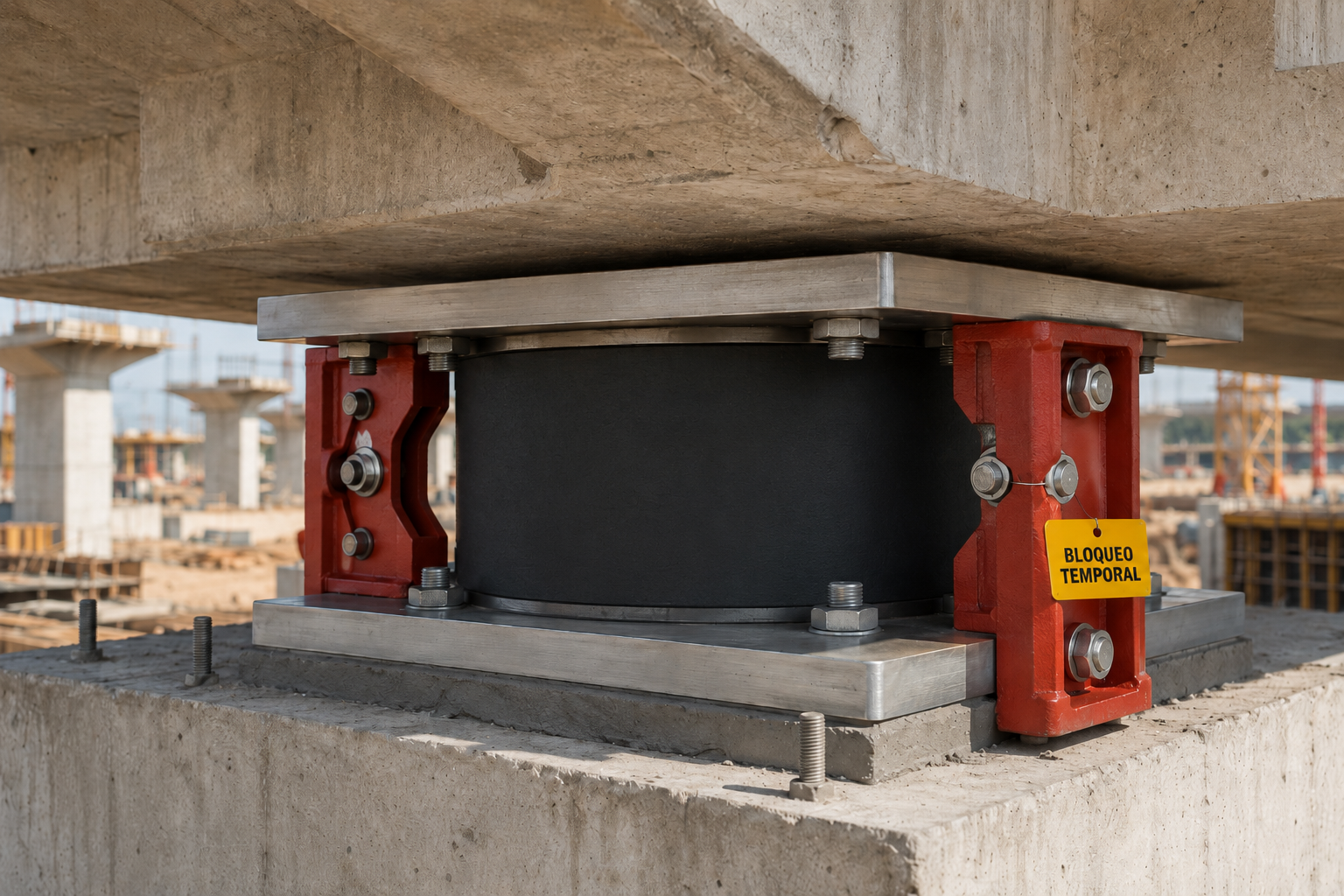
- Bloqueo temporal (candados). Se instalan dispositivos de bloqueo —los "candados"— que inmovilizan cada aislador durante toda la construcción.
- Construcción sobre los aisladores. El puente se construye directamente encima de los aisladores ya colocados, sin apoyos provisionales.
- Activación del aislamiento. Al concluir la obra, los candados se retiran de forma controlada y secuenciada: en ese momento el sistema de aislamiento queda "activo".
Por qué hacen falta los candados
Una estructura aislada es, por diseño, lateralmente flexible: esa es justo la cualidad que la protege durante un sismo. Pero durante la construcción esa flexibilidad es un problema. Si los aisladores quedaran libres mientras se monta el puente, la superestructura podría desplazarse por el viento, los efectos térmicos, la propia secuencia de montaje o incluso por un sismo antes de terminar la obra, comprometiendo la estabilidad y el control geométrico.
Los candados —pernos o barras de bloqueo, o topes laterales entre las placas del aislador— inmovilizan el dispositivo durante todo el montaje y se retiran al final, de forma secuenciada, para "soltar" el sistema de manera controlada.
Cómo se protege el aislador durante la obra
El cuerpo de caucho del aislador es un elemento de precisión y debe llegar intacto al final de la construcción. Durante la obra se protege con:
- Cubierta contra polvo y contaminantes.
- Protección perimetral contra golpes e impactos.
- Protección contra rayones y abrasión.
- Resguardo contra soldadura, fuego, químicos y agua.
Estas protecciones se retiran, junto con los candados, al concluir la obra.
Comparación: costo, riesgo y tiempo
La diferencia entre ambos métodos se aprecia con claridad al ponerlos lado a lado:
| Concepto | Método convencional | Método VELATOPH |
|---|---|---|
| Apoyos temporales | Requeridos (~$80,000 / apoyo) | No se requieren |
| Gateo y transferencia de carga | Requerido (~$60,000 / apoyo) | No se requiere |
| Retiro / demolición de temporales | Requerido (~$20,000 / apoyo) | No aplica |
| Candados de bloqueo temporal | — | Sí (~$10,000 / apoyo) |
| Control geométrico del aislador | Más difícil (tras el gateo) | Más preciso (acceso libre, desde el inicio) |
| Riesgo en la transferencia de carga | Presente (maniobra delicada) | Eliminado |
| Suministro desde el primer mes (SICT 6.15) | Difícil de cumplir | Se cumple de origen |
El ahorro tiene un origen concreto: el método VELATOPH elimina los apoyos temporales (su suministro y montaje), la operación de gateo y el retiro y demolición de los provisionales. A cambio solo añade los candados de bloqueo, mucho más económicos.
Cuánto se ahorra (con su contexto)
Para dimensionarlo, tomemos como referencia un viaducto de ~50 apoyos. Las cifras están en pesos mexicanos (MXN) y se expresan por apoyo:
- Método convencional ≈ $160,000 por apoyo: apoyos temporales (~$80,000) + gateo y transferencia de carga (~$60,000) + retiro y demolición (~$20,000).
- Método VELATOPH ≈ $10,000 por apoyo: el costo de los candados de bloqueo temporal.
- Ahorro ≈ $150,000 por apoyo → del orden de $7 millones de pesos en costos directos para un viaducto de ~50 apoyos.
- Programa: del orden de 6 a 8 semanas (~45 días) menos, además de la consecuente reducción de costos indirectos y de financiamiento por el menor plazo.
Los riesgos que se reducen
- Sin gateo sincronizado de una superestructura pesada: se elimina una de las maniobras más delicadas de la obra.
- Mejor control geométrico: los aisladores se colocan con acceso libre, antes de construir, lo que permite una instalación más precisa.
- Menor riesgo de daño y de error en la transferencia de carga.
- Cumplimiento del suministro desde el primer mes que exigen las licitaciones de la SICT (cláusula tipo 6.15): con este método, los aisladores están en obra desde el principio.
El respaldo de VELATOPH®
VELATOPH® es un fabricante mexicano de aisladores sísmicos —LRB de goma con núcleo de plomo, apoyos HDR y péndulos de fricción— y disipadores de energía, con planta propia de 1,000 m² en Colima. Fundada en 2010, suma más de 60 proyectos en 5 países y un laboratorio de ensayo en la Universidad de Colima, donde cada dispositivo se certifica bajo AASHTO y ASCE. En puentes, nuestra experiencia incluye los Puentes El Quelite 1 y 2 (2022), con 70 + 70 aisladores LRB suministrados e instalados.
Diseñamos tanto el dispositivo como su sistema de instalación a la medida de cada puente, conforme a las AASHTO Guide Specifications for Seismic Isolation Design, la ASCE 7-22, la ISO 22762 y la normativa de la SICT.
Si proyectas, construyes o licitas un puente con aislamiento sísmico, podemos mostrarte cómo el método de instalación desde el inicio puede ahorrar tiempo y costo en tu obra. Escríbenos por WhatsApp o desde nuestra página de contacto.
Bridges are critical infrastructure: they must remain operational right after an earthquake, when they are most needed for response and rescue. Seismic isolation —with LRB isolators, high-damping rubber bearings (HDR) or friction pendulums— protects the bridge by decoupling the deck from the piers and abutments, drastically reducing the force the earthquake transmits to the structure.
But there is a construction question that defines much of the cost and schedule of the project: how and when are the isolators installed during the bridge's construction? The traditional answer is more expensive, slower and riskier than many assume. At VELATOPH® we apply a different method that changes that equation.
The conventional method (and what it costs)
In common practice, the isolators are not placed at the beginning, but almost at the end. The typical sequence is:
- Temporary supports (steel or concrete) are mounted on the pier caps.
- The entire superstructure —girders and slab— is built resting on those provisional elements.
- Upon completion, by means of hydraulic jacking, the superstructure is lifted, the temporary supports are removed, the definitive isolators are placed and the load is lowered back onto them. Bearing by bearing.
Each step adds cost and risk: the supply and installation of the temporary supports, the jacking and load-transfer operation —a delicate maneuver with a superstructure of hundreds of tons— and, finally, the removal and demolition of the provisional elements. To this is added a more difficult geometric control (the isolator is positioned in a confined space, already with the bridge on top) and the risk of error or damage during the load transfer.
The VELATOPH method, step by step
The idea is simple and powerful: install the isolators from the start and keep them locked until the bridge is finished.
- Installation from the start. The isolators are placed directly on the pier caps, with free access and before building the superstructure.
- Temporary locking (locks). Locking devices —the "locks"— are installed to immobilize each isolator throughout the construction.
- Construction on top of the isolators. The bridge is built directly on top of the already-placed isolators, without provisional supports.
- Activating the isolation. Upon completion of the work, the locks are removed in a controlled and sequenced way: at that moment the isolation system becomes "active".
Why the locks are needed
An isolated structure is, by design, laterally flexible: that is precisely the quality that protects it during an earthquake. But during construction that flexibility is a problem. If the isolators were left free while the bridge is being assembled, the superstructure could shift due to wind, thermal effects, the assembly sequence itself or even due to an earthquake before the work is finished, compromising stability and geometric control.
The locks —locking bolts or bars, or lateral stops between the isolator's plates— immobilize the device throughout the assembly and are removed at the end, in a sequenced manner, to "release" the system in a controlled way.
How the isolator is protected during the work
The rubber body of the isolator is a precision element and must reach the end of construction intact. During the work it is protected with:
- A cover against dust and contaminants.
- Perimeter protection against blows and impacts.
- Protection against scratches and abrasion.
- Shielding against welding, fire, chemicals and water.
These protections are removed, together with the locks, upon completion of the work.
Comparison: cost, risk and time
The difference between the two methods is clearly seen when they are placed side by side:
| Item | Conventional method | VELATOPH method |
|---|---|---|
| Temporary supports | Required (~$80,000 / bearing) | Not required |
| Jacking and load transfer | Required (~$60,000 / bearing) | Not required |
| Removal / demolition of temporary supports | Required (~$20,000 / bearing) | Not applicable |
| Temporary locking devices (locks) | — | Yes (~$10,000 / bearing) |
| Isolator geometric control | Harder (after jacking) | More precise (free access, from the start) |
| Load-transfer risk | Present (delicate operation) | Eliminated |
| Supply from the first month (SICT 6.15) | Hard to meet | Met by design |
The saving has a concrete origin: the VELATOPH method eliminates the temporary supports (their supply and installation), the jacking operation and the removal and demolition of the provisional elements. In return it only adds the locking devices, which are much cheaper.
How much is saved (with its context)
To size it up, let us take as a reference a viaduct of ~50 bearings. The figures are in Mexican pesos (MXN) and are expressed per bearing:
- Conventional method ≈ $160,000 per bearing: temporary supports (~$80,000) + jacking and load transfer (~$60,000) + removal and demolition (~$20,000).
- VELATOPH method ≈ $10,000 per bearing: the cost of the temporary locking devices.
- Saving ≈ $150,000 per bearing → on the order of $7 million pesos in direct costs for a viaduct of ~50 bearings.
- Schedule: on the order of 6 to 8 weeks (~45 days) less, plus the consequent reduction of indirect and financing costs due to the shorter schedule.
The risks that are reduced
- No synchronized jacking of a heavy superstructure: one of the most delicate maneuvers of the work is eliminated.
- Better geometric control: the isolators are placed with free access, before building, which allows a more precise installation.
- Lower risk of damage and error in the load transfer.
- Compliance with supply from the first month required by SICT tenders (standard clause 6.15): with this method, the isolators are on site from the beginning.
The backing of VELATOPH®
VELATOPH® is a Mexican manufacturer of seismic isolators —rubber LRB with lead core, HDR bearings and friction pendulums— and energy dissipators, with its own 1,000 m² plant in Colima. Founded in 2010, it has more than 60 projects in 5 countries and a testing laboratory at the Universidad de Colima, where each device is certified under AASHTO and ASCE. In bridges, our experience includes the El Quelite Bridges 1 and 2 (2022), with 70 + 70 LRB isolators supplied and installed.
We design both the device and its installation system tailored to each bridge, in accordance with the AASHTO Guide Specifications for Seismic Isolation Design, ASCE 7-22, ISO 22762 and the SICT regulations.
If you are designing, building or bidding a bridge with seismic isolation, we can show you how the install-from-the-start method can save time and cost on your project. Write to us on WhatsApp or through our contact page.