México es uno de los países con mayor actividad sísmica del planeta. Los sismos de 1985 y 2017 en la Ciudad de México demostraron que el daño no termina con las fachadas caídas: las viviendas también pierden contenidos, quedan inhabitables durante semanas o meses, y en muchos casos se convierten en pérdida total. La gran mayoría de las casas en el país se diseñan bajo el criterio de "no colapso" —la estructura resiste sin derrumbarse, pero acepta daño estructural importante que puede inutilizarla por completo.
¿Existe una alternativa real? Sí: el aislamiento sísmico de base. Y desde 2010, VELATOPH® desarrolló el primer sistema de aislamiento diseñado específicamente para vivienda en México: el LDRB (Low Damping Rubber Bearing).
¿Qué es el aislamiento sísmico de base?
En una estructura convencional, la energía del sismo entra por la cimentación y sube por toda la superestructura: los pisos superiores experimentan aceleraciones varias veces mayores que las del suelo, y los contenidos —muebles, electrodomésticos, instalaciones— sufren daños aunque la estructura no colapse. El aislamiento sísmico de base opera a la inversa: intercepta la energía sísmica antes de que llegue al edificio.
Al insertar dispositivos flexibles horizontalmente entre la cimentación y la superestructura, se alarga el período natural de la estructura (T) hasta un rango donde el suelo ya no puede transmitirle energía eficientemente. El resultado: la fuerza sísmica que llega a la casa se reduce hasta un 90%. La vivienda prácticamente no siente el sismo.
El sistema LDRB: bajo amortiguamiento sin núcleo de plomo
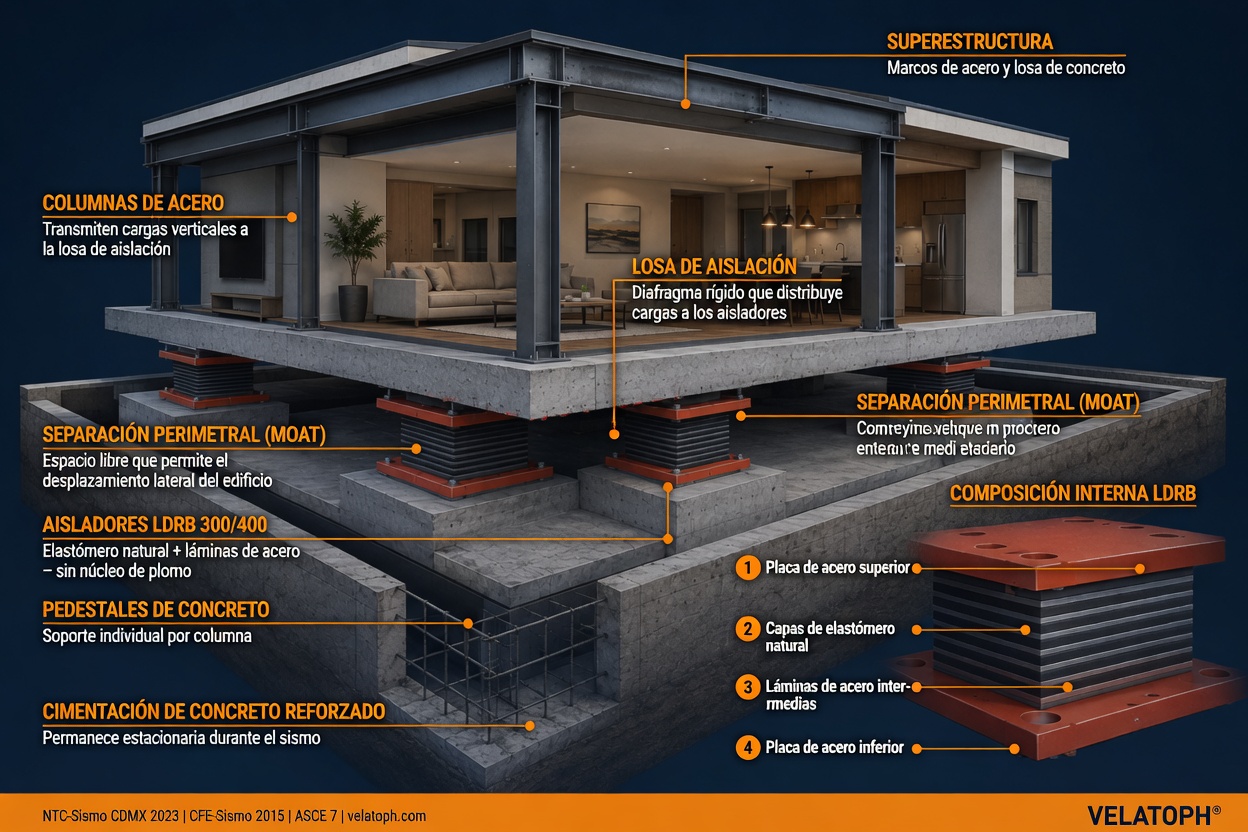
El LDRB es un Aislador Elastomérico de Bajo Amortiguamiento. Está fabricado con capas alternadas de neopreno natural de alta calidad y láminas de acero A-36 vulcanizadas en caliente, formando un bloque compacto de alta rigidez vertical y baja rigidez horizontal. Su amortiguamiento efectivo es ξ ≈ 15%.
Un punto técnico que se confunde con frecuencia: el LDRB no lleva núcleo de plomo. El núcleo de plomo es una característica exclusiva del LRB (Lead Rubber Bearing), diseñado para estructuras de mayor importancia sísmica como hospitales y puentes, donde se requiere mayor disipación de energía por ciclo. El LDRB es el sistema adecuado para vivienda precisamente porque su manufactura más accesible reduce el costo unitario sin sacrificar el desempeño sísmico en este tipo de aplicación.
Es también el primer sistema de aislamiento sísmico diseñado específicamente para vivienda en México, resultado de más de una década de investigación y ensayos en laboratorio por parte de VELATOPH®.
¿Cómo funciona físicamente?
El principio del LDRB descansa en dos propiedades mecánicas complementarias:
- Alta rigidez vertical: el dispositivo soporta la carga gravitacional de la estructura sin deformarse, igual que cualquier cimentación convencional.
- Baja rigidez horizontal: cuando el suelo se mueve durante un sismo, el aislador se deforma lateralmente, desacoplando el movimiento del suelo del movimiento de la casa. La aceleración que llega a la estructura se reduce aproximadamente en la proporción (Ts/T)2, donde Ts es el período del suelo y T es el período de la estructura aislada.
Gracias a la elasticidad del neopreno, el sistema también ofrece re-centrado elástico automático: una vez que el sismo termina, los aisladores recuperan su posición original y la vivienda vuelve exactamente a donde estaba. El desplazamiento residual es inferior a 5 mm. No hay inclinaciones permanentes ni deformaciones visibles.
Modelos disponibles
VELATOPH® fabrica dos versiones del LDRB para vivienda y edificios pequeños:
- LDRB300 (300 × 300 mm): para casas de 1 y 2 niveles con cargas gravitacionales bajas a medias.
- LDRB400 (400 × 400 mm): para edificios de hasta 4 niveles, condominios y conjuntos residenciales pequeños.
La selección del modelo y la cantidad de dispositivos se determina mediante análisis estructural que considera la masa total de la estructura, el tipo de suelo y la zonificación sísmica del sitio.
La economía del aislamiento: inversión frente a riesgo
Niveles de protección: lo que cambia con el LDRB
La diferencia de desempeño entre una vivienda convencional y una aislada se vuelve concreta al comparar por nivel de sismo:
- Sismo moderado (frecuente): la vivienda convencional sufre daño menor —grietas, acabados desprendidos, puertas atascadas. La vivienda aislada permanece totalmente operativa, sin daño perceptible.
- Sismo de diseño (raro, pero posible): la vivienda convencional puede quedar inhabilitada temporalmente, con daño estructural que requiere evaluación y reparación. La vivienda aislada sufre solo daño leve no estructural —en la gran mayoría de los casos, habitable al día siguiente.
Instalación y requerimientos constructivos
Una advertencia técnica honesta
El respaldo de VELATOPH®
VELATOPH® es una empresa mexicana fundada en 2010, con planta de producción de 1,000 m² en Manzanillo, Colima, y laboratorio de ensayo propio en la Universidad de Colima. Es la primera empresa en México en desarrollar aisladores sísmicos para uso habitacional.
Con más de 60 proyectos ejecutados en 5 países —México, Guatemala, Ecuador, República Dominicana y Puerto Rico— el portafolio incluye hospitales, puentes, edificios universitarios y numerosas casas habitación en Colima, Oaxaca, Morelos, Ciudad de México y Puerto Rico. Todos los sistemas se diseñan bajo las normativas de referencia: ASCE 7, ISO 22762, NTC-Sismo y MDOC-CFE.
Cada dispositivo entregado incluye certificado de ensayo individual con los resultados de prueba de carga vertical y desplazamiento horizontal, junto con la memoria de cálculo del sistema de aislamiento para el proyecto específico.
Mexico is one of the most seismically active countries on the planet. The 1985 and 2017 earthquakes in Mexico City showed that the damage does not end with fallen façades: homes also lose their contents, become uninhabitable for weeks or months, and in many cases turn into a total loss. The vast majority of houses in the country are designed under the "no-collapse" criterion —the structure withstands without falling down, but accepts significant structural damage that can render it completely unusable.
Is there a real alternative? Yes: base seismic isolation. And since 2010, VELATOPH® developed the first isolation system designed specifically for housing in Mexico: the LDRB (Low Damping Rubber Bearing).
What is base seismic isolation?
In a conventional structure, the earthquake's energy enters through the foundation and rises through the entire superstructure: the upper floors experience accelerations several times greater than those of the ground, and the contents —furniture, appliances, fixtures— suffer damage even if the structure does not collapse. Base seismic isolation works in reverse: it intercepts the seismic energy before it reaches the building.
By inserting horizontally flexible devices between the foundation and the superstructure, the structure's natural period (T) is lengthened into a range where the ground can no longer transmit energy to it efficiently. The result: the seismic force reaching the house is reduced by up to 90%. The home barely feels the earthquake.
The LDRB system: low damping without a lead core
The LDRB is a Low Damping Elastomeric Bearing. It is manufactured with alternating layers of high-quality natural neoprene and A-36 steel plates hot-vulcanized together, forming a compact block with high vertical stiffness and low horizontal stiffness. Its effective damping is ξ ≈ 15%.
A technical point that is frequently confused: the LDRB does not have a lead core. The lead core is an exclusive feature of the LRB (Lead Rubber Bearing), designed for structures of greater seismic importance such as hospitals and bridges, where greater energy dissipation per cycle is required. The LDRB is the appropriate system for housing precisely because its more accessible manufacture reduces the unit cost without sacrificing seismic performance in this type of application.
It is also the first seismic isolation system designed specifically for housing in Mexico, the result of more than a decade of research and laboratory testing by VELATOPH®.
How does it work physically?
The LDRB principle rests on two complementary mechanical properties:
- High vertical stiffness: the device supports the gravitational load of the structure without deforming, just like any conventional foundation.
- Low horizontal stiffness: when the ground moves during an earthquake, the bearing deforms laterally, decoupling the ground motion from the house motion. The acceleration reaching the structure is reduced approximately in the proportion (Ts/T)2, where Ts is the period of the soil and T is the period of the isolated structure.
Thanks to the elasticity of the neoprene, the system also offers automatic elastic re-centering: once the earthquake ends, the bearings recover their original position and the home returns exactly to where it was. The residual displacement is less than 5 mm. There are no permanent tilts or visible deformations.
Available models
VELATOPH® manufactures two versions of the LDRB for housing and small buildings:
- LDRB300 (300 × 300 mm): for 1- and 2-story houses with low to medium gravitational loads.
- LDRB400 (400 × 400 mm): for buildings up to 4 stories, condominiums and small residential complexes.
The selection of the model and the number of devices is determined through structural analysis that considers the total mass of the structure, the soil type and the seismic zoning of the site.
The economics of isolation: investment versus risk
Levels of protection: what changes with the LDRB
The difference in performance between a conventional home and an isolated one becomes concrete when compared by earthquake level:
- Moderate earthquake (frequent): the conventional home suffers minor damage —cracks, detached finishes, jammed doors. The isolated home remains fully operational, with no perceptible damage.
- Design earthquake (rare, but possible): the conventional home may become temporarily unusable, with structural damage requiring evaluation and repair. The isolated home suffers only minor non-structural damage —in the vast majority of cases, habitable the next day.
Installation and construction requirements
An honest technical warning
The backing of VELATOPH®
VELATOPH® is a Mexican company founded in 2010, with a 1,000 m² production plant in Manzanillo, Colima, and its own testing laboratory at the University of Colima. It is the first company in Mexico to develop seismic isolators for residential use.
With more than 60 projects executed in 5 countries —Mexico, Guatemala, Ecuador, the Dominican Republic and Puerto Rico— the portfolio includes hospitals, bridges, university buildings and numerous residential houses in Colima, Oaxaca, Morelos, Mexico City and Puerto Rico. All systems are designed under the reference standards: ASCE 7, ISO 22762, NTC-Sismo and MDOC-CFE.
Each device delivered includes an individual test certificate with the results of the vertical load and horizontal displacement tests, together with the calculation report of the isolation system for the specific project.