México posee uno de los acervos de patrimonio construido más ricos de toda América. Templos coloniales, conventos, campanarios, palacios y edificios históricos que tienen entre dos y cinco siglos de existencia salpican el territorio de norte a sur. Al mismo tiempo, México es uno de los países de mayor actividad sísmica del planeta. Esta combinación —herencia histórica extraordinaria y riesgo sísmico permanente— convierte la protección del patrimonio construido en uno de los retos más complejos y urgentes de la ingeniería y la conservación en el país.
Los sismos de 1985 y 2017 lo hicieron dolorosamente visible: cientos de inmuebles históricos resultaron dañados o destruidos. Bóvedas colapsadas, fachadas agrietadas, cúpulas fisuradas y campanarios derrumbados. En muchos casos, daños que tomaron siglos construir desaparecieron en segundos. La pregunta que surge de inmediato es inevitable: ¿cómo se protege algo que tiene siglos, está hecho de materiales frágiles y cuyo valor patrimonial está justamente en no alterarlo?
Por qué el patrimonio histórico es especialmente vulnerable
Los edificios históricos no fueron diseñados con criterios sísmicos modernos. Su lógica constructiva es gravitacional: se pensaron para soportar peso, no para resistir fuerzas laterales. Sus materiales —mampostería de piedra, ladrillo, adobe y argamasa de cal— son pesados, rígidos y frágiles ante los esfuerzos de tensión y corte que genera un sismo.
A diferencia del concreto reforzado moderno, la mampostería histórica no tiene acero que la mantenga unida cuando se agrieta. Una vez que el mortero falla, los bloques simplemente se separan. Y la geometría lo complica aún más: muros altos y esbeltos, bóvedas de cañón, cúpulas y campanarios concentran masa en la parte superior del edificio y fallan por volteo o cortante con relativa facilidad cuando el suelo se sacude.
La disyuntiva de la conservación: proteger sin destruir
Ante la amenaza sísmica, la respuesta intuitiva de la ingeniería convencional sería reforzar: añadir concreto, insertar varillas de acero, engrapar muros, agregar contrafuertes. Estas técnicas son efectivas desde el punto de vista estructural, pero tienen un costo patrimonial inaceptable: modifican o destruyen la materia histórica original del monumento. En muchos casos, los lineamientos del Instituto Nacional de Antropología e Historia (INAH) prohíben expresamente ese tipo de intervenciones en inmuebles catalogados, precisamente para proteger su autenticidad.
El dilema es real: reforzar de forma convencional resuelve lo estructural pero compromete lo patrimonial. No intervenir preserva la autenticidad pero deja el monumento expuesto al próximo sismo. Durante décadas, muchos proyectos de conservación vivieron atrapados entre estas dos opciones. El aislamiento sísmico ofrece una tercera vía.
La solución: aislar el monumento de la energía sísmica
El aislamiento sísmico aplicado a patrimonio histórico parte del mismo principio que en edificios nuevos, pero adaptado a las condiciones y restricciones de un monumento: en vez de reforzar la estructura para que resista, se intercepta la energía sísmica antes de que llegue al elemento histórico.
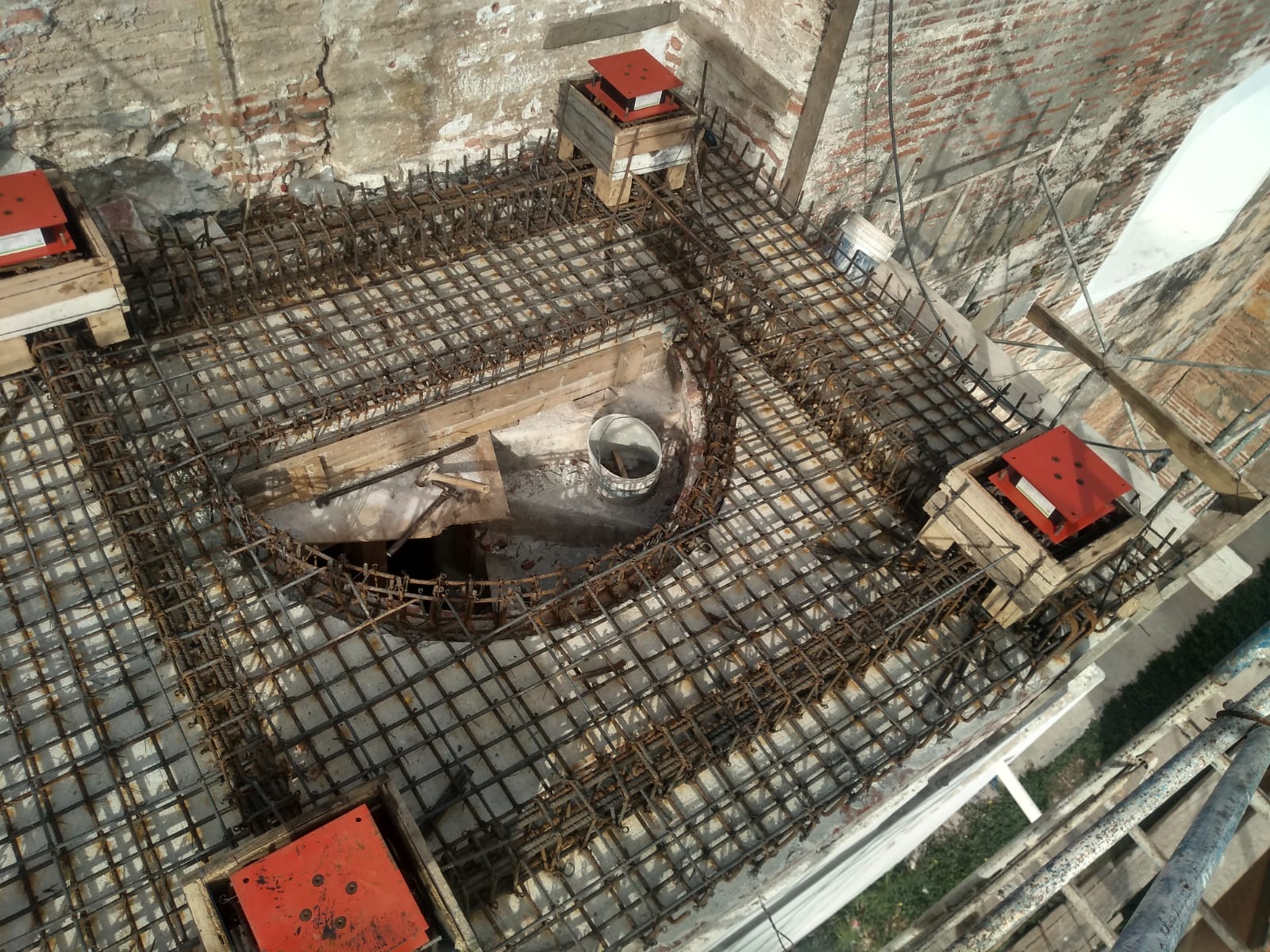
Se diseñan y fabrican aisladores elastoméricos —tipo LDRB o LRB— a la medida de la carga real del elemento a proteger, y se instalan en su base. Cuando el suelo se sacude durante un sismo, el aislador se deforma lateralmente y absorbe la energía, de modo que el monumento recibe solo una fracción de la fuerza que de otro modo lo golpearía. La reducción puede alcanzar el 90% de la fuerza sísmica transmitida.
La intervención es discreta y reversible: los aisladores quedan ocultos en la base de la estructura, sin modificar la apariencia del monumento ni alterar sus materiales históricos. Desde afuera, nada ha cambiado. Por dentro, el campanario o la torre está protegido.
Cómo se realiza la intervención
A diferencia de un proyecto en construcción nueva, la intervención en patrimonio requiere un proceso cuidadoso que respeta la integridad del inmueble en cada etapa:
- Diagnóstico y levantamiento: se realiza un estudio detallado de la estructura —materiales, geometría, estado de conservación, peso real y modos de falla probables. Cada monumento es diferente y no existe una solución de catálogo única para patrimonio.
- Diseño a la medida: con base en el diagnóstico, se diseña el aislador con las propiedades mecánicas exactas que la estructura necesita: rigidez vertical para soportar la carga, rigidez horizontal adecuada para el período de aislamiento deseado, y dimensiones que se adapten al espacio disponible.
- Fabricación y certificación: cada dispositivo se fabrica en la planta de VELATOPH® en Manzanillo, Colima, y se somete a ensayo individual en el laboratorio de la Universidad de Colima, con certificado de prueba de carga vertical y desplazamiento horizontal.
- Instalación controlada: mediante técnicas de apuntalamiento temporal y corte controlado, se abre el espacio necesario en la base de la estructura para insertar los aisladores sin dañar la fábrica histórica. El proceso es reversible: si en el futuro se necesitara retirar o sustituir un dispositivo, puede hacerse sin afectar la integridad del monumento.
Proyectos realizados en México
VELATOPH® ha aplicado esta tecnología en inmuebles históricos de alto valor patrimonial en México:
- Templo de San Luis Obispo de Tolosa, Xochimilco, CDMX — protección sísmica de campanarios mediante aisladores elastoméricos diseñados a la medida, instalados en la base de las torres del templo colonial.
- Templo de Santo Domingo, Oaxaca — intervención en campanarios del templo para reducir la vulnerabilidad sísmica de uno de los ejemplos más representativos del barroco novohispano en el sur del país.
Estos proyectos forman parte de las más de 60 obras ejecutadas por VELATOPH® en 5 países desde 2010 y representan una línea de trabajo en la que la empresa ha desarrollado metodología propia para la intervención en patrimonio construido.
Una herramienta, no una solución mágica
Hay algo más que piedra y cal en juego. Un campanario colonial que lleva cuatrocientos años en pie es parte de la memoria colectiva de una comunidad: marca el tiempo, convoca a la gente, da identidad al paisaje urbano. Cuando cae, no se pierde solo una estructura; se pierde un fragmento de quiénes somos. Proteger el patrimonio sísmico no es un lujo técnico: es un acto de responsabilidad con la historia y con las generaciones que vienen.
Mexico holds one of the richest collections of built heritage in all of the Americas. Colonial temples, convents, bell towers, palaces and historic buildings between two and five centuries old are scattered across the territory from north to south. At the same time, Mexico is one of the most seismically active countries on the planet. This combination —an extraordinary historical legacy and permanent seismic risk— makes the protection of built heritage one of the most complex and urgent challenges for engineering and conservation in the country.
The earthquakes of 1985 and 2017 made this painfully visible: hundreds of historic buildings were damaged or destroyed. Collapsed vaults, cracked façades, fissured domes and fallen bell towers. In many cases, damage that took centuries to build vanished in seconds. The question that immediately arises is unavoidable: how do you protect something that is centuries old, made of fragile materials, and whose heritage value lies precisely in not altering it?
Why historic heritage is especially vulnerable
Historic buildings were not designed with modern seismic criteria. Their construction logic is gravitational: they were conceived to bear weight, not to resist lateral forces. Their materials —stone, brick and adobe masonry and lime mortar— are heavy, rigid and brittle against the tensile and shear stresses generated by an earthquake.
Unlike modern reinforced concrete, historic masonry has no steel holding it together when it cracks. Once the mortar fails, the blocks simply separate. And the geometry complicates it further: tall, slender walls, barrel vaults, domes and bell towers concentrate mass in the upper part of the building and fail by overturning or shear relatively easily when the ground shakes.
The conservation dilemma: protecting without destroying
Faced with the seismic threat, the intuitive response of conventional engineering would be to reinforce: add concrete, insert steel rebar, staple walls, add buttresses. These techniques are effective from a structural standpoint, but they carry an unacceptable heritage cost: they modify or destroy the monument's original historic fabric. In many cases, the guidelines of the National Institute of Anthropology and History (INAH) expressly prohibit this type of intervention on listed buildings, precisely to protect their authenticity.
The dilemma is real: reinforcing conventionally solves the structural issue but compromises the heritage. Not intervening preserves authenticity but leaves the monument exposed to the next earthquake. For decades, many conservation projects were caught between these two options. Seismic isolation offers a third way.
The solution: isolating the monument from seismic energy
Seismic isolation applied to historic heritage starts from the same principle as in new buildings, but adapted to the conditions and constraints of a monument: instead of reinforcing the structure so it resists, the seismic energy is intercepted before it reaches the historic element.
Elastomeric isolators —LDRB or LRB type— are designed and manufactured to match the real load of the element to be protected, and installed at its base. When the ground shakes during an earthquake, the isolator deforms laterally and absorbs the energy, so that the monument receives only a fraction of the force that would otherwise hit it. The reduction can reach 90% of the transmitted seismic force.
The intervention is discreet and reversible: the isolators remain hidden at the base of the structure, without modifying the monument's appearance or altering its historic materials. From the outside, nothing has changed. Inside, the bell tower or steeple is protected.
How the intervention is carried out
Unlike a new-construction project, intervention on heritage requires a careful process that respects the integrity of the building at every stage:
- Diagnosis and survey: a detailed study of the structure is carried out —materials, geometry, state of conservation, real weight and probable failure modes. Every monument is different and there is no single catalog solution for heritage.
- Custom design: based on the diagnosis, the isolator is designed with the exact mechanical properties the structure needs: vertical stiffness to support the load, horizontal stiffness suited to the desired isolation period, and dimensions that fit the available space.
- Manufacturing and certification: each device is manufactured at the VELATOPH® plant in Manzanillo, Colima, and undergoes individual testing at the laboratory of the Universidad de Colima, with a certificate of vertical load and horizontal displacement testing.
- Controlled installation: using temporary shoring and controlled cutting techniques, the necessary space is opened at the base of the structure to insert the isolators without damaging the historic fabric. The process is reversible: if a device needs to be removed or replaced in the future, it can be done without affecting the integrity of the monument.
Projects completed in Mexico
VELATOPH® has applied this technology in historic buildings of high heritage value in Mexico:
- Templo de San Luis Obispo de Tolosa, Xochimilco, CDMX — seismic protection of bell towers using custom-designed elastomeric isolators, installed at the base of the colonial temple's towers.
- Templo de Santo Domingo, Oaxaca — intervention on the temple's bell towers to reduce the seismic vulnerability of one of the most representative examples of New Spanish baroque in the south of the country.
These projects are part of the more than 60 works carried out by VELATOPH® in 5 countries since 2010 and represent a line of work in which the company has developed its own methodology for intervention on built heritage.
A tool, not a magic solution
There is more than stone and lime at stake. A colonial bell tower that has stood for four hundred years is part of a community's collective memory: it marks time, gathers people, gives identity to the urban landscape. When it falls, it is not just a structure that is lost; a fragment of who we are is lost. Protecting seismic heritage is not a technical luxury: it is an act of responsibility toward history and toward the generations to come.