Después de un sismo fuerte, en un edificio con aislamiento sísmico o con disipadores conviven dos preguntas distintas. La primera es de seguridad: ¿se puede entrar, hay riesgo de colapso? La segunda es de desempeño: ¿el sistema de protección trabajó como estaba previsto y sigue en condiciones de volver a hacerlo? La primera se responde con un protocolo de evaluación rápida; la segunda exige mirar donde un edificio convencional no mira: el plano de aislamiento.
En un edificio aislado, la estructura principal suele salir bien librada porque el movimiento se concentró abajo. Eso puede ser engañoso: el edificio se ve intacto y nadie reporta daños, pero el sistema que absorbía el movimiento pudo haber llegado a su límite o haber quedado desplazado de su posición neutra. Por eso la inspección no empieza por las columnas: empieza por los dispositivos, por el foso y por todo lo que cruza la junta.
Primero la seguridad, después el desempeño
La evaluación de seguridad posterior a un sismo tiene metodología propia. El ATC-20 distingue una evaluación rápida, una detallada y una de ingeniería. La rápida la hace personal capacitado en horas y su producto es una señalización: inspeccionado, uso restringido o inseguro. El FEMA P-2055 consolidó esas prácticas; en México, el CENAPRED publica material de evaluación de estructuras para protección civil.
Ese filtro es indispensable y no se sustituye por la revisión del aislamiento. Primero se acordona, se revisan los peligros inmediatos —fachadas, parapetos, gas, escaleras— y se decide si alguien puede entrar; después se revisa el sistema que protegió al edificio.
La lectura que más información da: el desplazamiento
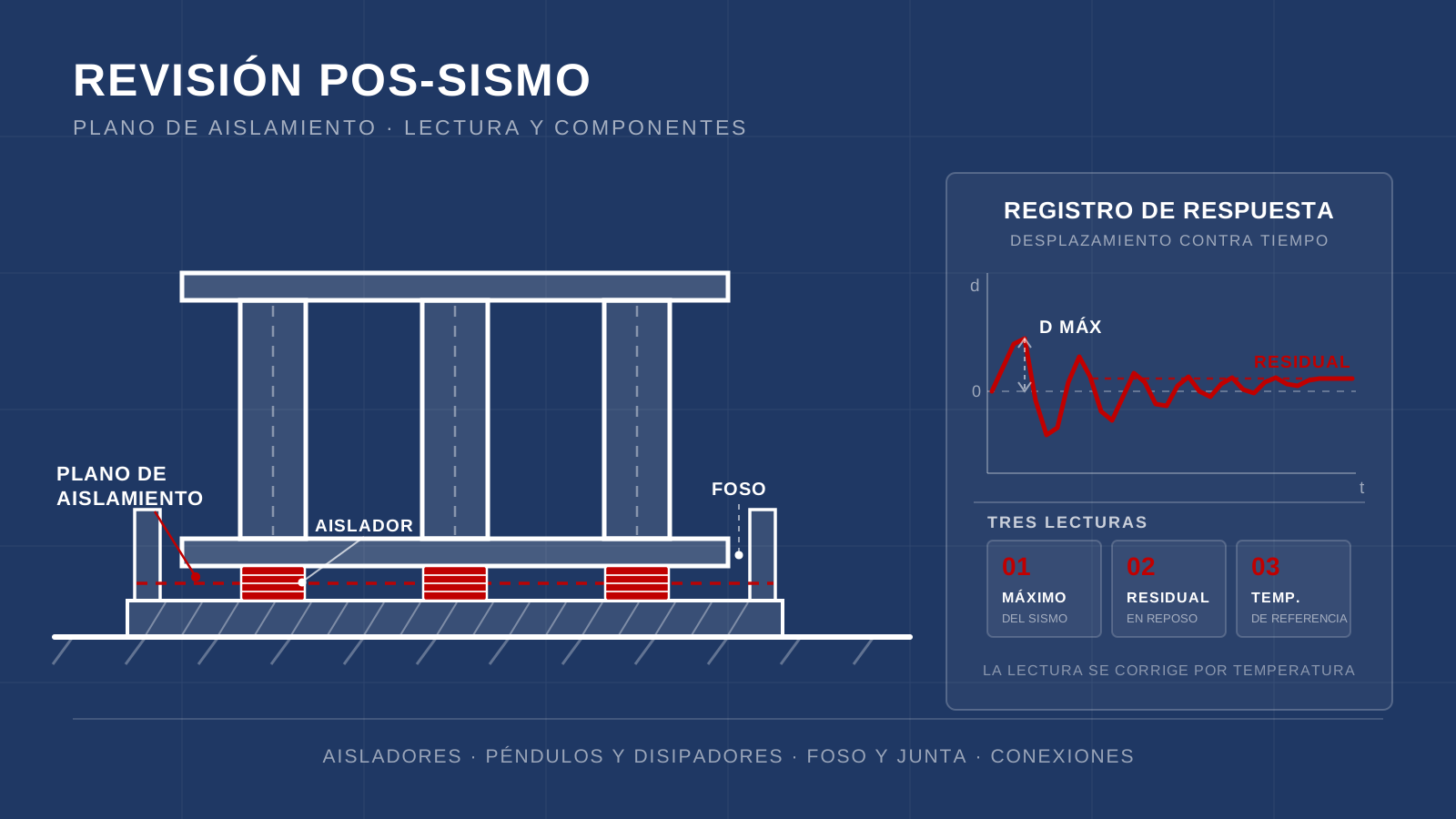
Todo edificio aislado debería registrar cuánto se movió y dónde quedó. Puede ser una placa de rayado o un testigo en el plano de aislamiento, o transductores conectados a un registrador. La guía neozelandesa de aislamiento sísmico recomienda esos grabadores, incluidas las placas de rayado, en el nivel del plano de aislamiento.
Importan dos números: el desplazamiento máximo alcanzado y el residual, la posición en la que el sistema quedó en reposo. El residual se mide contra la posición neutra de instalación, corregida por temperatura: un edificio aislado se mueve a diario con el calor y el frío, y unos milímetros aparentes pueden ser solo térmicos. Por eso el punto de partida es la lectura de referencia dejada al terminar la obra, con su temperatura.
La comparación útil es contra el desplazamiento de diseño y contra el máximo que el dispositivo puede admitir. Si el sismo llevó al sistema cerca o más allá del primero, procede una evaluación detallada; si superó el segundo, hay que revisar la capacidad remanente y evaluar muestras o el reemplazo. Un residual pequeño no garantiza ausencia de daño; uno grande no implica colapso, pero obliga a revisar.
Qué revisar, componente por componente
| Componente | Qué se revisa | Señal de alarma |
|---|---|---|
| Aislador elastomérico LRB / LDRB / HDRB | Deformación, abultamiento, núcleo de plomo y anclajes | Hule desgarrado, láminas expuestas, plomo extrusionado o inclinación permanente |
| Péndulo de fricción FPS / DFP | Superficie deslizante, sellos, agua o suciedad, desplazador | Rayado o desgaste, desplazador descentrado, residual que no recentra |
| Disipador viscoso DVF | Sellos, vástago, pasadores, acumulador y marcas de carrera | Fuga visible, vástago rayado o doblado, holgura en pasadores |
| Disipador por fricción DEF | Pastillas, precarga de tornillos, guías y topes | Desgaste irregular, agarrotamiento, pérdida de precarga |
| Foso y junta | Limpieza, drenaje, holgura, tapas y topes | Escombro, agua, marcas de contacto, tapas abiertas |
| Conexiones que cruzan | Lazos flexibles, juntas, escaleras, ascensores e instalaciones | Elemento rígido agregado, lazo tenso, junta cerrada, tubería deformada |
Aisladores elastoméricos: qué es normal y qué no
En un LRB, un LDRB o un HDRB, lo esperado es deformación cortante uniforme, abultamiento simétrico del hule y regreso casi completo a la posición neutra. También es normal cierto agrietamiento superficial por ozono y el desprendimiento de pintura. No lo es un desgarro profundo, un corte diagonal, láminas de acero expuestas, el núcleo de plomo extrusionado, tuercas flojas o anclajes estirados; tampoco que un dispositivo quede inclinado mientras sus vecinos están verticales.
Comparar dispositivos es útil: en una misma zona todos deberían deformarse de forma consistente con un movimiento de cuerpo rígido. Si uno se deforma mucho más o mucho menos, el problema puede estar en el dispositivo, en su anclaje o en la estructura. Se revisa uno por uno, con identificador y fotografías.
Péndulos y disipadores
En un FPS o un DFP, la superficie deslizante es crítica. Hay que revisar que no tenga rayado, desgaste irregular, suciedad o agua; que sellos y tapas estén en su lugar; que el desplazador articulado esté centrado y que la restricción de levantamiento no tenga holgura. Un péndulo debe recentrar por geometría: si queda con un desplazamiento permanente apreciable, hay que investigar si cambió la fricción o si algo quedó trabado.
En los disipadores, la inspección se concentra en sellos y recorrido. Un DVF con fuga visible, un vástago rayado o doblado, un pasador con holgura o un acumulador sin presión ya no aporta lo que el modelo supone. En un DEF hay que ver el desgaste de las pastillas, las guías y la precarga: la carga de deslizamiento se pierde en silencio. En ambos casos, las conexiones reciben la fuerza del dispositivo y merecen la misma atención.
El foso y todo lo que cruza la junta
La mayoría de los problemas pos-sismo no están en el aislador sino en lo que lo rodea. El foso debe estar limpio, drenado y libre de escombros, materiales o agua. Las tapas y los topes deben estar completos. La holgura entre estructura y muro debe medirse en varios puntos: si hay marcas de contacto, el edificio ya golpeó y la fuerza llegó a la cimentación.
Después vienen las conexiones que cruzan el plano: escaleras, ascensores, fachadas, tuberías, ductos, rociadores y comunicaciones. Deben conservar su holgura o lazo flexible y ninguno debe quedar tenso. Es común que una remodelación agregue un conducto rígido, una barandilla o una jardinera que cruza la junta y anula localmente el aislamiento.
Documentar y decidir
El producto de la inspección no es una opinión verbal: es un registro. Para cada dispositivo conviene anotar identificador, ubicación, lectura, temperatura, hora, condición y fotografía. Con esos datos se compara contra la línea base y los valores de diseño, y se decide si el edificio puede reocuparse o si requiere evaluación detallada. idealmente, el manual de mantenimiento define quién lee, con qué instrumento y contra qué valores.
Si hay que reemplazar un dispositivo, el procedimiento importa tanto como el dispositivo nuevo: plan de izaje o liberación controlada, restricciones temporales, secuencia y verificación de la temperatura de referencia. Recentrar la estructura empujándola o levantándola sin cálculo convierte una inspección en un problema mayor.
Errores comunes después del sismo
- Recentrar con gatos o maquinaria sin un procedimiento calculado.
- Abrir las tapas de inspección y dejarlas abiertas.
- Limpiar superficies deslizantes con solventes o lubricarlas sin indicación del fabricante.
- Agregar elementos rígidos que cruzan la junta durante las reparaciones.
- Pintar o cubrir las marcas de desplazamiento.
- Sustituir un aislador sin verificar la carga, la conexión y la compatibilidad con el sistema.
En VELATOPH®
VELATOPH® fabrica en Manzanillo, Colima, aisladores elastoméricos LRB y LDRB, aisladores pendulares FPS y DFP, y disipadores DEF y DVF. En una revisión pos-sismo partimos de lo mismo que en el diseño: entender qué dispositivo hay y cómo está conectado.
Si necesitas revisar un edificio aislado o con disipadores después de un sismo, ofrecemos una evaluación técnica gratuita por WhatsApp para revisar la lectura de desplazamientos y el estado de los dispositivos. También puedes consultar el procedimiento de mantenimiento e inspección, la guía del desplazamiento máximo y la nota sobre la junta y el foso.
Fuentes
- FEMA. ATC-20, Postearthquake Safety Evaluation of Buildings. fema.gov
- FEMA. Post-disaster Building Safety Evaluation Guidance (P-2055), 2019. fema.gov (PDF)
- FEMA. Guidance for Accelerated Building Reoccupancy (P-2055-1), 2023. fema.gov (PDF)
- NZSEE. Seismic Isolation Guidelines, 2019. nzsee.org.nz (PDF)
- NIED. Response of Seismically Isolated Buildings, informe del sismo de Tōhoku de 2011. kenken.go.jp (PDF)
- CENAPRED. Evaluación de estructuras, material de capacitación. gob.mx (PDF)
- ASCE/SEI 7-22, Minimum Design Loads and Associated Criteria for Buildings and Other Structures, capítulo 17 (estructuras aisladas sísmicamente).
- ISO 22762, Elastomeric seismic-protection isolators, partes 1 a 3; EN 15129, Anti-seismic devices.
Artículo de carácter general y educativo; no sustituye la evaluación de un ingeniero estructurista responsable de cada proyecto ni las indicaciones de la autoridad de protección civil.
After a strong earthquake, two different questions coexist in a building with seismic isolation or dampers. The first is about safety: can people enter, is there a risk of collapse or falling elements? The second is about performance: did the protection system work as intended, and is it still able to? The first is answered by a rapid evaluation protocol; the second requires looking where a conventional building does not: the isolation plane.
In an isolated building, the main structure usually fares well because the movement was concentrated below. That can be misleading: the building looks intact and no one reports damage, yet the system that absorbed the motion may have reached its limit or been left displaced from its neutral position. That is why the inspection does not start with the columns: it starts with the devices, the moat and everything that crosses the joint.
Safety first, performance second
Post-earthquake safety evaluation has its own methodology. ATC-20 distinguishes a rapid evaluation, a detailed evaluation and an engineering evaluation. The rapid one is carried out by trained personnel within hours and its product is not a structural verdict but a posting: inspected, restricted use or unsafe. FEMA P-2055 consolidated those practices; in Mexico, CENAPRED publishes structural evaluation material for civil protection.
That filter is essential and is not replaced by reviewing the isolation system. First cordon off, check immediate hazards —façades, parapets, gas, stairs— and decide whether anyone may enter; then review the system that protected the building. Getting the order wrong is common: sending someone to read the isolators in a building that should not be occupied yet.
The reading that provides the most information: displacement
Every isolated building should record how far it moved and where it came to rest. It can be a scratch plate or a tell-tale at the isolation plane, or transducers connected to a logger. The New Zealand seismic isolation guideline recommends such recorders, including scratch plates, at the level of the isolation plane. Without a record, only visual inspection remains, far less informative.
Two numbers matter: the maximum displacement reached and the residual, the position in which the system came to rest. The residual is measured against the installation neutral position, corrected for temperature: an isolated building moves daily with heat and cold, and a few apparent millimetres may be purely thermal. That is why the starting point is the reference reading left at completion, with its temperature.
The useful comparison is against the design displacement and against the maximum the device can admit. If the earthquake brought the system close to or beyond the former, a detailed evaluation is warranted; if it exceeded the latter, remaining capacity must be reviewed and samples or replacement evaluated. A small residual does not guarantee the absence of damage; a large one does not imply collapse, but it requires review.
What to inspect, component by component
| Component | What is checked | Warning sign |
|---|---|---|
| Elastomeric isolator LRB / LDRB / HDRB | Shear deformation, rubber bulging, lead core, anchors and uplift restraints | Torn rubber, exposed shims, extruded lead, loose nuts or permanent tilt |
| Friction pendulum FPS / DFP | Sliding surface, seals, water or dirt ingress, articulated slider | Scoring or wear, off-centre slider, residual that does not re-centre |
| Viscous damper DVF | Seals, rod, pins, accumulator and stroke marks | Visible leak, scored or bent rod, play at the pins |
| Friction damper DEF | Pads, bolt preload, guides and stops | Irregular wear, binding, loss of preload |
| Moat and joint | Cleanliness, drainage, clearance, covers and stops | Debris, water, contact marks, open covers |
| Crossing connections | Flexible loops, seismic joints, stairs, elevators and services | Added rigid element, taut loop, closed joint, deformed pipe |
Elastomeric isolators: what is normal and what is not
In an LRB, an LDRB or an HDRB, what is expected is uniform shear deformation, symmetric rubber bulging and an almost complete return to the neutral position. Some surface cracking from ozone and paint flaking are also normal. A deep tear, a diagonal cut, exposed steel shims, extruded lead, loose nuts or stretched anchors are not; nor is a device left tilted while its neighbours stand vertical.
Comparing devices is a powerful tool: in the same zone all should deform consistently with rigid-body movement. If one deforms much more or much less than its neighbours, the problem may lie in the device, its anchorage or the structure reaching it. Each is reviewed individually, with its identifier and photographs.
Pendulums and dampers
In an FPS or a DFP, the sliding surface is critical. It must be checked for scoring, irregular wear, dirt or water; seals and covers must be in place; the articulated slider must be centred and the uplift restraint must have no play. A pendulum must re-centre by geometry: if it is left with an appreciable permanent displacement, it must be investigated whether friction changed or something became locked.
In dampers, inspection focuses on seals and travel. A DVF with a visible leak, a scored or bent rod, a pin with play or an accumulator without pressure no longer provides what the model assumes. In a DEF, pad wear, guides and preload must be checked: slip load is lost silently. In both cases, the connections receive the damper force and deserve the same attention.
The moat and everything that crosses the joint
Most post-earthquake problems are not in the isolator but in what surrounds it. The moat must be clean, drained and free of debris, materials or water. Covers and stops must be complete. Clearance between structure and wall must be measured at several points: if there are contact marks, the building has pounded and the force reached the foundation.
Then come the connections crossing the plane: stairs, elevators, façades, pipes, ducts, sprinklers and communications. They must keep their clearance or flexible loop and none should be taut. It is common for a renovation to add a rigid conduit, a handrail or a planter that crosses the joint and locally cancels the isolation. Look for exactly that: what was added after the original work.
Document and decide
The product of the inspection is not a verbal opinion: it is a record. For each device note identifier, location, reading, temperature, time, condition and photograph. With that data, compare against the baseline and design values, and decide whether the building can be reoccupied or needs a detailed evaluation. Ideally, the maintenance manual defines who reads, with which instrument and against which values.
If a device must be replaced, the procedure matters as much as the new device: lifting or controlled-release plan, temporary restraints, sequence and reference temperature check. Recentring the structure by pushing or jacking it without analysis turns an inspection into a bigger problem.
Common mistakes after the earthquake
- Recentring with jacks or machinery without a calculated procedure.
- Opening inspection covers and leaving them open.
- Cleaning sliding surfaces with solvents or lubricating them without the manufacturer’s instruction.
- Adding rigid elements that cross the joint during repairs.
- Painting over or covering displacement marks.
- Replacing an isolator without checking the load, the connection and compatibility with the system.
At VELATOPH®
VELATOPH® manufactures in Manzanillo, Colima, LRB and LDRB elastomeric isolators, FPS and DFP pendulum isolators, and DEF and DVF dampers. In a post-earthquake review we start from the same place as in design: understand which device is installed, how it is connected and what was expected of it.
If you need to review an isolated or damped building after an earthquake, we offer a free technical assessment via WhatsApp to review displacement readings and device condition. You can also consult the maintenance and inspection procedure, the maximum displacement guide and the note on the joint and moat.
Sources
- FEMA. ATC-20, Postearthquake Safety Evaluation of Buildings. fema.gov
- FEMA. Post-disaster Building Safety Evaluation Guidance (P-2055), 2019. fema.gov (PDF)
- FEMA. Guidance for Accelerated Building Reoccupancy (P-2055-1), 2023. fema.gov (PDF)
- NZSEE. Seismic Isolation Guidelines, 2019. nzsee.org.nz (PDF)
- NIED. Response of Seismically Isolated Buildings, report on the 2011 Tōhoku earthquake. kenken.go.jp (PDF)
- CENAPRED. Evaluación de estructuras, training material. gob.mx (PDF)
- ASCE/SEI 7-22, Minimum Design Loads and Associated Criteria for Buildings and Other Structures, Chapter 17 (seismically isolated structures).
- ISO 22762, Elastomeric seismic-protection isolators, parts 1 to 3; EN 15129, Anti-seismic devices.
General, educational article; it does not replace the evaluation by the structural engineer responsible for each project or the instructions of the civil protection authority.