Desde VELATOPH® expresamos nuestra solidaridad con el pueblo de Venezuela tras el sismo del 24 de junio de 2026. Nuestro pensamiento está con las familias afectadas, con quienes perdieron su hogar y con los equipos de búsqueda, rescate y atención que trabajan en la zona. Este artículo busca explicar, con respeto y con rigor técnico, qué ocurrió y qué podemos aprender como sociedad para que un sismo así cause el menor daño posible en el futuro.
Qué ocurrió
El 24 de junio de 2026, alrededor de las 18:04 (hora local), el noroeste de Venezuela fue sacudido por un doblete sísmico (earthquake doublet): un sismo precursor de magnitud Mw 7.2 seguido apenas 39 segundos después por el sismo principal, de Mw 7.5. Son magnitudes preliminares reportadas por el USGS, sujetas a ajuste; los reportes iniciales mencionaron 7.1. El evento principal es, según los registros, el sismo más fuerte en Venezuela en más de 125 años.
El epicentro se ubicó en el estado Yaracuy, en el municipio Veroes, cerca de Morón, San Felipe y Yumare, a unos 160–200 km al oeste de Caracas. Ambos sismos fueron superficiales —el principal a ~10 km de profundidad y el precursor a ~22 km—, una característica que amplificó la intensidad del sacudimiento en la superficie.
El alcance de los daños
Aunque el epicentro estuvo en Yaracuy, los efectos se sintieron en buena parte del país. Se reportaron colapsos de edificios en Caracas —las zonas de Los Palos Grandes y Altamira figuraron entre las más afectadas, según declaró el ministro del Interior, Diosdado Cabello—, así como daños severos en La Guaira y afectaciones en Trujillo, Carabobo, Aragua y Miranda. El Aeropuerto Internacional Simón Bolívar sufrió daños estructurales y suspendió operaciones.
Se emitieron alertas de tsunami para islas del Caribe (Aruba, Curazao y Bonaire), y se evaluó el riesgo para Puerto Rico e Islas Vírgenes; las alertas se cancelaron posteriormente. El gobierno venezolano decretó estado de emergencia. Al momento de los reportes había víctimas y damnificados, con cifras aún en evaluación por las labores de búsqueda y rescate; por respeto a las personas afectadas, evitamos presentarlas como un número cerrado.
En cuanto al impacto económico, el sistema PAGER del USGS estimó de forma preliminar una probabilidad significativa de pérdidas en un rango muy amplio, desde unos US$10 mil millones hasta más de US$100 mil millones.
Fuentes: USGS y su sistema de alerta PAGER; cobertura de prensa internacional (CNN, BBC, Infobae, Milenio) del 24–25 de junio de 2026; y el análisis técnico de la firma de ingeniería Miyamoto International. Las magnitudes y cifras son preliminares y pueden ajustarse en los días siguientes.
Por qué fue tan destructivo
Más allá de la magnitud, dos factores explican la severidad del daño, y ambos dejan lecciones de ingeniería.
1. El efecto del doblete
Un doblete sísmico es especialmente peligroso. El primer sismo agrieta y debilita las estructuras; segundos después, el segundo —más fuerte— actúa sobre edificios ya comprometidos, que han perdido parte de su capacidad para resistir. Es un golpe sobre una herida abierta: muchas construcciones que quizá habrían sobrevivido a un solo evento no resistieron la secuencia.
2. Construcciones anteriores a las normas sísmicas modernas
Diversos ingenieros señalaron que muchas de las edificaciones colapsadas habrían sido construidas antes de los años setenta, bajo códigos previos a las normas sísmicas modernas. Son estructuras que nunca fueron diseñadas para soportar un sismo de esta intensidad. A ello se sumó la poca profundidad del evento, que intensificó el sacudimiento en la superficie.
Qué nos enseña: la ingeniería puede reducir la tragedia
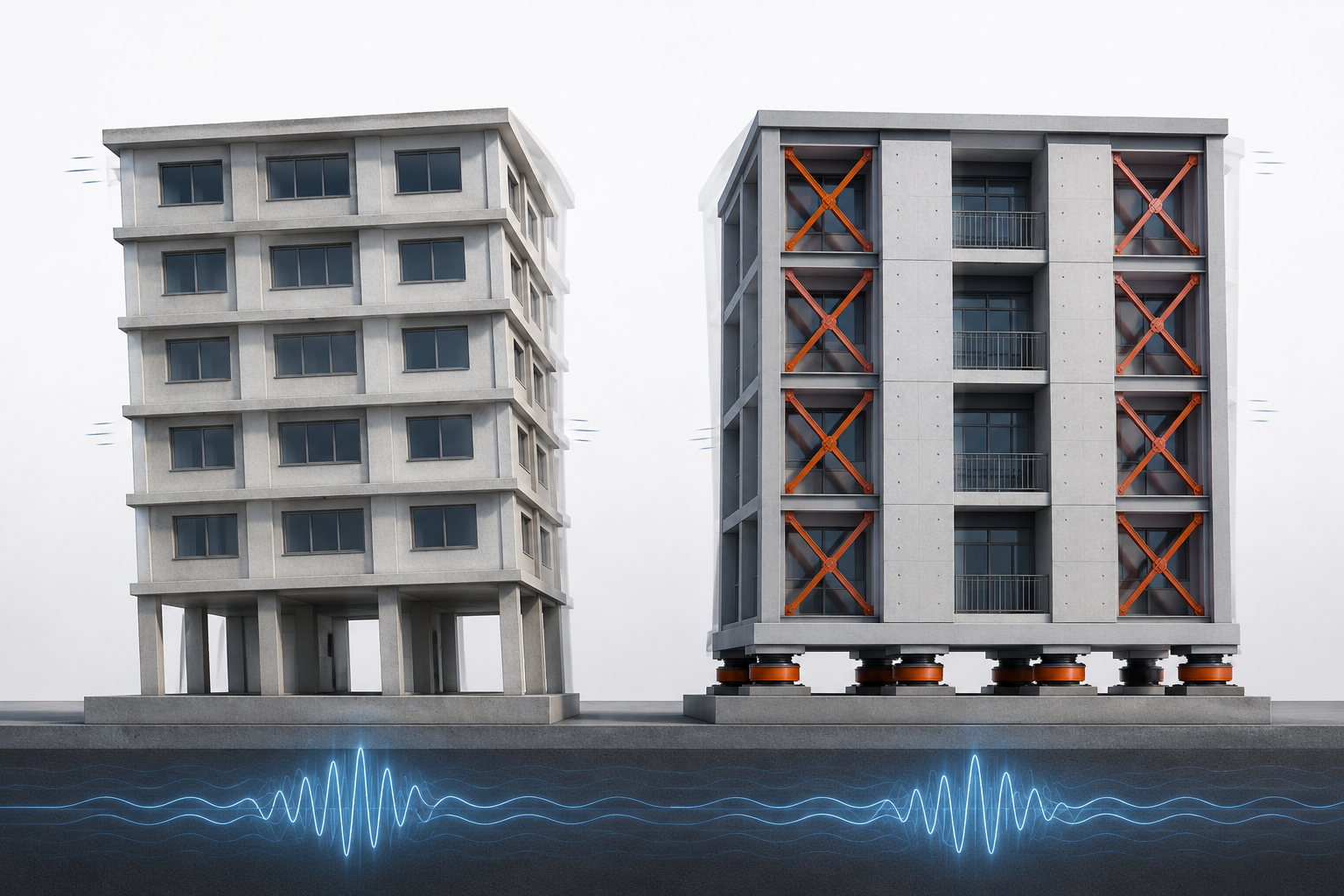
Un sismo es inevitable; el desastre, en gran medida, no lo es. La diferencia entre una estructura que colapsa y otra que protege a sus ocupantes está en el diseño y la tecnología. Hoy existen sistemas ampliamente probados que reducen drásticamente el daño:
- Aislamiento sísmico de base (LRB, LDRB, FPS): desacopla el edificio del suelo y puede reducir hasta ~90% la fuerza que llega a la estructura.
- Disipación de energía (DEF, DVF y los contraventeos de pandeo restringido, BRB): absorben la energía del sismo y concentran el daño en componentes reemplazables, protegiendo la estructura principal.
- Reforzamiento sísmico de construcciones existentes: especialmente relevante para los millones de edificios antiguos que, como en este sismo, resultan ser los más vulnerables.
En VELATOPH® diseñamos y fabricamos estas tecnologías, pero la lección de fondo es más amplia que cualquier producto: construir y reforzar conforme a las normas sísmicas modernas salva vidas. No lo escribimos para vender sobre una tragedia, sino porque es, precisamente, lo que esta tragedia nos recuerda.
Si estás en una zona afectada
La seguridad de las personas es lo primero. Si tu vivienda o tu lugar de trabajo resultó afectado:
- No regreses a una estructura dañada hasta que un profesional la evalúe.
- Atiende las indicaciones de Protección Civil y de los servicios de emergencia locales.
- Mantente atento a las réplicas, frecuentes y a veces fuertes tras un evento de esta magnitud.
Como orientación inicial —nunca como sustituto de un ingeniero— puedes usar nuestro evaluador preliminar de daños sísmicos, una herramienta educativa y gratuita que te ayuda a identificar señales de alerta y a saber cuándo es urgente buscar ayuda profesional.
Acompañamos a Venezuela en este momento difícil. La reconstrucción será un esfuerzo enorme; hacerla de forma más segura es la mejor manera de honrar lo perdido.
At VELATOPH® we express our solidarity with the people of Venezuela following the earthquake of June 24, 2026. Our thoughts are with the affected families, with those who lost their homes, and with the search, rescue and relief teams working in the area. This article seeks to explain, with respect and technical rigor, what happened and what we can learn as a society so that an earthquake like this causes the least possible damage in the future.
What happened
On June 24, 2026, at around 18:04 (local time), northwestern Venezuela was struck by an earthquake doublet: a foreshock of magnitude Mw 7.2 followed barely 39 seconds later by the main shock, of Mw 7.5. These are preliminary magnitudes reported by the USGS, subject to adjustment; initial reports mentioned 7.1. The main event is, according to the records, the strongest earthquake in Venezuela in more than 125 years.
The epicenter was located in the state of Yaracuy, in the municipality of Veroes, near Morón, San Felipe and Yumare, about 160–200 km west of Caracas. Both quakes were shallow —the main one at ~10 km depth and the foreshock at ~22 km—, a characteristic that amplified the intensity of the shaking at the surface.
The extent of the damage
Although the epicenter was in Yaracuy, the effects were felt across much of the country. Building collapses were reported in Caracas —the areas of Los Palos Grandes and Altamira were among the worst affected, according to Interior Minister Diosdado Cabello—, as well as severe damage in La Guaira and impacts in Trujillo, Carabobo, Aragua and Miranda. The Aeropuerto Internacional Simón Bolívar suffered structural damage and suspended operations.
Tsunami alerts were issued for Caribbean islands (Aruba, Curazao and Bonaire), and the risk was assessed for Puerto Rico and the Islas Vírgenes; the alerts were later cancelled. The Venezuelan government declared a state of emergency. At the time of the reports there were casualties and people displaced, with figures still being assessed amid the search-and-rescue efforts; out of respect for those affected, we refrain from presenting them as a final number.
As for the economic impact, the USGS PAGER system preliminarily estimated a significant probability of losses across a very wide range, from around US$10 billion to more than US$100 billion.
Sources: USGS and its PAGER alert system; international press coverage (CNN, BBC, Infobae, Milenio) from June 24–25, 2026; and the technical analysis by the engineering firm Miyamoto International. The magnitudes and figures are preliminary and may be adjusted in the following days.
Why it was so destructive
Beyond the magnitude, two factors explain the severity of the damage, and both leave engineering lessons.
1. The doublet effect
An earthquake doublet is especially dangerous. The first quake cracks and weakens structures; seconds later, the second —stronger— acts on already compromised buildings that have lost part of their capacity to resist. It is a blow upon an open wound: many constructions that might have survived a single event did not withstand the sequence.
2. Buildings predating modern seismic codes
Various engineers pointed out that many of the collapsed buildings were likely built before the 1970s, under codes predating modern seismic standards. These are structures that were never designed to withstand an earthquake of this intensity. Added to this was the shallow depth of the event, which intensified the shaking at the surface.
What it teaches us: engineering can reduce the tragedy
An earthquake is inevitable; the disaster, to a large extent, is not. The difference between a structure that collapses and one that protects its occupants lies in design and technology. Today there are widely proven systems that drastically reduce damage:
- Seismic base isolation (LRB, LDRB, FPS): decouples the building from the ground and can reduce by up to ~90% the force that reaches the structure.
- Energy dissipation (DEF, DVF and buckling-restrained braces, BRB): absorb the earthquake's energy and concentrate the damage in replaceable components, protecting the main structure.
- Seismic retrofitting of existing buildings: especially relevant for the millions of old buildings that, as in this earthquake, turn out to be the most vulnerable.
At VELATOPH® we design and manufacture these technologies, but the underlying lesson is broader than any product: building and retrofitting in accordance with modern seismic standards saves lives. We do not write this to sell on the back of a tragedy, but because it is, precisely, what this tragedy reminds us of.
If you are in an affected area
People's safety comes first. If your home or workplace was affected:
- Do not return to a damaged structure until a professional has assessed it.
- Follow the instructions of Civil Protection and local emergency services.
- Stay alert to aftershocks, which are frequent and sometimes strong after an event of this magnitude.
As initial guidance —never as a substitute for an engineer— you can use our preliminary seismic damage assessor, a free educational tool that helps you identify warning signs and know when it is urgent to seek professional help.
We stand with Venezuela in this difficult moment. The reconstruction will be an enormous effort; doing it more safely is the best way to honor what was lost.