Un aislador elastomérico es un compuesto viscoelástico: su comportamiento depende también de la temperatura, de la velocidad con que se deforma y de su historia de ciclos. Las propiedades nominales con las que se diseña —rigidez efectiva, amortiguamiento, desplazamiento— corresponden a una temperatura de referencia del orden de 20 a 23 °C. El dispositivo, sin embargo, trabajará toda su vida en un rango que en México va de las madrugadas frías del altiplano a las superficies expuestas al sol de la costa: en Manzanillo el ambiente supera los 30 °C buena parte del año y una placa asoleada se calienta bastante más.
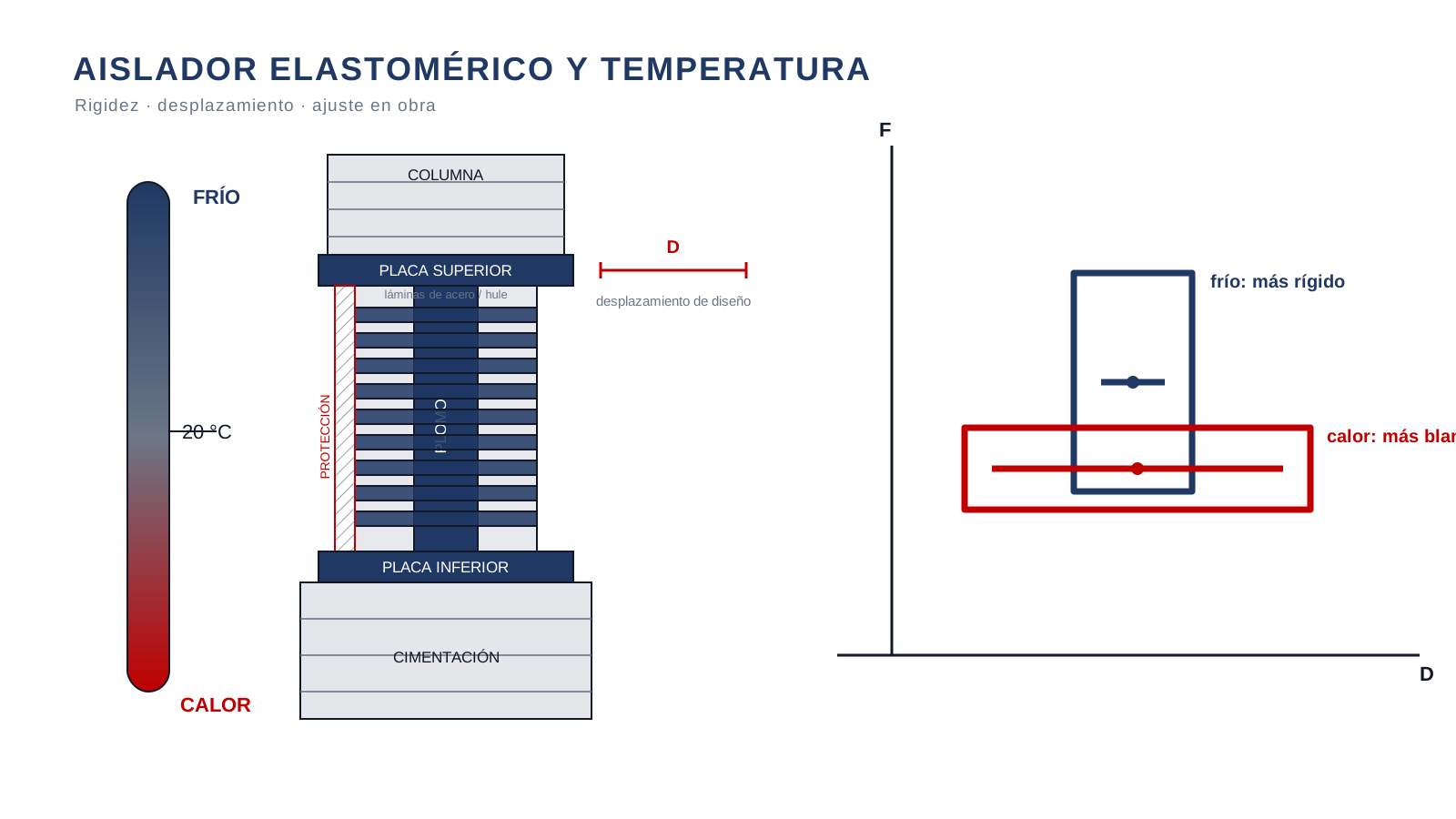
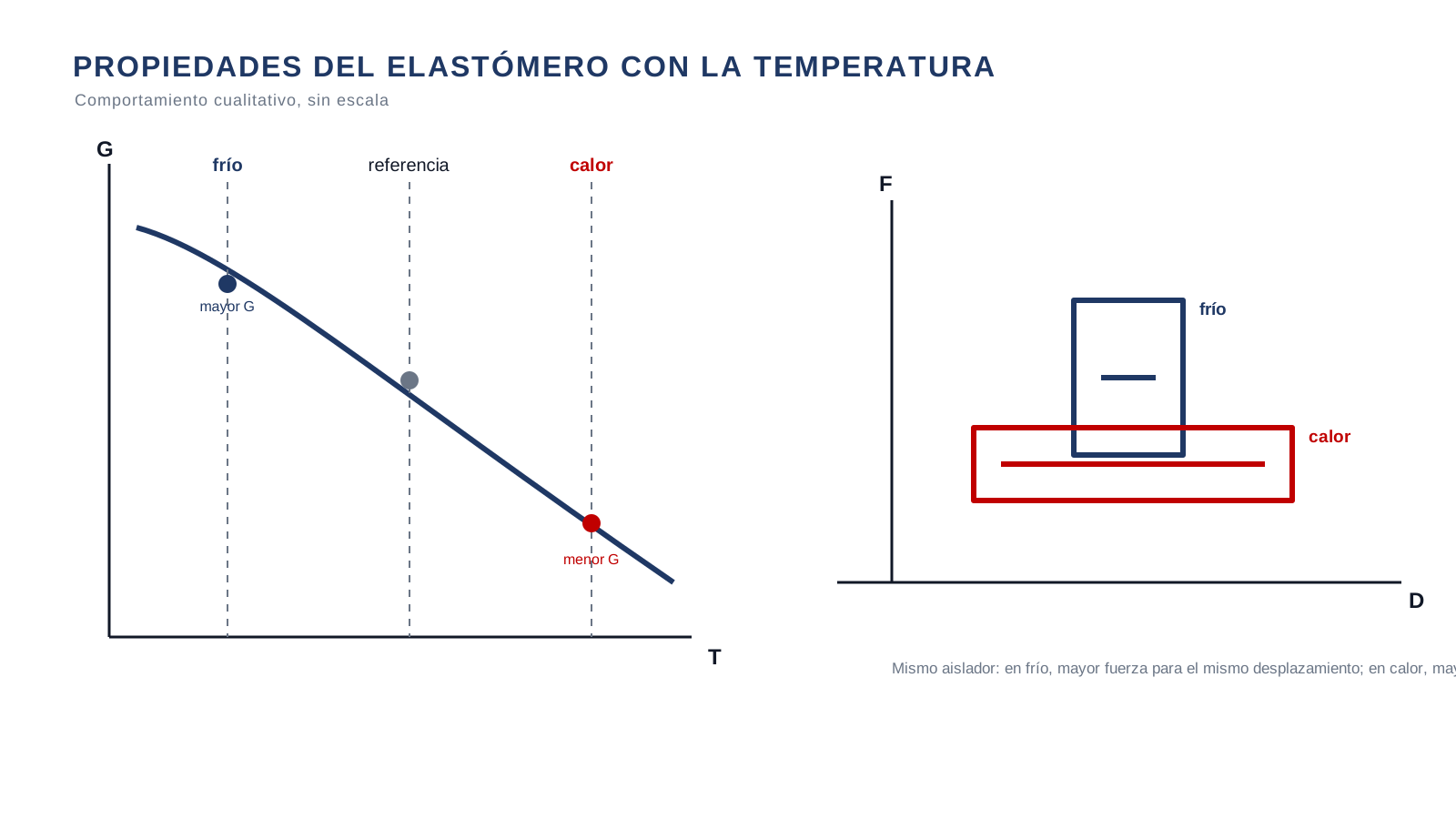
La consecuencia práctica es doble. A baja temperatura el elastómero se endurece: la rigidez efectiva sube, el periodo del sistema aislado se acorta y la fuerza que llega a la superestructura crece. A alta temperatura ocurre lo contrario: el material se ablanda, el desplazamiento de diseño tiende a aumentar, y son el foso, las juntas y las instalaciones los que deben absorber la diferencia. El diseño no se hace con una sola curva, sino con un límite superior y otro inferior de propiedades.
Por qué el hule responde a la temperatura
El módulo de cortante del hule cae conforme sube la temperatura: las cadenas del polímero se reorganizan con menos resistencia. Es un comportamiento termorreológico conocido, no un defecto de fabricación. Cerca del frío extremo el endurecimiento se acelera, y si el compuesto cristaliza —como puede ocurrir en hules con base de hule natural sometidos a temperaturas bajo cero durante tiempos largos— la rigidez crece de forma apreciable, tal como documentan Fuller, Gough y Thomas (2004).
El efecto no es simétrico. Un enfriamiento moderado mueve el módulo de forma gradual; la cristalización y la aproximación a la transición vítrea pueden cambiarlo drásticamente. El calor ablanda el compuesto de manera progresiva y acelera el envejecimiento: la oxidación avanza más rápido cuando el dispositivo opera caliente, y las normas lo tratan por separado, con factores por envejecimiento.
En un LRB hay un segundo material sensible: el plomo. El núcleo se recristaliza después de cada ciclo y su esfuerzo de fluencia disminuye al subir la temperatura. La caracterización del aislador a distintas temperaturas es la que permite saber cuánto del ciclo de histéresis se debe al plomo y cuánto al hule.
Qué piden las normas
ISO 22762-1, la norma de ensayo de aisladores elastoméricos, exige caracterizar las propiedades del dispositivo dentro del rango de temperaturas de servicio del proyecto y registrar la temperatura de cada ensayo, con el acondicionamiento previo del prototipo o la probeta. Un informe que no diga a qué temperatura se midió no sirve para verificar el diseño.
ASCE/SEI 7-22, capítulo 17, incorpora la temperatura mediante los factores de modificación de propiedades λ: junto con envejecimiento, scragging y velocidad, definen el límite superior e inferior del sistema de aislamiento. Con el límite superior se dimensiona la fuerza; con el inferior, el desplazamiento. En el blog ya explicamos cómo se combinan esos factores en la nota sobre los factores λ de ASCE 7.
AASHTO exige lo mismo para puentes en su Guide Specifications for Seismic Isolation Design: las propiedades de diseño deben reflejar la temperatura mínima y máxima del sitio, y en climas fríos la rigidez a baja temperatura puede gobernar las fuerzas que recibe la subestructura. En México, ni la NTC-CDMX ni el manual CFE-Sismo detallan este paso; la práctica es adoptar el marco de ISO, ASCE y AASHTO.
Del laboratorio al modelo: límite superior e inferior
El modelo de análisis no usa una temperatura: usa un rango. Con la rigidez del límite superior (frío) se obtiene el cortante basal y las fuerzas de conexión; con la del límite inferior (calor) se obtiene el desplazamiento de diseño que dimensiona el foso, las juntas de instalaciones y las holguras. El amortiguamiento efectivo también cambia con la temperatura, y en hules de alto amortiguamiento la forma del ciclo se modifica: la energía disipada por ciclo no es la misma en invierno que en verano.
Cardone, Gesualdi y Nigro (2011) ensayaron aisladores elastoméricos variando la temperatura del aire y documentaron cambios apreciables de rigidez y de forma del ciclo al alejarse de la temperatura ambiente. Estudios recientes modelan el acoplamiento termomecánico dentro del propio ciclo: un aislador que se calienta durante el sismo también eleva la temperatura de su elastómero. La literatura en climas fríos (Roeder y otros, 1990; Yakut y Yura, 2002) insiste: la temperatura de prueba debe parecerse a la de servicio, o los resultados no representan al dispositivo instalado.
| Parámetro | Frío (límite superior) | Calor (límite inferior) | Lo que dimensiona |
|---|---|---|---|
| Rigidez efectiva | Sube | Baja | Periodo y cortante basal |
| Desplazamiento de diseño | Tiende a bajar | Tiende a subir | Foso, juntas e instalaciones |
| Amortiguamiento efectivo | Puede caer en HDRB | Depende del compuesto | Fuerza sísmica y desplazamiento |
| Núcleo de plomo (LRB) | Mayor esfuerzo de fluencia | Menor esfuerzo de fluencia | Característica de histéresis |
Ajuste en obra: la temperatura también es construcción
La temperatura no es sólo un dato de diseño: es un dato de montaje. Las placas se nivelan y se calzan a la temperatura del momento; un cambio grande de temperatura entre el colado de la cimentación y la colocación del aislador altera las holguras, y la dilatación térmica de una superestructura larga produce movimientos lentos que el aislador absorbe sin daño, pero que conviene prever en la posición inicial del dispositivo.
Los movimientos térmicos son lentos y repetidos: no generan la energía de un sismo, pero sí ciclos de servicio que el compuesto debe soportar sin degradarse. Por eso el rango de temperaturas del sitio se escribe en las especificaciones y en el manual de inspección, como se explica en la nota sobre mantenimiento e inspección de aisladores.
Donde el sol golpea directo —azoteas, estaciones de viaducto, fachadas— conviene proteger el cuerpo elastomérico. Los dispositivos VELATOPH® salen de fábrica con manta de protección que cubre el cuerpo de neopreno contra fuego y radiación solar, lo que también modera el ciclo térmico diario del hule.
Lista de verificación para el proyectista
- ¿Está definido el rango de temperaturas de servicio del sitio (mínima y máxima)?
- ¿Se diseñó con límite superior e inferior, incluyendo el factor λ por temperatura?
- ¿El informe de ensayo indica la temperatura del laboratorio y el acondicionamiento previo?
- ¿El desplazamiento de diseño cubre el caso de rigidez baja (calor)?
- ¿El cortante basal cubre el caso de rigidez alta (frío)?
- ¿Los movimientos térmicos lentos de la superestructura están considerados en la posición inicial?
- ¿Los aisladores expuestos tienen protección contra el sol directo?
- ¿El manual de inspección pide registrar la temperatura ambiente en cada revisión?
En VELATOPH®
VELATOPH® fabrica en Manzanillo, Colima, aisladores LRB de 300 a 1,500 mm de diámetro, carga vertical de diseño de 500 a 50,000 kN y amortiguamiento efectivo del 20 al 35%; LDRB de 300 a 1,200 mm y 3 a 5%; y DEF de 50 a 5,000 kN. El diseño se apoya en ASCE 7-22, ISO 22762, NTC-CDMX 2023 y CFE-Sismo 2015, y se documenta con el protocolo de ensayo del proyecto, incluida la caracterización en el rango de temperaturas de servicio.
Si proyectas o revisas un edificio aislado en clima extremo, ofrecemos una evaluación técnica gratuita por WhatsApp. También puedes leer las notas sobre los factores de modificación λ, las pruebas de prototipo y producción y los aisladores HDRB.
Fuentes
- ISO. ISO 22762-1:2024, Elastomeric seismic-protection isolators — Part 1: Test methods. iso.org
- ASCE. ASCE/SEI 7-22, Minimum Design Loads and Associated Criteria for Buildings and Other Structures, capítulo 17 (estructuras aisladas). asce.org
- AASHTO. Guide Specifications for Seismic Isolation Design, 4.ª edición. store.transportation.org
- Cardone, D., Gesualdi, G. y Nigro, D. (2011). Effects of air temperature on the cyclic behavior of elastomeric seismic isolators. Bulletin of Earthquake Engineering 9(4): 1227–1255. link.springer.com
- Roeder, C. W., Stanton, J. F. y Feller, T. (1990). Low-temperature performance of elastomeric bearings. Journal of Cold Regions Engineering 4(3): 113–132. ascelibrary.org
- Yakut, A. y Yura, J. A. (2002). Parameters influencing performance of elastomeric bearings at low temperature. Journal of Structural Engineering 128(8): 986–994. ascelibrary.org
- Engineering Structures. Hysteretic restoring force model of high damping rubber bearings including thermo-mechanical coupled effect. sciencedirect.com
- JSCE Journal of Earthquake Engineering. Experimental study on temperature dependence of high damping rubber bearings considering strain and contact pressure. jstage.jst.go.jp
Artículo de carácter general y educativo; no sustituye el diseño ni la revisión de un ingeniero responsable de cada proyecto, ni las indicaciones de la autoridad competente.
An elastomeric isolator is a viscoelastic compound: its behavior also depends on temperature, on the speed at which it deforms and on its cycling history. The nominal properties used in design —effective stiffness, damping, displacement— correspond to a reference temperature on the order of 20 to 23 °C. The device, however, will work its whole life across a range that in Mexico runs from the cold early mornings of the highlands to sun-exposed coastal surfaces: in Manzanillo the ambient temperature exceeds 30 °C for much of the year, and a sunlit plate gets considerably hotter.
The practical consequence is twofold. At low temperature the elastomer stiffens: effective stiffness rises, the isolated period shortens and the force reaching the superstructure grows. At high temperature the opposite happens: the material softens, design displacement tends to increase, and the moat, the joints and the services must absorb the difference. Design is not done with a single curve, but with an upper and a lower bound of properties.
Why rubber responds to temperature
The shear modulus of rubber falls as temperature rises: polymer chains rearrange with less resistance. This is a well-known thermorheological behavior, not a manufacturing defect. Near extreme cold the stiffening accelerates, and if the compound crystallizes —as can happen in natural-rubber-based compounds kept below freezing for long periods— stiffness grows appreciably, as documented by Fuller, Gough and Thomas (2004).
The effect is not symmetric. Moderate cooling moves the modulus gradually; crystallization and approaching the glass transition can change it drastically. Heat softens the compound progressively and accelerates aging: oxidation advances faster when the device operates hot, and standards treat it separately, through aging factors.
In an LRB there is a second temperature-sensitive material: lead. The core recrystallizes after each cycle and its yield stress decreases as temperature rises. Characterizing the isolator at different temperatures is what allows separating how much of the hysteresis loop comes from the lead and how much from the rubber.
What the codes require
ISO 22762-1, the test standard for elastomeric isolators, requires characterizing the device's properties within the project's service temperature range and recording the temperature of every test, with prior conditioning of the prototype or specimen. A report that does not state the temperature at which it was measured cannot verify the design.
ASCE/SEI 7-22, Chapter 17, brings temperature in through the property modification factors λ: together with aging, scragging and velocity, they define the upper and lower bound of the isolation system. The upper bound sizes the force; the lower bound sizes the displacement. In the blog we already explained how those factors combine, in the note on the λ factors in ASCE 7.
AASHTO requires the same for bridges in its Guide Specifications for Seismic Isolation Design: design properties must reflect the site's minimum and maximum temperature, and in cold climates the low-temperature stiffness can govern the forces received by the substructure. In Mexico, neither the NTC-CDMX nor the CFE-Sismo manual details this step; the practice is to adopt the ISO, ASCE and AASHTO framework.
From the laboratory to the model: upper and lower bound
The analysis model does not use one temperature: it uses a range. With the upper-bound stiffness (cold) one obtains the base shear and the connection forces; with the lower-bound stiffness (heat) one obtains the design displacement that sizes the moat, the service joints and the clearances. Effective damping also changes with temperature, and in high-damping rubbers the shape of the loop changes: the energy dissipated per cycle is not the same in winter as in summer.
Cardone, Gesualdi and Nigro (2011) tested elastomeric isolators while varying the air temperature and documented appreciable changes in stiffness and loop shape away from room temperature. Recent studies model the thermo-mechanical coupling within the cycle itself: an isolator heating up during the earthquake also raises the temperature of its elastomer. The cold-climate literature (Roeder et al., 1990; Yakut and Yura, 2002) insists: the test temperature must resemble the service temperature, or the results do not represent the installed device.
| Parameter | Cold (upper bound) | Heat (lower bound) | What it sizes |
|---|---|---|---|
| Effective stiffness | Rises | Falls | Period and base shear |
| Design displacement | Tends to fall | Tends to rise | Moat, joints and services |
| Effective damping | May drop in HDRB | Compound-dependent | Seismic force and displacement |
| Lead core (LRB) | Higher yield stress | Lower yield stress | Hysteretic characteristic |
On-site adjustment: temperature is also construction
Temperature is not only a design input: it is an erection input. Plates are leveled and shimmed at the temperature of the moment; a large temperature change between pouring the foundation and placing the isolator alters the clearances, and the thermal expansion of a long superstructure produces slow movements that the isolator absorbs without damage, but which are worth anticipating in the device's initial position.
Thermal movements are slow and repeated: they do not carry the energy of an earthquake, but they do add service cycles the compound must endure without degrading. That is why the site's temperature range is written into the specifications and into the inspection manual, as explained in the note on isolator maintenance and inspection.
Where the sun hits directly —roofs, viaduct stations, façades— it is worth protecting the elastomeric body. VELATOPH® devices leave the factory with a protective blanket covering the rubber body against fire and solar radiation, which also moderates the daily thermal cycle of the rubber.
Checklist for the design engineer
- Is the site's service temperature range defined (minimum and maximum)?
- Was the design carried out with upper and lower bounds, including the λ factor for temperature?
- Does the test report state the laboratory temperature and the prior conditioning?
- Does the design displacement cover the low-stiffness (heat) case?
- Does the base shear cover the high-stiffness (cold) case?
- Are the slow thermal movements of the superstructure considered in the initial position?
- Do exposed isolators have protection against direct sunlight?
- Does the inspection manual require recording ambient temperature at each review?
At VELATOPH®
VELATOPH® manufactures in Manzanillo, Colima, LRB isolators from 300 to 1,500 mm in diameter, design vertical load from 500 to 50,000 kN and effective damping from 20% to 35%; LDRB from 300 to 1,200 mm and 3% to 5%; and DEF from 50 to 5,000 kN. Design relies on ASCE 7-22, ISO 22762, NTC-CDMX 2023 and CFE-Sismo 2015, and is documented with the project's test protocol, including characterization over the service temperature range.
If you design or review an isolated building in an extreme climate, we offer a free technical assessment via WhatsApp. You can also read the notes on the property modification factors λ, prototype and production testing and HDRB isolators.
Sources
- ISO. ISO 22762-1:2024, Elastomeric seismic-protection isolators — Part 1: Test methods. iso.org
- ASCE. ASCE/SEI 7-22, Minimum Design Loads and Associated Criteria for Buildings and Other Structures, Chapter 17 (seismically isolated structures). asce.org
- AASHTO. Guide Specifications for Seismic Isolation Design, 4th edition. store.transportation.org
- Cardone, D., Gesualdi, G., and Nigro, D. (2011). Effects of air temperature on the cyclic behavior of elastomeric seismic isolators. Bulletin of Earthquake Engineering 9(4): 1227–1255. link.springer.com
- Roeder, C. W., Stanton, J. F., and Feller, T. (1990). Low-temperature performance of elastomeric bearings. Journal of Cold Regions Engineering 4(3): 113–132. ascelibrary.org
- Yakut, A., and Yura, J. A. (2002). Parameters influencing performance of elastomeric bearings at low temperature. Journal of Structural Engineering 128(8): 986–994. ascelibrary.org
- Engineering Structures. Hysteretic restoring force model of high damping rubber bearings including thermo-mechanical coupled effect. sciencedirect.com
- JSCE Journal of Earthquake Engineering. Experimental study on temperature dependence of high damping rubber bearings considering strain and contact pressure. jstage.jst.go.jp
General, educational article; it does not replace the design or review by an engineer responsible for each project, or the instructions of the competent authority.