Todo aislador sísmico tiene que hacer dos cosas a la vez: ser flexible en dirección horizontal, para alargar el periodo del edificio, y disipar energía, para que el desplazamiento en la interfaz no crezca sin control. El aislador con núcleo de plomo (LRB) resuelve la segunda tarea con un cilindro de plomo que fluye en cada ciclo. El aislador de hule de alto amortiguamiento —HDRB, por sus siglas en inglés— la resuelve de otra forma: la energía se disipa dentro del propio hule, gracias a la formulación del compuesto. Entender esa diferencia ayuda a leer especificaciones, comparar ofertas y saber qué preguntar en las pruebas.
Cómo está hecho un HDRB
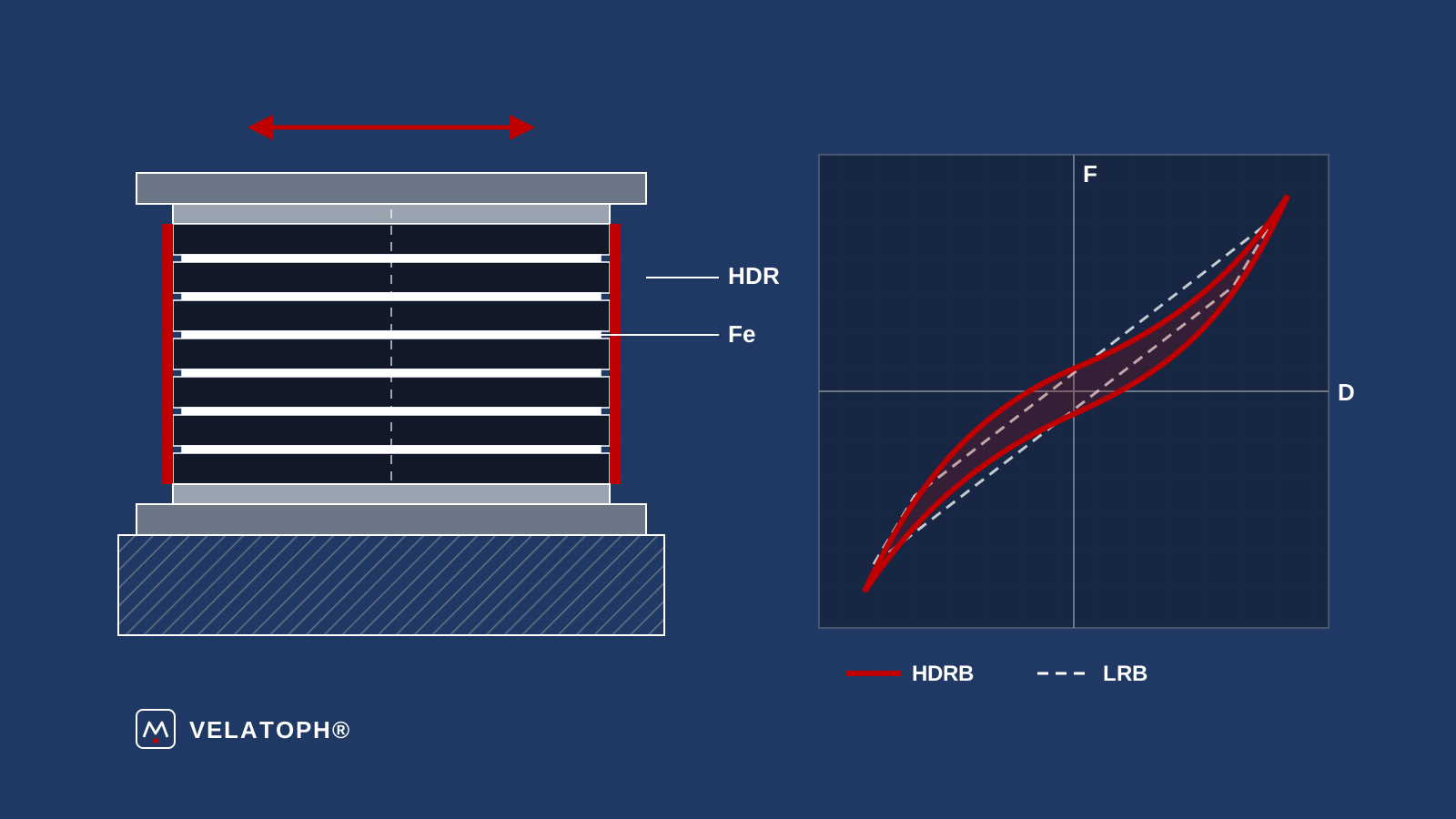
Por fuera, un HDRB se parece mucho a cualquier aislador elastomérico: capas delgadas de hule vulcanizadas a láminas de acero, placas de conexión arriba y abajo y un recubrimiento lateral que protege el conjunto. Las láminas de acero dan rigidez vertical y evitan que el hule se abombe bajo la carga del edificio; el hule da la flexibilidad horizontal.
La diferencia está en el material. El hule de un HDRB es un compuesto de hule natural al que se añaden rellenos —negro de humo, aceites, resinas y otros aditivos— que aumentan la fricción interna entre las cadenas del polímero. Según Naeim y Kelly, con estos compuestos se alcanzan amortiguamientos equivalentes del orden de 10 a 20 % a deformaciones por cortante cercanas a 100 %, frente al 2–5 % de un hule de bajo amortiguamiento. No hay núcleo de plomo ni otro elemento disipador: el amortiguamiento viene del hule mismo.
La tecnología se desarrolló a principios de los años ochenta en el Reino Unido, en la Malaysian Rubber Producers' Research Association, y uno de los primeros edificios aislados de Estados Unidos, el Foothill Communities Law and Justice Center en California, se apoyó en aisladores de este tipo. En Chile, el primer edificio aislado del país —la Comunidad Andalucía, en Santiago— también usó hule de alto amortiguamiento.
Un comportamiento que cambia con la deformación
El lazo fuerza-desplazamiento de un LRB se describe bien con un modelo bilineal: una rigidez inicial alta hasta que el plomo fluye y una rigidez posterior menor, dada por el hule. El HDRB es más complejo y su rigidez depende de cuánto se deforma:
- Pequeñas deformaciones (del orden de 20 % o menos): el hule es comparativamente rígido. Eso ayuda contra viento y sismos menores, porque el edificio casi no se mueve.
- Deformaciones de diseño: la rigidez baja y el lazo se ensancha; es la zona donde el aislador trabaja y disipa energía.
- Deformaciones muy grandes: el hule se endurece por la cristalización inducida por deformación. Ese endurecimiento limita el desplazamiento en sismos extremos, pero aumenta la fuerza que llega a la superestructura, y hay que considerarlo en el análisis.
Además, el HDRB tiene una memoria peculiar. En los primeros ciclos a una deformación dada, el compuesto es más rígido y amortigua más que en los ciclos siguientes; parte de esa diferencia se pierde en forma permanente (el scragging) y parte se recupera con el tiempo (el efecto Mullins). Grant, Fenves y Whittaker propusieron un modelo bidireccional que separa precisamente esas dos componentes de degradación. En la práctica significa que el fabricante debe declarar si las propiedades que reporta son vírgenes (sin ciclar) o cicladas, y el diseñador debe usar las dos.
HDRB, LRB y LDRB lado a lado
La tabla es orientativa; las propiedades reales salen de las pruebas de cada fabricante y cada compuesto:
| HDRB | LRB | LDRB | |
|---|---|---|---|
| Origen del amortiguamiento | El compuesto de hule | Fluencia del núcleo de plomo | Muy poco; se complementa con disipadores |
| Amortiguamiento típico | ≈10–20 % | Mayor, según el tamaño del núcleo | ≈2–5 % |
| Forma del lazo | Redondeada, con endurecimiento a gran deformación | Aproximadamente bilineal | Casi lineal |
| Modelado | Más exigente: depende de la deformación, del ciclado y de la temperatura | Bilineal bien establecido | Sencillo |
| Punto a vigilar | Scragging, envejecimiento y sensibilidad a la temperatura del compuesto | Calentamiento del plomo en ciclos repetidos | Desplazamientos grandes si no hay disipación adicional |
Qué implica para el diseño
Diseñar con límites superior e inferior
ASCE 7-22, en su capítulo 17, pide que el sistema de aislamiento se analice con propiedades de límite superior e inferior, que cubren la variabilidad de fabricación, el envejecimiento, la temperatura y los efectos de ciclado. En un HDRB esos factores suelen pesar más que en un LRB, porque el comportamiento del compuesto es más sensible a ellos. El límite inferior gobierna el desplazamiento máximo (véase desplazamiento máximo del aislador); el superior, las fuerzas en la superestructura.
Modelos numéricos
Un modelo bilineal simple puede no reproducir bien un HDRB a pequeñas y grandes deformaciones. Programas de investigación como OpenSees incluyen elementos específicos para hule de alto amortiguamiento que consideran la degradación por ciclado. Para el análisis lineal equivalente, Dall'Asta y Ragni estudiaron cómo aproximar el comportamiento no lineal del HDR con rigidez y amortiguamiento efectivos.
Pruebas
Las pruebas de prototipo y de producción de ASCE 7 y de ISO 22762 aplican igual que a otros elastoméricos, pero en el HDRB conviene revisar con especial cuidado cómo se trató el primer ciclo, a qué temperatura se ensayó y cuánto varían las propiedades entre lotes (véase pruebas de prototipo y de producción).
¿Cuándo tiene sentido un HDRB?
- Cuando se busca un aislador sin plomo, por ejemplo por restricciones ambientales o de disposición final.
- Cuando un amortiguamiento moderado basta para controlar el desplazamiento del sitio.
- Cuando el fabricante tiene un compuesto con historial de pruebas y datos de envejecimiento documentados.
Si el sitio exige más amortiguamiento, o se prefiere un modelo bilineal bien conocido, el LRB o el péndulo de fricción suelen ser la alternativa; si se busca una interfaz muy flexible, un LDRB combinado con disipadores también lo es (véase qué sistema necesita tu proyecto).
¿Estás eligiendo el sistema de aislamiento?
VELATOPH® fabrica en Manzanillo, Colima, aisladores elastoméricos LRB y LDRB, aisladores de péndulo FPS y DFP y disipadores DEF y DVF.
Si tu proyecto está comparando tipos de aislador, te ofrecemos una evaluación técnica gratuita para ver qué sistema conviene a tu sitio y a tu estructura. Escríbenos por WhatsApp.
Fuentes
- ASCE/SEI 7-22, Minimum Design Loads and Associated Criteria for Buildings and Other Structures, cap. 17 (estructuras con aislamiento sísmico). asce.org/publications-and-news/asce-7
- ISO 22762, Elastomeric seismic-protection isolators (partes 1 a 3). iso.org
- Naeim, F. y Kelly, J. M. (1999). Design of Seismic Isolated Structures: From Theory to Practice. John Wiley & Sons.
- Grant, D. N., Fenves, G. L. y Whittaker, A. S. (2004). "Bidirectional modelling of high-damping rubber bearings". Journal of Earthquake Engineering. researchconnect.suny.edu
- Dall'Asta, A. y Ragni, L. (2008). Comportamiento no lineal y aproximación lineal equivalente de sistemas con hule de alto amortiguamiento. pubblicazioni.unicam.it
- OpenSees, elemento HDR (hule de alto amortiguamiento; Kumar, Whittaker y Constantinou, 2014). opensees.berkeley.edu
Every seismic isolator has to do two things at once: be flexible horizontally, to lengthen the building's period, and dissipate energy, so that the displacement at the interface does not grow out of control. The lead rubber bearing (LRB) handles the second task with a lead cylinder that yields in every cycle. The high-damping rubber bearing —HDRB— handles it differently: energy is dissipated within the rubber itself, thanks to the formulation of the compound. Understanding that difference helps to read specifications, compare bids and know what to ask about testing.
How an HDRB is made
From the outside, an HDRB looks much like any elastomeric isolator: thin rubber layers vulcanised to steel shims, connection plates at top and bottom and a side cover that protects the assembly. The steel shims provide vertical stiffness and prevent the rubber from bulging under the building's load; the rubber provides horizontal flexibility.
The difference lies in the material. The rubber in an HDRB is a natural rubber compound with added fillers —carbon black, oils, resins and other additives— that increase internal friction between the polymer chains. According to Naeim and Kelly, these compounds reach equivalent damping on the order of 10 to 20% at shear strains near 100%, compared with 2–5% for a low-damping rubber. There is no lead core or other dissipating element: the damping comes from the rubber itself.
The technology was developed in the early 1980s in the United Kingdom, at the Malaysian Rubber Producers' Research Association, and one of the first isolated buildings in the United States, the Foothill Communities Law and Justice Center in California, was supported on isolators of this type. In Chile, the country's first isolated building —Comunidad Andalucía, in Santiago— also used high-damping rubber.
A behaviour that changes with strain
The force-displacement loop of an LRB is well described by a bilinear model: a high initial stiffness until the lead yields and a lower post-yield stiffness provided by the rubber. The HDRB is more complex, and its stiffness depends on how much it deforms:
- Small strains (on the order of 20% or less): the rubber is comparatively stiff. This helps against wind and minor earthquakes, because the building barely moves.
- Design strains: stiffness drops and the loop widens; this is the range where the isolator works and dissipates energy.
- Very large strains: the rubber stiffens due to strain-induced crystallisation. That stiffening limits displacement in extreme earthquakes, but it increases the force reaching the superstructure and must be accounted for in the analysis.
The HDRB also has a peculiar memory. In the first cycles at a given strain, the compound is stiffer and damps more than in subsequent cycles; part of that difference is lost permanently (scragging) and part recovers over time (the Mullins effect). Grant, Fenves and Whittaker proposed a bidirectional model that separates precisely these two components of degradation. In practice this means the manufacturer must state whether the properties it reports are virgin (unscragged) or scragged, and the designer must use both.
HDRB, LRB and LDRB side by side
The table is indicative; actual properties come from each manufacturer's tests and each compound:
| HDRB | LRB | LDRB | |
|---|---|---|---|
| Source of damping | The rubber compound | Yielding of the lead core | Very little; supplemented with dampers |
| Typical damping | ≈10–20% | Higher, depending on core size | ≈2–5% |
| Loop shape | Rounded, stiffening at large strains | Approximately bilinear | Nearly linear |
| Modelling | More demanding: depends on strain, scragging and temperature | Well-established bilinear | Simple |
| Point to watch | Scragging, ageing and temperature sensitivity of the compound | Heating of the lead under repeated cycles | Large displacements without added damping |
What it means for design
Designing with upper and lower bounds
ASCE 7-22, in chapter 17, requires the isolation system to be analysed with upper-bound and lower-bound properties, which cover manufacturing variability, ageing, temperature and cycling effects. In an HDRB these factors usually weigh more than in an LRB, because the behaviour of the compound is more sensitive to them. The lower bound governs the maximum displacement (see maximum isolator displacement); the upper bound, the forces in the superstructure.
Numerical models
A simple bilinear model may not reproduce an HDRB well at small and large strains. Research programs such as OpenSees include specific elements for high-damping rubber that account for degradation from scragging. For equivalent linear analysis, Dall'Asta and Ragni studied how to approximate the nonlinear behaviour of HDR with effective stiffness and damping.
Testing
The prototype and production tests of ASCE 7 and ISO 22762 apply as they do to other elastomeric isolators, but with an HDRB it is worth checking with particular care how the first cycle was treated, at what temperature the tests were run and how much the properties vary between batches (see prototype and production tests).
When does an HDRB make sense?
- When a lead-free isolator is wanted, for example because of environmental or disposal restrictions.
- When moderate damping is enough to control the displacement at the site.
- When the manufacturer has a compound with a documented testing history and ageing data.
If the site demands more damping, or a well-known bilinear model is preferred, the LRB or the friction pendulum are usually the alternative; if a very flexible interface is sought, an LDRB combined with dampers is another (see which system your project needs).
Choosing an isolation system?
VELATOPH® manufactures in Manzanillo, Colima, LRB and LDRB elastomeric isolators, FPS and DFP pendulum isolators and DEF and DVF dissipators.
If your project is comparing isolator types, we offer a free technical assessment to see which system suits your site and your structure. Write to us on WhatsApp.
Sources
- ASCE/SEI 7-22, Minimum Design Loads and Associated Criteria for Buildings and Other Structures, ch. 17 (seismically isolated structures). asce.org/publications-and-news/asce-7
- ISO 22762, Elastomeric seismic-protection isolators (parts 1 to 3). iso.org
- Naeim, F. and Kelly, J. M. (1999). Design of Seismic Isolated Structures: From Theory to Practice. John Wiley & Sons.
- Grant, D. N., Fenves, G. L. and Whittaker, A. S. (2004). "Bidirectional modelling of high-damping rubber bearings". Journal of Earthquake Engineering. researchconnect.suny.edu
- Dall'Asta, A. and Ragni, L. (2008). Nonlinear behaviour and equivalent linear approximation of systems with high-damping rubber. pubblicazioni.unicam.it
- OpenSees, HDR element (high-damping rubber; Kumar, Whittaker and Constantinou, 2014). opensees.berkeley.edu