Un edificio puede resistir un sismo sin colapsar y, aun así, quedar fuera de servicio: los servidores se desplazan, los racks se vuelcan, los tableros eléctricos se desanclan. En un centro de datos, un hospital o una sala de control, lo que importa es que el equipo siga operando. Para eso existe el aislamiento de equipos y de piso.
El problema: el daño no estructural
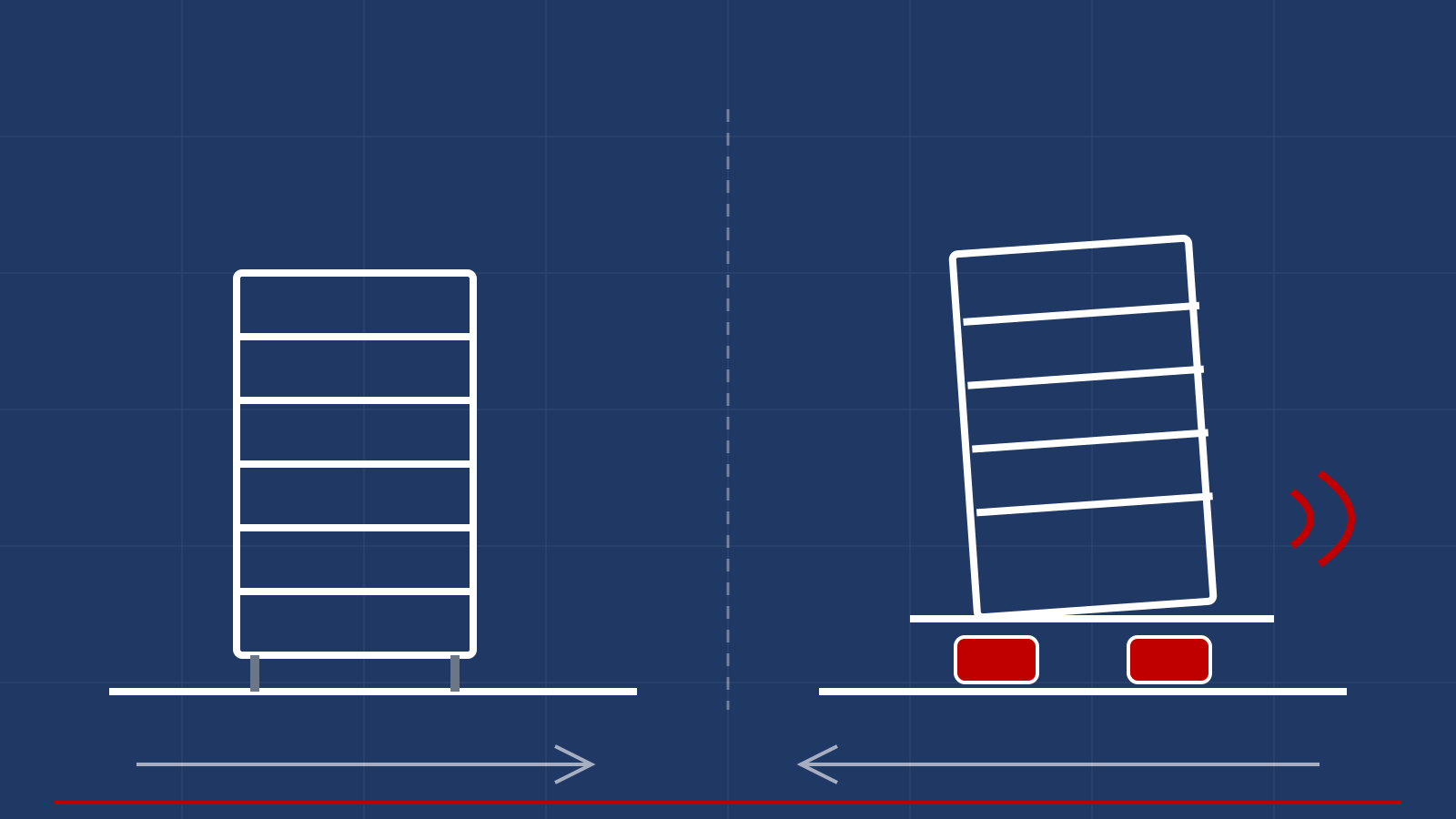
La guía FEMA E-74 señala que los daños no estructurales han representado la mayor parte de los daños en varios sismos recientes en Estados Unidos. En equipos, el riesgo tiene dos caras: volcamiento y deslizamiento (por falta de anclaje) y daño por aceleración (por exceso de ella). Anclar de forma rígida un rack evita lo primero, pero le transmite al equipo la aceleración del piso, que en pisos altos puede ser mayor que la del suelo.
Los pisos elevados convencionales tampoco son neutros: según la literatura de patentes del sector, pueden amplificar la aceleración de la losa base y dañar racks y gabinetes.
Tres niveles de protección
| Qué protege | Cómo funciona | |
|---|---|---|
| Edificio aislado | Toda la estructura y su contenido. | Aisladores en la base reducen la aceleración que llega a todos los pisos. |
| Piso aislado | Una sala completa (por ejemplo, la de servidores). | Una plataforma o piso sobre aisladores se desacopla de la losa. |
| Equipo aislado | Un rack o gabinete en particular. | Una base aislante bajo el equipo permite que se mueva sin volcarse. |
Lo que muestran pruebas publicadas
Investigadores de la Universidad de Buffalo ensayaron en mesa vibradora un rack de servidores con aislamiento local y amortiguamiento: en una simulación basada en el 80 % de la fuerza del sismo de Northridge de 1994, el rack se movió pero no cayó. En el Laboratorio Lawrence Berkeley, un piso sísmico para un nuevo edificio de cómputo se probó antes de su instalación con ensayos equivalentes, según el propio laboratorio, a unos 3,000 años de sismos. Son ejemplos informativos, no garantías de desempeño para otro equipo o sitio.
Por qué aislar reduce la aceleración
El principio es el mismo que en un edificio aislado: una interfaz flexible alarga el periodo del sistema y lo aleja de las frecuencias donde el sismo es más energético, de modo que la aceleración que llega al equipo baja. A cambio, el sistema se desplaza más que uno rígido. Por eso el diseño siempre equilibra dos cantidades: aceleración transmitida y desplazamiento. Para entender el papel del periodo, véase cómo leer un espectro de diseño.
Esto explica también por qué conviene decidir el nivel de protección desde el proyecto. Si el edificio entero va a estar aislado, el equipo recibe una aceleración mucho menor en todos los pisos y a menudo basta con un anclaje convencional bien diseñado. Si el edificio es convencional y sólo una sala es crítica, el aislamiento local puede ser la opción razonable, siempre que se acepte el desplazamiento adicional y se prevea el espacio. Y si lo único que existe es un riesgo de volcamiento, un buen anclaje o arriostre puede resolverlo sin aislar nada.
Un punto que suele olvidarse: el aislamiento protege al equipo, pero no a lo que lo conecta. Un servidor que se mueve libremente sobre su base seguirá conectado a cables de energía, de red y a ductos de enfriamiento; si éstos no admiten el movimiento relativo, se convierten en el eslabón débil. La misma lógica aplica a las juntas de separación en edificios aislados (véase junta de separación).
Qué debe revisarse antes de decidir
- Qué se protege y cuánto aguanta: aceleración y desplazamiento admisibles del equipo, según el fabricante.
- Espacio para el desplazamiento: un piso aislado necesita holgura libre; cables, ductos y tuberías deben ser flexibles en el cruce.
- Cargas y distribución: racks pesados y cargas asimétricas afectan el comportamiento del sistema.
- Reconfiguración: la sala cambiará con los años; el sistema debe admitirlo.
- Servicios cercanos: energía, enfriamiento y comunicaciones deben seguir funcionando también.
- Norma aplicable: ASCE 7-22 (capítulo 13 para componentes no estructurales, capítulo 17 para estructuras aisladas) y la normativa local vigente.
Una precisión honesta: este artículo resume criterios generales y ejemplos de la literatura. La solución para una instalación concreta exige un análisis específico, y nada de lo aquí descrito proviene de un proyecto de VELATOPH®. Lo que VELATOPH® fabrica son aisladores y disipadores para estructuras; no se describe aquí un producto de piso para racks.
En VELATOPH®
VELATOPH® fabrica en Manzanillo, Colima, aisladores elastoméricos LRB y LDRB, aisladores de péndulo FPS y DFP y disipadores DEF y DVF. Cuando el contenido de un edificio es crítico, aislar la estructura completa reduce la aceleración desde la base; véase también aislamiento en hospitales.
Si proyectas una instalación con equipo crítico y quieres evaluar si conviene aislar el edificio, te ofrecemos una evaluación técnica gratuita. Escríbenos por WhatsApp.
Fuentes
- FEMA E-74. Reducing the Risks of Nonstructural Earthquake Damage — A Practical Guide. atcouncil.org
- University at Buffalo. Can a stack of computer servers survive an earthquake? (2014). buffalo.edu
- Berkeley Lab. New computing sciences facility features first-of-its-kind seismic floor (2015). cs.lbl.gov
- ASCE 7-22: Chapter 13 (Seismic Design Requirements for Nonstructural Components) and Chapter 17 (Isolated Structures) (consultar la edición vigente).
A building can withstand an earthquake without collapsing and still go out of service: servers slide, racks tip over, switchboards come loose. In a data center, hospital or control room, what matters is that the equipment keeps running. That is what equipment and floor isolation are for.
The problem: nonstructural damage
The FEMA E-74 guide notes that nonstructural damage has accounted for most of the damage in several recent U.S. earthquakes. For equipment, the risk has two sides: tipping and sliding (from lack of anchorage) and acceleration damage (from too much of it). Rigidly anchoring a rack prevents the first, but passes the floor acceleration on to the equipment, which on upper floors can be larger than ground acceleration.
Conventional raised floors are not neutral either: according to patent literature in the field, they can amplify base-slab acceleration and damage racks and cabinets.
Three levels of protection
| What it protects | How it works | |
|---|---|---|
| Isolated building | The whole structure and its contents. | Base isolators reduce the acceleration reaching every floor. |
| Isolated floor | An entire room (for example, the server room). | A platform or floor on isolators is decoupled from the slab. |
| Isolated equipment | A particular rack or cabinet. | An isolating base under the unit lets it move without tipping. |
What published tests show
Researchers at the University at Buffalo shake-table tested a server rack with local isolation and damping: in a simulation based on 80% of the force of the 1994 Northridge earthquake, the rack moved but did not fall. At Lawrence Berkeley Laboratory, a seismic floor for a new computing building was tested before installation with testing equivalent, according to the lab itself, to about 3,000 years of earthquakes. These are informative examples, not performance guarantees for other equipment or sites.
Why isolating reduces acceleration
The principle is the same as in an isolated building: a flexible interface lengthens the period of the system and moves it away from the frequencies where the earthquake is most energetic, so the acceleration reaching the equipment drops. In exchange, the system displaces more than a rigid one. That is why design always balances two quantities: transmitted acceleration and displacement. To understand the role of the period, see how to read a design spectrum.
This also explains why the level of protection is best decided at the design stage. If the whole building will be isolated, the equipment receives a much lower acceleration on every floor and a well-designed conventional anchorage is often enough. If the building is conventional and only one room is critical, local isolation may be the reasonable option, provided the extra displacement is accepted and the space is planned. And if the only issue is a tipping risk, good anchorage or bracing may solve it without isolating anything.
A point that is often forgotten: isolation protects the equipment, but not what connects to it. A server moving freely on its base will still be connected to power and network cables and cooling ducts; if these cannot accommodate the relative motion, they become the weak link. The same logic applies to the separation joints in isolated buildings (see separation joint).
What to check before deciding
- What is protected and its tolerance: allowable acceleration and displacement of the equipment, per the manufacturer.
- Room to move: an isolated floor needs clear gap; cables, ducts and pipes must be flexible where they cross.
- Loads and distribution: heavy racks and asymmetric loads affect system behavior.
- Reconfiguration: the room will change over the years; the system must allow it.
- Nearby services: power, cooling and communications must keep working as well.
- Applicable standard: ASCE 7-22 (Chapter 13 for nonstructural components, Chapter 17 for isolated structures) and current local codes.
An honest note: this article summarizes general criteria and examples from the literature. The solution for a specific facility requires its own analysis, and nothing described here comes from a VELATOPH® project. What VELATOPH® manufactures are isolators and dissipators for structures; no rack-floor product is described here.
At VELATOPH®
VELATOPH® manufactures in Manzanillo, Colima, LRB and LDRB elastomeric isolators, FPS and DFP pendulum isolators and DEF and DVF dissipators. When a building's contents are critical, isolating the whole structure reduces acceleration from the base; see also isolation in hospitals.
If you are planning a facility with critical equipment and want to assess whether isolating the building makes sense, we offer a free technical assessment. Write to us on WhatsApp.
Sources
- FEMA E-74. Reducing the Risks of Nonstructural Earthquake Damage — A Practical Guide. atcouncil.org
- University at Buffalo. Can a stack of computer servers survive an earthquake? (2014). buffalo.edu
- Berkeley Lab. New computing sciences facility features first-of-its-kind seismic floor (2015). cs.lbl.gov
- ASCE 7-22: Chapter 13 (Seismic Design Requirements for Nonstructural Components) and Chapter 17 (Isolated Structures) (check the current edition).