Japón es, por amplio margen, el país con más edificios sobre aisladores sísmicos. No es casualidad ni moda: es la respuesta técnica de un país que vive sobre cuatro placas tectónicas y que, después del sismo de Kobe de 1995, decidió que proteger la estructura ya no bastaba. Este artículo resume lo que documenta el Instituto de Investigación de la Edificación de Japón (BRI) y lo que podemos aprender en México, un país con peligro sísmico comparable en la costa del Pacífico.
Cuántos edificios hay y cuándo despegó el aislamiento
Según el BRI, en diciembre de 2008 había alrededor de 2,500 edificios aislados en Japón (sin contar casas de una y dos plantas), además de unas 3,300 casas con estructura aislada. El punto de quiebre fue el sismo de Hyogo-ken Nambu (Kobe) de 1995: después de él, el número de edificios aislados en construcción aumentó bruscamente, los condominios con aislamiento se volvieron comunes desde 1996 y, desde 1997, se han proyectado entre 120 y 250 edificios aislados cada año. Las cifras más recientes varían según el año de la encuesta y si se cuentan o no las viviendas, por lo que conviene citar siempre la fuente y la fecha.
También es notable el tipo de edificio: el BRI señala que es cada vez más habitual que instalaciones públicas y hospitales, que sirven como refugio en un desastre, se construyan con aislamiento. La lógica es la misma que explicamos en nuestra nota sobre aislamiento en hospitales: lo que importa es que el edificio siga funcionando.
Qué se midió en sismos reales
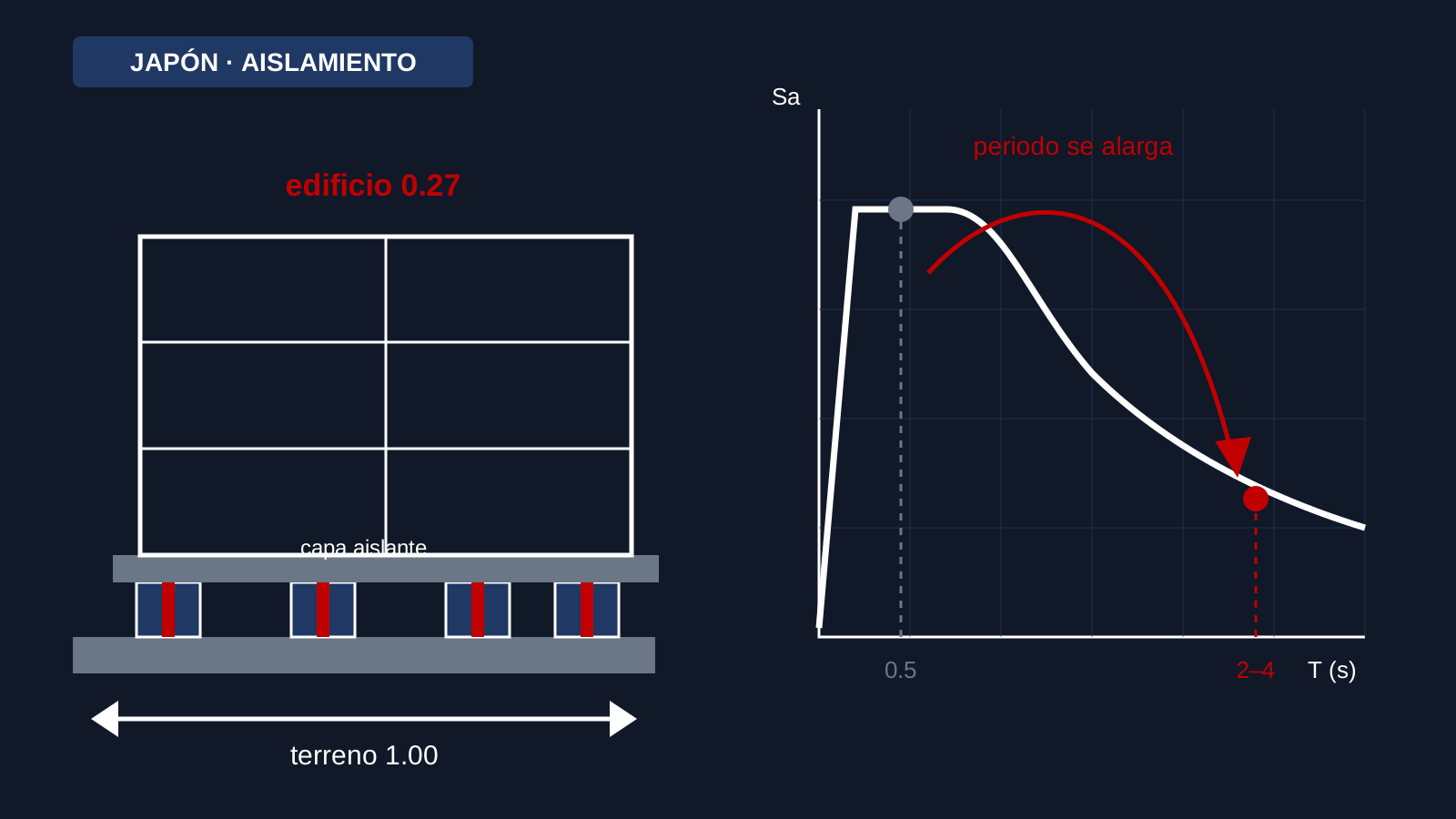
Desde Kobe, Japón acumuló muchos registros de aceleración de edificios aislados. El BRI presenta como ejemplo un edificio en Ojiya (un centro de salud para personas mayores) durante el sismo de Niigata Chuetsu de 2004, con la capa aislante entre la cimentación y el primer nivel:
| Dirección | Aceleración máxima: primer nivel / cimentación |
|---|---|
| Norte–sur (horizontal) | 0.27 |
| Este–oeste (horizontal) | 0.25 |
| Vertical | 1.54 (amplificada) |
Es decir, la aceleración horizontal se redujo a casi una cuarta parte, pero la vertical no se reduce: los aisladores de hule laminado son muy flexibles en horizontal y muy rígidos en vertical. Dentro del edificio aislado la vajilla quedó en su sitio; en uno cercano sin aislamiento, los muebles y objetos quedaron esparcidos, y el centro mantuvo su operación, incluido el cuidado de pacientes de larga estancia.
En el sismo de Tohoku de 2011, el BRI informó que la aceleración máxima sobre la capa aislante de los edificios aislados fue menor que la aceleración máxima del terreno y que casi no hubo evidencia de volcamiento ni dispersión de mobiliario. El mismo documento es prudente: en ese momento aún no se tenía un panorama completo del desempeño ni de los daños.
Por qué funciona: periodo y amortiguamiento
El BRI explica el mecanismo con dos ideas. Primera: la rigidez horizontal de un aislador de hule laminado es del orden de 1/1000 de su rigidez vertical, lo que alarga el periodo natural del edificio y reduce su respuesta en aceleración (un edificio rígido de 5 a 10 niveles, con periodo cercano a 0.5 s, cae justo en la zona de mayor respuesta). Segunda: un periodo largo trae desplazamientos grandes, que se concentran en la capa aislante; por eso se agregan amortiguadores que aportan un amortiguamiento de al menos alrededor de 20 % para limitar ese desplazamiento. Es el mismo razonamiento que desarrollamos en cómo leer un espectro de diseño.
Lo que Japón también advierte
- Sismos de periodo largo. Si el movimiento del terreno tiene un periodo cercano al del edificio aislado, el desplazamiento de la capa aislante crece. El BRI recomienda estudiar las regiones donde se observan movimientos de periodo largo.
- Dependencia de los dispositivos. La respuesta depende mucho del desempeño real de aisladores y amortiguadores, por lo que hace falta conocer sus propiedades y detectar problemas pronto. Por eso son importantes las pruebas de prototipo y producción y el mantenimiento a lo largo de la vida útil.
- Detalles de obra. El espacio perimetral y las juntas deben diseñarse para el desplazamiento esperado; véase junta de separación (foso).
Qué podemos aprender en México
Japón no tiene un secreto tecnológico: tiene una combinación de peligro alto, normativa que reconoce el aislamiento, registros instrumentales de edificios reales y casos visibles (hospitales, refugios, condominios) que fueron construyendo confianza. México comparte el peligro en la costa del Pacífico; la ruta práctica es la misma: diseñar con el espectro del sitio (véase CFE-Sismo 2015 y NTC-CDMX), verificar los dispositivos con pruebas y dar seguimiento después de la obra. Una precisión honesta: las cifras de desempeño citadas aquí provienen de un informe del propio BRI, una institución del sector, y deben leerse como tales.
En VELATOPH®
VELATOPH® fabrica en Manzanillo, Colima, aisladores elastoméricos LRB y LDRB, aisladores de péndulo FPS y DFP y disipadores DEF y DVF, y trabaja con la normativa ASCE 7-22 (capítulos 17 y 18), AASHTO LRFD, ISO 22762, NTC-CDMX 2023 y CFE-Sismo 2015.
Si tienes un proyecto y quieres saber si el aislamiento o la disipación convienen para tu predio, te ofrecemos una evaluación técnica gratuita. Escríbenos por WhatsApp.
Fuentes
- Iiba, M. (2011). Benefits of Seismically Isolated Buildings. Japan Journal, agosto de 2011, Building Research Institute (con datos de la Japan Society of Seismic Isolation). kenken.go.jp
- American Society of Civil Engineers. ASCE/SEI 7-22, capítulo 17. asce.org
Japan is, by a wide margin, the country with the most buildings on seismic isolators. It is neither chance nor fashion: it is the technical answer of a country that sits on four tectonic plates and that, after the 1995 Kobe earthquake, decided that protecting the structure alone was no longer enough. This article summarizes what Japan's Building Research Institute (BRI) documents and what we can learn in Mexico, a country with comparable seismic hazard along the Pacific coast.
How many buildings there are and when isolation took off
According to the BRI, in December 2008 there were about 2,500 isolated buildings in Japan (not counting one- and two-storey houses), plus about 3,300 houses with an isolated structure. The turning point was the 1995 Hyogo-ken Nambu (Kobe) earthquake: afterwards the number of isolated buildings under construction rose sharply, isolated condominiums became common from 1996, and since 1997 between 120 and 250 isolated buildings have been planned every year. More recent figures vary with the survey year and with whether houses are counted, so always cite the source and date.
The type of building is also notable: the BRI points out that it is increasingly common for public facilities and hospitals, which serve as shelters in a disaster, to be built with isolation. The logic is the one we explained in our note on isolation in hospitals: what matters is that the building keeps working.
What was measured in real earthquakes
Since Kobe, Japan has accumulated many acceleration records from isolated buildings. The BRI presents as an example a building in Ojiya (a health center for the elderly) during the 2004 Niigata Chuetsu earthquake, with the isolation layer between the foundation and the first floor:
| Direction | Peak acceleration: first floor / foundation |
|---|---|
| North–south (horizontal) | 0.27 |
| East–west (horizontal) | 0.25 |
| Vertical | 1.54 (amplified) |
In other words, horizontal acceleration dropped to almost a quarter, but vertical acceleration is not reduced: laminated rubber isolators are very flexible horizontally and very stiff vertically. Inside the isolated building the tableware stayed in place; in a nearby non-isolated building, furniture and objects were scattered, and the center kept operating, including care for long-stay patients.
In the 2011 Tohoku earthquake, the BRI reported that the peak acceleration above the isolation layer of isolated buildings was lower than peak ground acceleration and that there was little evidence of overturning or scattering of furniture. The same document is cautious: at that time a full picture of performance and damage was not yet available.
Why it works: period and damping
The BRI explains the mechanism with two ideas. First: the horizontal stiffness of a laminated rubber isolator is on the order of 1/1000 of its vertical stiffness, which lengthens the building's natural period and reduces its acceleration response (a stiff 5- to 10-storey building, with a period near 0.5 s, falls right in the zone of highest response). Second: a long period brings large displacements, which concentrate in the isolation layer; that is why dampers are added to provide damping of at least about 20% to limit that displacement. It is the same reasoning we developed in how to read a design spectrum.
What Japan also warns about
- Long-period earthquakes. If ground motion has a period close to that of the isolated building, the displacement of the isolation layer grows. The BRI recommends surveying regions where long-period motion is observed.
- Dependence on the devices. The response depends heavily on the actual performance of isolators and dampers, so their properties must be understood and problems detected early. That is why prototype and production testing and maintenance over the service life matter.
- Construction details. The perimeter gap and joints must be designed for the expected displacement; see seismic gap (foso).
What we can learn in Mexico
Japan has no technological secret: it has a combination of high hazard, standards that recognize isolation, instrumental records of real buildings and visible cases (hospitals, shelters, condominiums) that built confidence over time. Mexico shares the hazard along the Pacific coast; the practical route is the same: design with the site spectrum (see CFE-Sismo 2015 and NTC-CDMX), verify the devices with tests and follow up after construction. An honest note: the performance figures cited here come from a report by the BRI itself, an institution within the sector, and should be read as such.
At VELATOPH®
VELATOPH® manufactures in Manzanillo, Colima, LRB and LDRB elastomeric isolators, FPS and DFP pendulum isolators and DEF and DVF dampers, and works with the ASCE 7-22 (Chapters 17 and 18), AASHTO LRFD, ISO 22762, NTC-CDMX 2023 and CFE-Sismo 2015 standards.
If you have a project and want to know whether isolation or energy dissipation is a good fit for your site, we offer a free technical assessment. Write to us on WhatsApp.
Sources
- Iiba, M. (2011). Benefits of Seismically Isolated Buildings. Japan Journal, August 2011, Building Research Institute (with data from the Japan Society of Seismic Isolation). kenken.go.jp
- American Society of Civil Engineers. ASCE/SEI 7-22, Chapter 17. asce.org