Cuando suena la alerta sísmica en la Ciudad de México, millones de personas saben que tienen unos segundos para ponerse a salvo. El Sistema de Alerta Sísmica Mexicano (SASMEX) es una de las redes de alerta temprana más antiguas del mundo y ha salvado vidas. Pero la alerta y la protección estructural resuelven problemas distintos: la primera avisa a las personas; la segunda hace que el edificio siga en pie y funcionando cuando llega la sacudida. Entender qué hace cada una, y qué no puede hacer, ayuda a dueños, ingenieros y autoridades a no confiar en una sola capa de defensa.
Cómo funciona el SASMEX
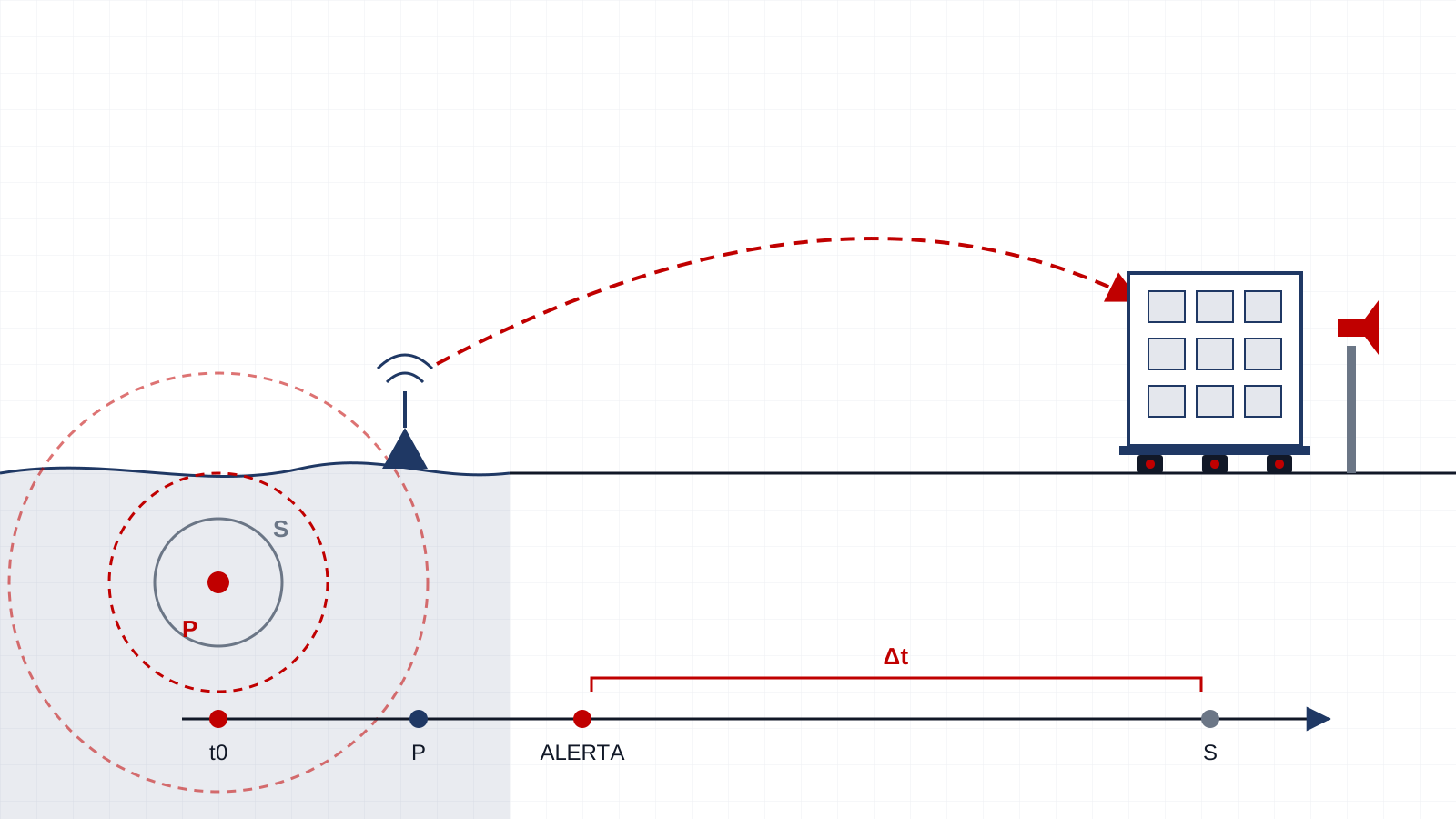
El SASMEX lo opera el Centro de Instrumentación y Registro Sísmico (CIRES). Su principio es sencillo: los sismos más peligrosos para el centro del país se originan en la zona de subducción del Pacífico, a cientos de kilómetros de las grandes ciudades. Una red de estaciones sísmicas instalada a lo largo de la costa —alrededor de un centenar; Suárez y colaboradores reportaron 97 en 2018— detecta las primeras ondas cerca del epicentro, estima con rapidez si el sismo es lo bastante fuerte y, de ser así, envía la señal por radio. Esa señal viaja prácticamente a la velocidad de la luz, mucho más rápido que las ondas sísmicas.
La clave física está en dos tipos de onda:
- Onda P (primaria): es la más rápida (del orden de 6 km/s en la corteza) pero suele ser la menos destructiva. Es la que detectan las estaciones.
- Onda S (secundaria) y ondas superficiales: más lentas (del orden de 3.5 km/s), traen la mayor parte de la sacudida horizontal que daña estructuras.
El sistema de la Ciudad de México opera desde 1991 y hoy la alerta se difunde por altavoces, radio, televisión y receptores dedicados en varias ciudades del centro y sur del país.
El tiempo de oportunidad depende de la distancia
El margen entre la alerta y la llegada de la sacudida fuerte se llama tiempo de oportunidad. Depende sobre todo de la distancia entre el epicentro y la ciudad: las fuentes oficiales hablan de unos 20 hasta 120 segundos. La siguiente tabla es una estimación ilustrativa, no un dato del sistema: supone una onda S a 3.5 km/s y unos 10 segundos para detectar, decidir y transmitir.
| Distancia epicentro–ciudad | Llegada aprox. de la onda S | Margen aprox. tras la alerta |
|---|---|---|
| 50 km | 14 s | ~4 s o ninguno |
| 150 km | 43 s | ~33 s |
| 300 km | 86 s | ~76 s |
| 400 km | 114 s | ~104 s |
Por eso un sismo en la costa de Michoacán o Guerrero puede dar más de un minuto a la capital, mientras que en las ciudades costeras —Acapulco, Manzanillo, Lázaro Cárdenas, Puerto Escondido— el margen es de pocos segundos o nulo: están prácticamente encima de la fuente.
Lo que la alerta no puede hacer
- Zona ciega: cerca del epicentro la sacudida llega antes que cualquier aviso. En la costa del Pacífico, la principal defensa es la estructura.
- Sismos fuera de la red costera: los sismos intraplaca, como el del 19 de septiembre de 2017 (Puebla-Morelos), ocurren tierra adentro y más cerca de las ciudades; el margen fue muy corto (véase lecciones del 19 de septiembre).
- Fallas de la red: tras el huracán Otis (2023) se reportaron daños en 27 sensores del Pacífico; mientras se reparan, una zona puede quedar sin cobertura.
- No reduce la fuerza del sismo: la alerta no cambia lo que la estructura tiene que resistir. Un edificio vulnerable sigue siéndolo aunque esté vacío.
- No todos pueden evacuar: pacientes en quirófano o terapia intensiva, personas mayores, pisos altos o naves industriales con procesos en marcha no salen en 30 segundos.
Tres capas que se suman
| Capa | Qué protege | Cuándo actúa | Límite |
|---|---|---|---|
| Alerta sísmica | Personas (repliegue o evacuación) y procesos automáticos | Segundos antes de la sacudida | Depende de la distancia y de la red |
| Aislamiento sísmico | Estructura, contenidos y operación | Durante el sismo, sin energía ni intervención humana | Requiere espacio para desplazarse (foso) |
| Disipadores de energía | Estructura (menos deriva y daño) | Durante el sismo, de forma pasiva | Reduce, no elimina, las aceleraciones de piso |
El aislamiento alarga el periodo de la estructura y concentra el desplazamiento en la interfaz de aislamiento, de modo que los pisos de arriba se aceleran mucho menos. Los disipadores, como los de fluido viscoso o fricción, convierten parte de la energía en calor y limitan la deriva. Ninguno necesita que alguien escuche la alerta: funcionan solos, incluso en la zona ciega.
Cómo aprovechar la alerta en un edificio protegido
Los segundos de aviso valen más cuando el edificio ya es seguro, porque se pueden dedicar a acciones automáticas en lugar de a una evacuación apresurada:
- Llevar elevadores al piso más cercano y abrir puertas.
- Cerrar válvulas de gas y detener procesos industriales o equipos sensibles.
- Pausar procedimientos médicos delicados y asegurar al personal en zonas de repliegue.
- Abrir puertas de salida y activar alumbrado de emergencia.
En un edificio aislado, la estrategia recomendada suele ser el repliegue en el interior, alejándose de ventanas y objetos que puedan caer, en vez de salir corriendo por escaleras durante la sacudida. La decisión final la deben fijar los planes de protección civil de cada inmueble.
En VELATOPH®
VELATOPH® fabrica en Manzanillo, Colima, aisladores elastoméricos LRB y LDRB, aisladores de péndulo FPS y DFP y disipadores DEF y DVF; también ofrece la Baliza Sísmica para localización de personas tras un colapso.
Si tu proyecto está en zona de alta sismicidad y quieres saber qué capa de protección le conviene, te ofrecemos una evaluación técnica gratuita. Escríbenos por WhatsApp.
Fuentes
- Suárez, G., Espinosa-Aranda, J. M., Cuéllar, A., et al. (2018). A Dedicated Seismic Early Warning Network: The Mexican Seismic Alert System (SASMEX). Seismological Research Letters. doi.org/10.1785/0220170184
- Espinosa-Aranda, J. M., Cuéllar, A., García, A., et al. (2009). Evolution of the Mexican Seismic Alert System (SASMEX). Seismological Research Letters, 80(5).
- ScienceDaily (2018). Resumen del artículo de SRL sobre SASMEX. sciencedaily.com
- Gobierno de México. Tema 3: Sistemas de Alerta Temprana. gob.mx
- Centro de Instrumentación y Registro Sísmico (CIRES). cires.org.mx
- Uno TV (2023). Alerta sísmica “apagada” por Otis; reportan daños en 27 sensores del Pacífico. unotv.com
When the seismic alert sounds in Mexico City, millions of people know they have a few seconds to get to safety. The Mexican Seismic Alert System (SASMEX) is one of the oldest early warning networks in the world and has saved lives. But early warning and structural protection solve different problems: the first warns people; the second keeps the building standing and operating when the shaking arrives. Understanding what each one does, and what it cannot do, helps owners, engineers and authorities avoid relying on a single layer of defense.
How SASMEX works
SASMEX is operated by the Center for Seismic Instrumentation and Registry (CIRES). Its principle is simple: the most dangerous earthquakes for central Mexico originate in the Pacific subduction zone, hundreds of kilometers from the large cities. A network of seismic stations along the coast —about a hundred; Suárez and colleagues reported 97 in 2018— detects the first waves near the epicenter, quickly estimates whether the earthquake is strong enough and, if so, sends the signal by radio. That signal travels practically at the speed of light, much faster than seismic waves.
The key physics lies in two types of wave:
- P wave (primary): the fastest (on the order of 6 km/s in the crust) but usually the least destructive. It is the one the stations detect.
- S wave (secondary) and surface waves: slower (on the order of 3.5 km/s), they carry most of the horizontal shaking that damages structures.
The Mexico City system has operated since 1991, and today the alert is broadcast through loudspeakers, radio, television and dedicated receivers in several cities in central and southern Mexico.
Warning time depends on distance
The margin between the alert and the arrival of strong shaking is called warning time. It depends mainly on the distance between the epicenter and the city: official sources cite roughly 20 to 120 seconds. The following table is an illustrative estimate, not system data: it assumes an S wave at 3.5 km/s and about 10 seconds to detect, decide and transmit.
| Epicenter–city distance | Approx. S-wave arrival | Approx. margin after the alert |
|---|---|---|
| 50 km | 14 s | ~4 s or none |
| 150 km | 43 s | ~33 s |
| 300 km | 86 s | ~76 s |
| 400 km | 114 s | ~104 s |
That is why an earthquake off the coast of Michoacán or Guerrero can give the capital more than a minute, while in coastal cities —Acapulco, Manzanillo, Lázaro Cárdenas, Puerto Escondido— the margin is a few seconds or none: they sit practically on top of the source.
What early warning cannot do
- Blind zone: near the epicenter the shaking arrives before any warning. On the Pacific coast, the main defense is the structure.
- Earthquakes outside the coastal network: intraslab earthquakes, such as the September 19, 2017 event (Puebla-Morelos), occur inland and closer to cities; the margin was very short (see lessons from September 19).
- Network failures: after Hurricane Otis (2023), damage to 27 Pacific sensors was reported; while they are repaired, an area may be left without coverage.
- It does not reduce the earthquake’s force: the alert does not change what the structure must resist. A vulnerable building remains vulnerable even if it is empty.
- Not everyone can evacuate: patients in surgery or intensive care, older people, upper floors or industrial plants with running processes cannot get out in 30 seconds.
Three layers that add up
| Layer | What it protects | When it acts | Limit |
|---|---|---|---|
| Seismic early warning | People (shelter in place or evacuation) and automatic processes | Seconds before the shaking | Depends on distance and on the network |
| Seismic isolation | Structure, contents and operation | During the earthquake, with no power or human action | Needs room to move (moat) |
| Energy dissipators | Structure (less drift and damage) | During the earthquake, passively | Reduces, does not eliminate, floor accelerations |
Isolation lengthens the period of the structure and concentrates displacement at the isolation interface, so the floors above accelerate much less. Dissipators, such as viscous fluid or friction devices, convert part of the energy into heat and limit drift. None of them needs anyone to hear the alert: they work on their own, even in the blind zone.
How to use the alert in a protected building
The seconds of warning are worth more when the building is already safe, because they can be spent on automatic actions instead of a rushed evacuation:
- Send elevators to the nearest floor and open the doors.
- Close gas valves and stop industrial processes or sensitive equipment.
- Pause delicate medical procedures and move staff to safe zones.
- Open exit doors and switch on emergency lighting.
In an isolated building, the recommended strategy is usually to shelter in place indoors, away from windows and objects that may fall, instead of running down stairs during the shaking. The final decision must be set by each building’s civil protection plan.
At VELATOPH®
VELATOPH® manufactures in Manzanillo, Colima, LRB and LDRB elastomeric isolators, FPS and DFP pendulum isolators and DEF and DVF dissipators; it also offers the Seismic Beacon for locating people after a collapse.
If your project is in a high-seismicity zone and you want to know which layer of protection suits it, we offer a free technical assessment. Write to us on WhatsApp.
Sources
- Suárez, G., Espinosa-Aranda, J. M., Cuéllar, A., et al. (2018). A Dedicated Seismic Early Warning Network: The Mexican Seismic Alert System (SASMEX). Seismological Research Letters. doi.org/10.1785/0220170184
- Espinosa-Aranda, J. M., Cuéllar, A., García, A., et al. (2009). Evolution of the Mexican Seismic Alert System (SASMEX). Seismological Research Letters, 80(5).
- ScienceDaily (2018). Summary of the SRL article on SASMEX. sciencedaily.com
- Government of Mexico. Tema 3: Sistemas de Alerta Temprana (in Spanish). gob.mx
- Center for Seismic Instrumentation and Registry (CIRES). cires.org.mx
- Uno TV (2023). Seismic alert “switched off” by Otis; damage reported at 27 Pacific sensors (in Spanish). unotv.com