En un puente es común ver bloques de hule laminado entre la trabe y el cabezal. Se llaman apoyos elastoméricos, y por fuera se parecen mucho a un aislador sísmico elastomérico. La confusión es frecuente, incluso en especificaciones: «ya tiene neopreno, ya está aislado». No es así, y la diferencia determina cómo se comporta el puente en un sismo.
Para qué se diseña cada uno
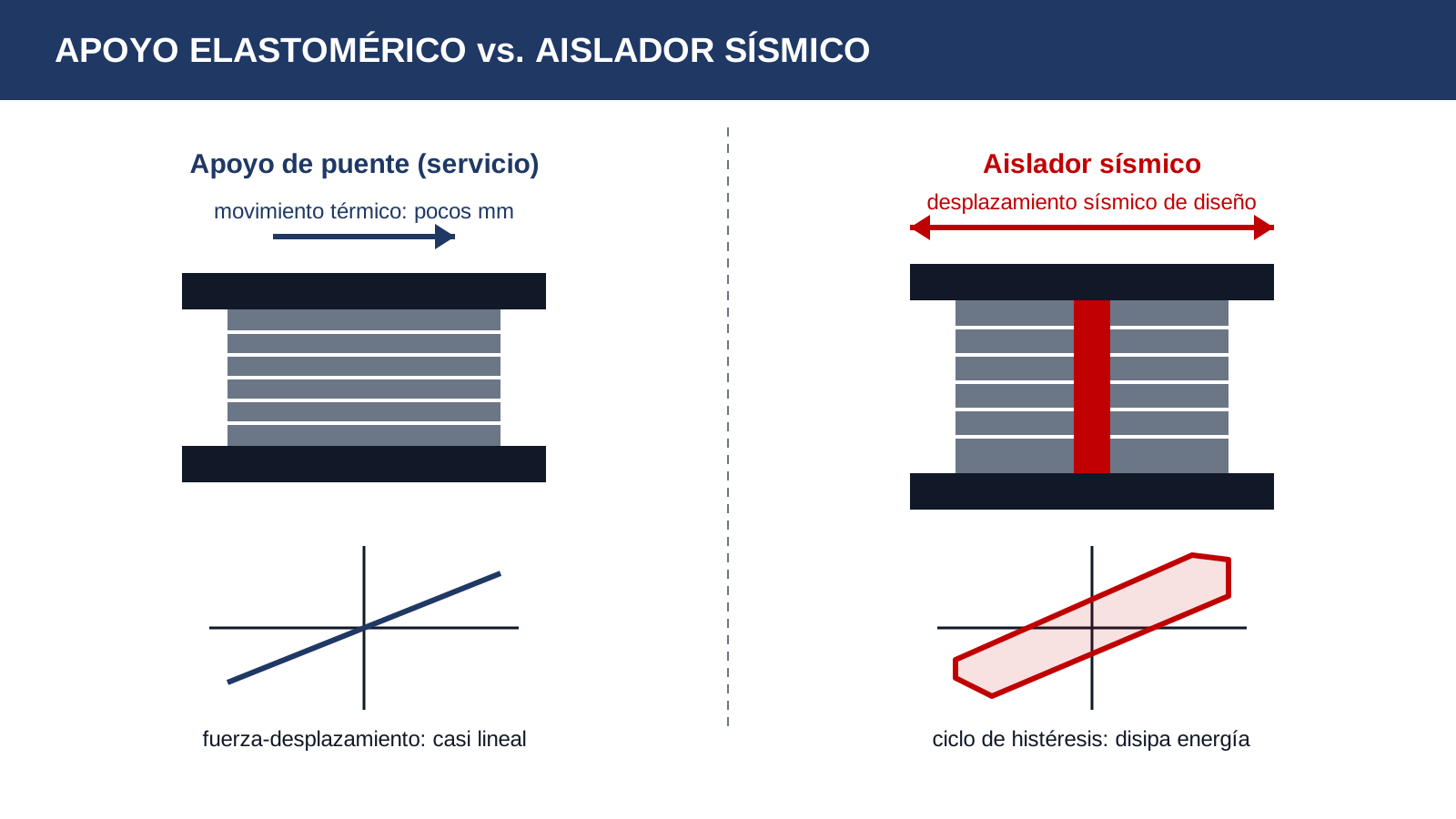
Un apoyo elastomérico está pensado para el servicio diario: soporta la carga vertical y deja que la trabe gire y se dilate sin transmitir esfuerzos grandes a la subestructura. Su norma de producto europea, EN 1337-3, cubre apoyos de hule laminado, con o sin elementos deslizantes, de hasta 1,200 × 1,200 mm en planta.
Un aislador sísmico se diseña para algo más exigente: sufrir grandes desplazamientos laterales cíclicos sin perder estabilidad bajo carga vertical, alargar el periodo de la estructura y, según el tipo, disipar energía. Por eso la serie ISO 22762 define requisitos mínimos y métodos de ensayo específicos para aisladores elastoméricos, con partes para puentes y para edificios.
| Apoyo elastomérico | Aislador sísmico | |
|---|---|---|
| Función principal | Transmitir carga vertical y permitir giros y movimientos de servicio (temperatura, contracción, tráfico). | Todo lo anterior, más alargar el periodo y limitar la fuerza sísmica que llega a la estructura. |
| Movimiento lateral considerado | Pequeño y lento (del orden de milímetros a centímetros). | Grande y cíclico: el desplazamiento sísmico de diseño, con margen de seguridad. |
| Amortiguamiento | Bajo; no se diseña para disipar energía. | Parte del diseño (núcleo de plomo, hule de alto amortiguamiento o fricción). |
| Norma típica | EN 1337-3; AASHTO LRFD para puentes. | ISO 22762; AASHTO Guide Specifications for Seismic Isolation Design; ASCE 7-22 cap. 17 en edificios. |
| Ensayos | Control de calidad del material y de la pieza. | Ensayos de prototipo y producción con ciclos al desplazamiento de diseño. |
Qué pasa en un sismo si sólo hay apoyos de servicio
Sin un diseño de aislamiento, los apoyos elastoméricos de un puente suelen trabajar junto con otros elementos para resistir el sismo: topes sísmicos, llaves de cortante y la propia rigidez de la subestructura. Según el caso, esos elementos pueden atraer fuerzas grandes, y el apoyo puede deslizar o deformarse más allá de lo previsto. El comportamiento sólo se puede asegurar cuando se verifica, no por suposición.
Esto no significa que un apoyo elastomérico nunca pueda usarse como parte de un sistema de aislamiento. Significa que, para considerarlo aislador, el diseño debe seguir el procedimiento de aislamiento (propiedades máximas y mínimas, desplazamiento de diseño, estabilidad, ensayos), en lugar de heredar el diseño del apoyo de servicio.
Preguntas para hacer antes de aprobar un sistema
- ¿Cuál es el desplazamiento sísmico de diseño y el dispositivo lo soporta con margen? Véase pruebas de prototipo y producción.
- ¿Hay propiedades de diseño ensayadas (rigidez, amortiguamiento) o sólo dureza del hule?
- ¿Qué norma de producto y de diseño aplica? ISO 22762, EN 1337-3, AASHTO.
- ¿Quién verifica la estabilidad a desplazamiento máximo con carga vertical?
- ¿El material es virgen y trazable? Véase neopreno virgen vs. reciclado.
Para ver cómo se instalan en puentes, consulta instalación de aisladores en puentes y puentes SICT del Pacífico.
Una precisión honesta: este artículo resume diferencias generales entre dos familias de producto. El alcance exacto, los límites y las exclusiones de cada norma deben consultarse en el texto completo de la edición vigente, y nada de lo aquí descrito proviene de un proyecto de VELATOPH®.
En VELATOPH®
VELATOPH® fabrica en Manzanillo, Colima, aisladores elastoméricos LRB y LDRB, aisladores de péndulo FPS y DFP y disipadores DEF y DVF, y trabaja con la normativa ASCE 7-22 (capítulos 17 y 18), AASHTO LRFD, ISO 22762, NTC-CDMX 2023 y CFE-Sismo 2015.
Si tienes un puente o viaducto y quieres saber si necesita aislamiento sísmico o bastan apoyos de servicio, te ofrecemos una evaluación técnica gratuita. Escríbenos por WhatsApp.
Fuentes
- ISO 22762-1 — Elastomeric seismic-protection isolators, Part 1: Test methods. iso.org
- ISO 22762-3:2010 — Elastomeric seismic-protection isolators, Part 3: Applications for buildings. iteh.es
- EN 1337-3:2005 — Structural bearings, Part 3: Elastomeric bearings. genorma.com
- Cerema. Technical guide — Laminated elastomeric bearings. cerema.fr
- AASHTO. Guide Specifications for Seismic Isolation Design and LRFD Bridge Design Specifications (consultar la edición vigente).
On a bridge it is common to see blocks of laminated rubber between the girder and the cap. They are called elastomeric bearings, and from the outside they look a lot like an elastomeric seismic isolator. The confusion is frequent, even in specifications: "it already has neoprene, so it is isolated." It is not, and the difference determines how the bridge behaves in an earthquake.
What each one is designed for
An elastomeric bearing is meant for everyday service: it carries vertical load and lets the girder rotate and expand without passing large forces to the substructure. Its European product standard, EN 1337-3, covers laminated rubber bearings, with or without sliding elements, up to 1,200 × 1,200 mm in plan.
A seismic isolator is designed for something more demanding: undergoing large cyclic lateral displacements without losing stability under vertical load, lengthening the structure's period and, depending on the type, dissipating energy. That is why the ISO 22762 series sets specific minimum requirements and test methods for elastomeric isolators, with parts for bridges and for buildings.
| Elastomeric bearing | Seismic isolator | |
|---|---|---|
| Main function | Carry vertical load and allow rotations and service movements (temperature, shrinkage, traffic). | All of the above, plus lengthening the period and limiting the seismic force reaching the structure. |
| Lateral movement considered | Small and slow (millimeters to centimeters). | Large and cyclic: the design seismic displacement, with a safety margin. |
| Damping | Low; not designed to dissipate energy. | Part of the design (lead core, high-damping rubber or friction). |
| Typical standard | EN 1337-3; AASHTO LRFD for bridges. | ISO 22762; AASHTO Guide Specifications for Seismic Isolation Design; ASCE 7-22 Ch. 17 for buildings. |
| Tests | Material and product quality control. | Prototype and production tests with cycles at the design displacement. |
What happens in an earthquake with only service bearings
Without an isolation design, a bridge's elastomeric bearings usually work together with other elements to resist the earthquake: seismic stoppers, shear keys and the substructure's own stiffness. Depending on the case, those elements can attract large forces, and the bearing may slide or deform beyond what was foreseen. The behavior can only be assured by verifying it, not by assuming it.
This does not mean an elastomeric bearing can never be part of an isolation system. It means that, to be considered an isolator, the design must follow the isolation procedure (upper and lower bound properties, design displacement, stability, tests) instead of inheriting the service bearing's design.
Questions to ask before approving a system
- What is the design seismic displacement and does the device withstand it with margin? See prototype and production testing.
- Are there tested design properties (stiffness, damping) or only rubber hardness?
- Which product and design standard applies? ISO 22762, EN 1337-3, AASHTO.
- Who verifies stability at maximum displacement under vertical load?
- Is the material virgin and traceable? See virgin vs. recycled neoprene.
To see how they are installed on bridges, read isolator installation on bridges and SICT Pacific bridges.
An honest note: this article summarizes general differences between two product families. The exact scope, limits and exclusions of each standard must be checked in the full text of the current edition, and nothing described here comes from a VELATOPH® project.
At VELATOPH®
VELATOPH® manufactures in Manzanillo, Colima, LRB and LDRB elastomeric isolators, FPS and DFP pendulum isolators and DEF and DVF dampers, and works with the ASCE 7-22 (Chapters 17 and 18), AASHTO LRFD, ISO 22762, NTC-CDMX 2023 and CFE-Sismo 2015 standards.
If you have a bridge or viaduct and want to know whether it needs seismic isolation or service bearings are enough, we offer a free technical assessment. Write to us on WhatsApp.
Sources
- ISO 22762-1 — Elastomeric seismic-protection isolators, Part 1: Test methods. iso.org
- ISO 22762-3:2010 — Elastomeric seismic-protection isolators, Part 3: Applications for buildings. iteh.es
- EN 1337-3:2005 — Structural bearings, Part 3: Elastomeric bearings. genorma.com
- Cerema. Technical guide — Laminated elastomeric bearings. cerema.fr
- AASHTO. Guide Specifications for Seismic Isolation Design and LRFD Bridge Design Specifications (check the current edition).