El 6 de febrero de 2023, dos sismos de magnitud 7.8 y 7.6 sacudieron el sureste de Turquía y el norte de Siria con unas nueve horas de diferencia. Fue una prueba extrema para todo tipo de edificio, y los hospitales son el caso más delicado: justo cuando más gente necesita atención, el edificio debe seguir en pie y funcionando. Este artículo resume lo que documentaron equipos de reconocimiento e investigadores sobre los hospitales con aislamiento sísmico, sin exagerar lo que los datos permiten afirmar.
Qué pasó el 6 de febrero de 2023
Los sismos de Kahramanmaraş (Mw 7.8 y Mw 7.6) rompieron un tramo de unos 300 km de la Falla de Anatolia Oriental y fueron registrados por más de 280 estaciones de movimiento fuerte. Los datos que usamos aquí vienen de tres fuentes de ingeniería: el reporte preliminar del equipo de reconocimiento de EERI, un estudio de campo publicado en Earthquake Spectra y el reporte rápido de un equipo de la Administración de Terremotos de China. Esta última fuente estima que la mayoría de los edificios sufrió movimientos más fuertes que los de diseño del reglamento turco de 2018.
Lo que se observó en hospitales aislados
Turquía exige desde 2013, según una revisión publicada en Nature Communications Engineering, aislamiento para hospitales de más de 100 camas en zonas sísmicas; por eso había hospitales aislados en la región afectada. Los reportes coinciden en lo esencial:
| Fuente | Qué reporta |
|---|---|
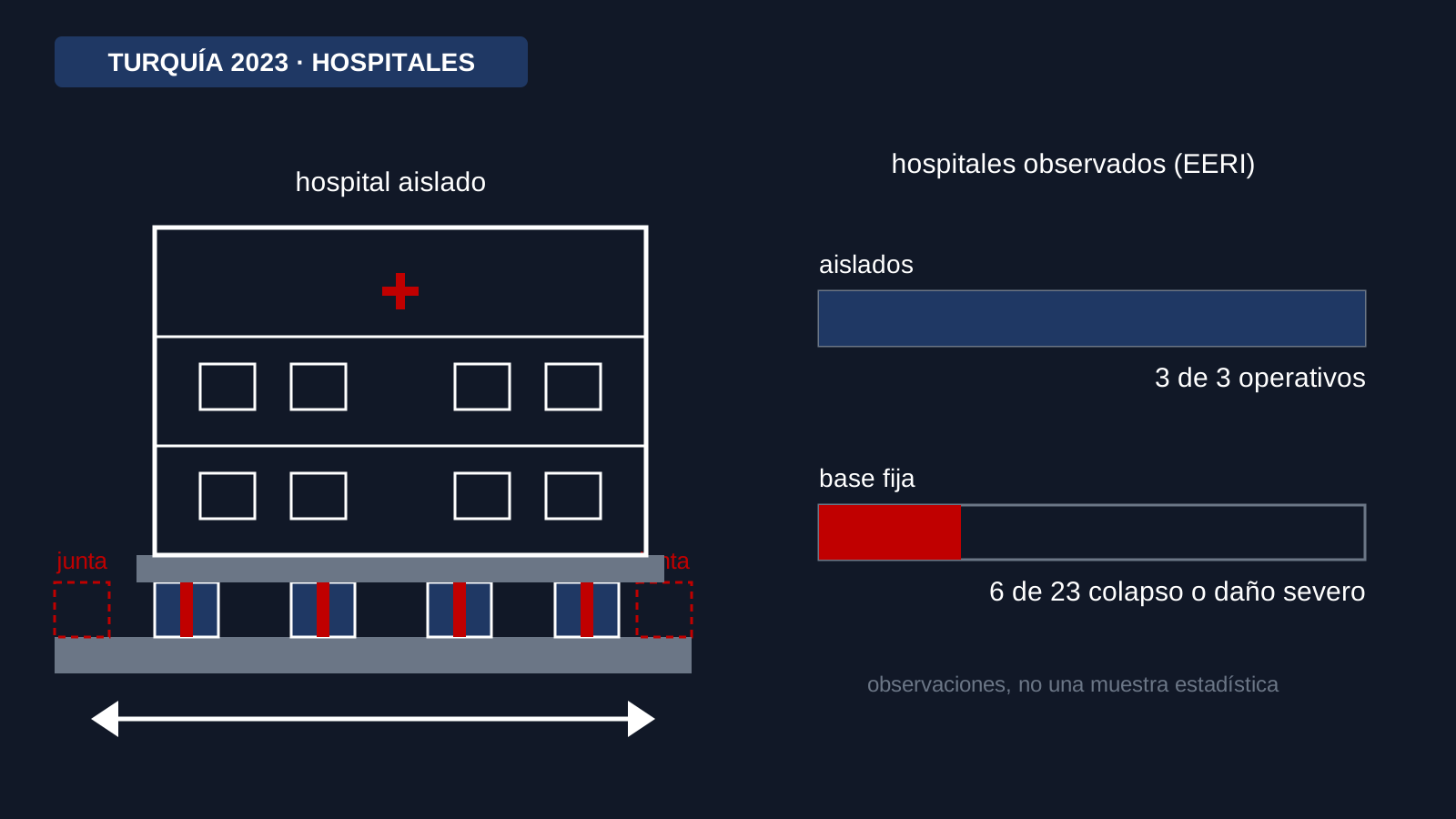
| EERI (reporte preliminar) | 3 hospitales aislados observados: todos operativos y sin daño significativo; desplazamientos del sistema de aislamiento muy inferiores a la capacidad de los aisladores. |
| EERI (reporte preliminar) | 23 hospitales de base fija observados: 6 (26 %) colapsaron, quedaron severamente dañados o fueron demolidos. |
| Kaatsız et al., Earthquake Spectra (2025) | 9 hospitales aislados a menos de 50 km de la falla; se estudiaron 5, todos con aisladores de péndulo de fricción de doble superficie esférica (como el DFP). |
| Qu et al. (2023), reporte rápido | 12 hospitales examinados (5 aislados, 7 de base fija). Los aislados con péndulo de fricción tendieron a quedar plenamente utilizables y a proteger mejor los elementos no estructurales. |
Por qué cerraron hospitales que no colapsaron
El reporte de EERI señala que, en los hospitales de base fija, el daño en el sistema estructural fue en general mínimo salvo en edificios antiguos (varios colapsaron total o parcialmente), y que en los más nuevos la estructura cumplió al menos con seguridad de vida. Aun así, algunos quedaron inutilizables por daño no estructural: tabiques, plafones, equipo médico, generadores de emergencia, fachadas y líneas de agua, electricidad y gas. Los tabiques pesados y rígidos sin detalle adecuado causaron mucho daño y, donde sostenían equipo y mobiliario, fallaron anclajes. También influyó el efecto psicológico de ver grietas. Para no exagerar: el reporte de Qu et al. también indica que los hospitales de concreto de base fija construidos después de 2001 evitaron el colapso y muchos siguieron operando; el aislamiento no es la única forma de que un hospital sobreviva, pero sí la que más reduce el daño no estructural.
Lo que no salió perfecto
Los mismos reportes advierten detalles de obra que, con un sismo mayor, podrían costar caro:
- Instalaciones y tabiques cruzando el plano de aislamiento sin detallar para el desplazamiento de diseño (EERI).
- Juntas perimetrales obstruidas: huecos cubiertos con grava o tierra, o cruzados por banquetas, que pueden resistir el movimiento (EERI). Kaatsız et al. también documentan separaciones sísmicas y muros de relleno inadecuados que produjeron daño no estructural en la superestructura aislada.
- Falta de comparación completa: EERI aclara que aún no determinó si los desplazamientos observados coinciden con los esperados según las propiedades de los aisladores y el espectro del sitio.
Es la misma lista de errores que describimos en junta de separación (foso): el aislador puede funcionar perfecto y aun así fallar la función del edificio por un detalle de obra.
Qué enseña esto para México
- Operación continua es un requisito de proyecto, no una consecuencia: véase aislamiento sísmico en hospitales.
- Se diseña para el sitio: el espectro importa tanto como el aislador (CFE-Sismo 2015, NTC-CDMX).
- Se verifica y se vigila: pruebas de prototipo y producción y mantenimiento a lo largo de la vida útil, incluida la inspección de la junta.
- Se coordinan las especialidades: arquitectura, instalaciones y obra deben conocer el desplazamiento de diseño desde el inicio.
Una precisión honesta: el reporte de EERI es preliminar, observó sólo 3 hospitales aislados y las observaciones dependieron del acceso a cada sitio; son evidencia valiosa, no una estadística. Y ninguna de estas fuentes habla de productos de VELATOPH®.
En VELATOPH®
VELATOPH® fabrica en Manzanillo, Colima, aisladores elastoméricos LRB y LDRB, aisladores de péndulo FPS y DFP y disipadores DEF y DVF, y trabaja con la normativa ASCE 7-22 (capítulos 17 y 18), AASHTO LRFD, ISO 22762, NTC-CDMX 2023 y CFE-Sismo 2015.
Si tienes un proyecto hospitalario o de infraestructura crítica y quieres saber si el aislamiento o la disipación convienen para tu predio, te ofrecemos una evaluación técnica gratuita. Escríbenos por WhatsApp.
Fuentes
- EERI (2023). Impact of the Kahramanmaraş Earthquakes on Hospitals: A Preliminary Report from the EERI Lifelines Reconnaissance Team. eeri.org
- Kaatsız, K. et al. (2025). Seismic performance assessment of base isolation systems in five hospitals during the Mw7.8 and Mw7.6 2023 earthquakes in Southeast Turkey. Earthquake Spectra 41(1), 176–197. doi.org/10.1177/87552930241284613
- Qu, Z. et al. (2023). Rapid report of seismic damage to hospitals in the 2023 Turkey earthquake sequences. Earthquake Research Advances. doi.org/10.1016/j.eqrea.2023.100234
- The 2023 Kahramanmaraş Earthquake Sequence: finding a path to a more resilient, sustainable, and equitable society. Communications Engineering (Nature). nature.com
On February 6, 2023, two earthquakes of magnitude 7.8 and 7.6 shook southeastern Türkiye and northern Syria about nine hours apart. It was an extreme test for every kind of building, and hospitals are the most delicate case: just when the most people need care, the building must stay standing and keep working. This article summarizes what reconnaissance teams and researchers documented about hospitals with seismic isolation, without overstating what the data allow us to say.
What happened on February 6, 2023
The Kahramanmaraş earthquakes (Mw 7.8 and Mw 7.6) ruptured a stretch of about 300 km of the East Anatolian Fault and were recorded by more than 280 strong-motion stations. The data we use here come from three engineering sources: the preliminary report of the EERI reconnaissance team, a field study published in Earthquake Spectra, and the rapid report of a China Earthquake Administration team. The latter estimates that most buildings experienced ground motion stronger than the design level of the 2018 Turkish code.
What was observed in isolated hospitals
Since 2013, according to a review in Communications Engineering (Nature), Türkiye has required isolation for hospitals of more than 100 beds in seismic zones; that is why there were isolated hospitals in the affected region. The reports agree on the essentials:
| Source | What it reports |
|---|---|
| EERI (preliminary report) | 3 isolated hospitals observed: all operational, with no significant damage; isolation-system displacements well below the isolators' capacity. |
| EERI (preliminary report) | 23 fixed-base hospitals observed: 6 (26%) collapsed, were severely damaged or were demolished. |
| Kaatsız et al., Earthquake Spectra (2025) | 9 isolated hospitals within 50 km of the fault; 5 were studied, all with double-spherical-surface friction pendulum isolators (like the DFP). |
| Qu et al. (2023), rapid report | 12 hospitals examined (5 isolated, 7 fixed-base). Isolated hospitals with friction pendulum bearings tended to stay fully usable and to better protect non-structural elements. |
Why hospitals that did not collapse still closed
The EERI report notes that in fixed-base hospitals the lateral force-resisting systems were generally minimally damaged except in older buildings (several of which collapsed fully or partially), and that in newer ones the structure performed at least at life-safety level. Even so, some became unusable because of non-structural damage: partitions, ceilings, medical equipment, emergency generators, cladding and water, electrical and gas lines. Heavy, stiff partitions without proper detailing caused heavy damage and, where they anchored equipment and furniture, anchors failed. The psychological effect of visible cracks also played a part. To keep perspective: the Qu et al. report also indicates that fixed-base reinforced concrete hospitals built after 2001 avoided collapse and many kept operating; isolation is not the only way a hospital can survive, but it is the one that most reduces non-structural damage.
What did not go perfectly
The same reports flag construction details that, in a larger earthquake, could prove costly:
- Services and partitions crossing the isolation plane without being detailed for the design displacement (EERI).
- Obstructed perimeter gaps: openings covered with gravel or soil, or crossed by sidewalks, which can resist movement (EERI). Kaatsız et al. also document inappropriate seismic gaps and infill walls that caused non-structural damage in the isolated superstructure.
- Incomplete comparison: EERI states it has not yet determined whether the observed displacements match those expected from the isolators' properties and the site spectrum.
It is the same list of mistakes we described in seismic gap (foso): the isolator can work perfectly and the building can still fail its purpose because of a construction detail.
What this teaches for Mexico
- Continued operation is a design requirement, not a by-product: see seismic isolation in hospitals.
- Design for the site: the spectrum matters as much as the isolator (CFE-Sismo 2015, NTC-CDMX).
- Verify and monitor: prototype and production testing and maintenance over the service life, including gap inspection.
- Coordinate the disciplines: architecture, services and construction must know the design displacement from the start.
An honest note: the EERI report is preliminary, observed only 3 isolated hospitals, and observations depended on access to each site; it is valuable evidence, not a statistic. And none of these sources discuss VELATOPH® products.
At VELATOPH®
VELATOPH® manufactures in Manzanillo, Colima, LRB and LDRB elastomeric isolators, FPS and DFP pendulum isolators and DEF and DVF dampers, and works with the ASCE 7-22 (Chapters 17 and 18), AASHTO LRFD, ISO 22762, NTC-CDMX 2023 and CFE-Sismo 2015 standards.
If you have a hospital or critical-infrastructure project and want to know whether isolation or energy dissipation is a good fit for your site, we offer a free technical assessment. Write to us on WhatsApp.
Sources
- EERI (2023). Impact of the Kahramanmaraş Earthquakes on Hospitals: A Preliminary Report from the EERI Lifelines Reconnaissance Team. eeri.org
- Kaatsız, K. et al. (2025). Seismic performance assessment of base isolation systems in five hospitals during the Mw7.8 and Mw7.6 2023 earthquakes in Southeast Turkey. Earthquake Spectra 41(1), 176–197. doi.org/10.1177/87552930241284613
- Qu, Z. et al. (2023). Rapid report of seismic damage to hospitals in the 2023 Turkey earthquake sequences. Earthquake Research Advances. doi.org/10.1016/j.eqrea.2023.100234
- The 2023 Kahramanmaraş Earthquake Sequence: finding a path to a more resilient, sustainable, and equitable society. Communications Engineering (Nature). nature.com