El péndulo de fricción es uno de los sistemas de aislamiento sísmico más usados en el mundo. Su versión simple (FPS) tiene una sola superficie cóncava; su evolución, el péndulo de fricción doble (DFP), usa dos. La diferencia parece pequeña en un plano, pero cambia el tamaño del aislador, la forma en que disipa energía y los proyectos en los que conviene. En este artículo explicamos cómo funciona cada uno y cuándo tiene sentido elegir el doble.
Primero, el péndulo simple (FPS)
Un FPS es una placa de acero con una superficie esférica cóncava sobre la que desliza un elemento articulado recubierto con un material de baja fricción. Cuando el suelo se mueve, el deslizador recorre la superficie curva y el edificio se eleva ligeramente, como la masa de un péndulo. La gravedad lo regresa al centro y la fricción disipa energía en cada ciclo.
Su comportamiento se describe con dos parámetros: el radio de curvatura efectivo R y el coeficiente de fricción μ. La fuerza lateral en el aislador vale aproximadamente F = (W/R)·u + μ·W, donde W es la carga vertical y u el desplazamiento. De ahí sale su propiedad más conocida: el periodo de aislamiento T = 2π√(R/g) depende sólo del radio, no de la masa del edificio. Por eso el centro de rigidez del sistema coincide con el centro de masa y se reducen los efectos de torsión.
La limitación del FPS es geométrica: todo el desplazamiento ocurre sobre una sola placa. Si el diseño pide 60 cm de desplazamiento, esa placa tiene que ser lo bastante grande para que el deslizador recorra los 60 cm hacia cualquier lado.
Cómo funciona el péndulo de fricción doble (DFP)
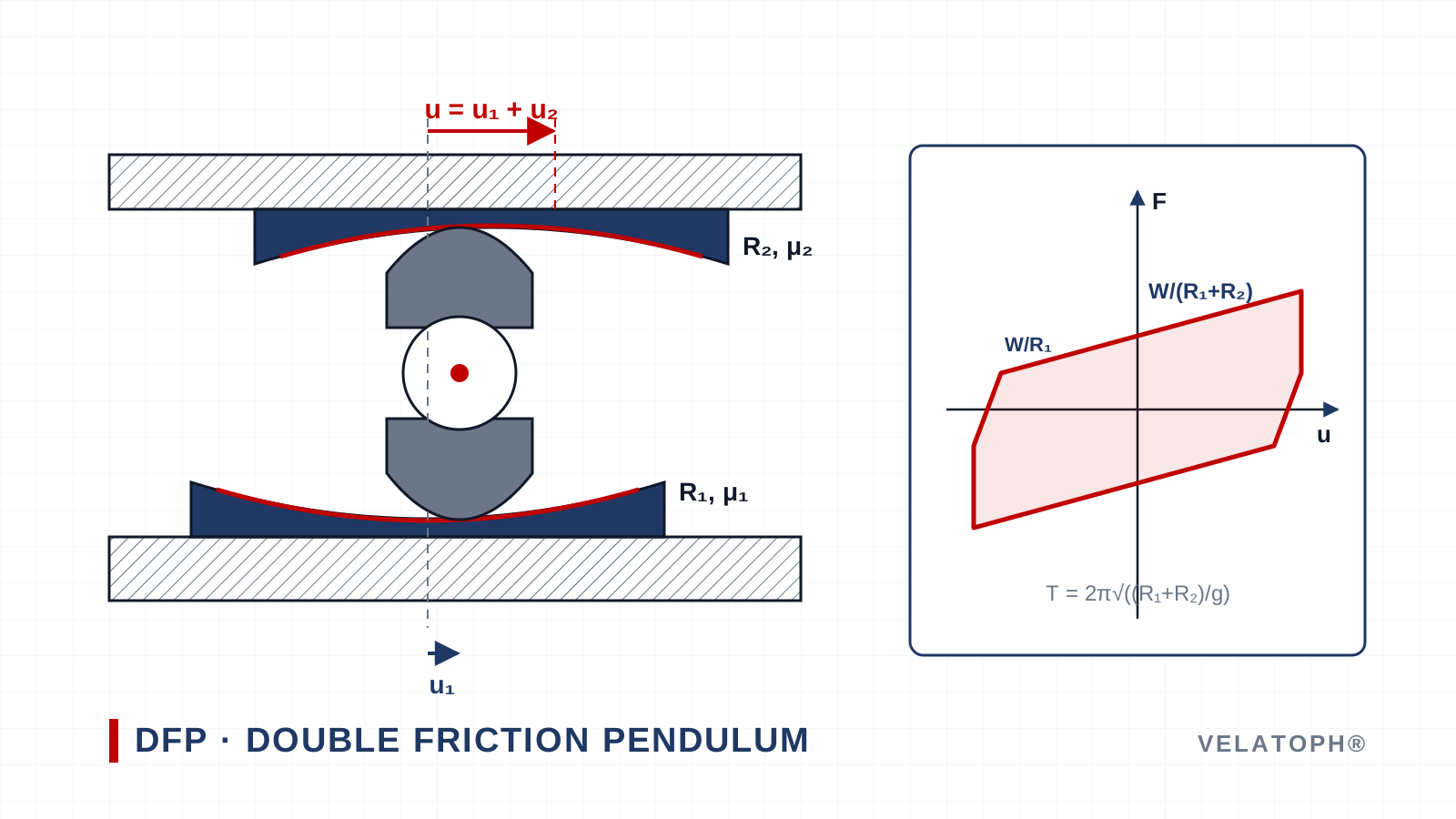
El DFP tiene dos placas cóncavas enfrentadas, una arriba y otra abajo, y entre ellas un deslizador articulado que puede moverse sobre ambas superficies. Cada superficie tiene su propio radio (R₁, R₂) y su propio coeficiente de fricción (μ₁, μ₂). El desplazamiento total del aislador es la suma de los desplazamientos en las dos superficies: u = u₁ + u₂.
Fenz y Constantinou (2006) demostraron que el DFP se comporta como dos péndulos simples conectados en serie. Si las dos superficies son iguales (mismo radio y misma fricción), el DFP equivale a un FPS con radio R₁ + R₂ y el periodo resulta:
T = 2π√((R₁ + R₂)/g)
Un ejemplo ilustrativo, no de un proyecto real: con dos superficies de radio efectivo 2.0 m, el periodo es de unos 4.0 s, mientras que un FPS con una sola superficie de 2.0 m tendría alrededor de 2.8 s. Para obtener esos 4.0 s con un FPS haría falta una sola superficie de 4.0 m de radio.
Tres ventajas que explican su uso
1. Más desplazamiento en menos espacio
Como el movimiento se reparte entre dos superficies, cada placa sólo necesita acomodar aproximadamente la mitad del desplazamiento total. El resultado es un aislador de menor diámetro en planta para la misma capacidad. Esto importa cuando el espacio es limitado: pedestales de columnas, cabezales de pilas de puente o la sustitución de apoyos en estructuras existentes.
2. El momento P-Δ se reparte
En un FPS, el momento que genera la carga vertical al desplazarse (P·Δ) recae completo sobre el elemento que está del lado de la placa cóncava. En un DFP con superficies iguales, ese momento se divide entre la estructura de arriba y la de abajo. Las trabes, columnas o pedestales de cada lado reciben menos flexión adicional.
3. Comportamiento adaptable
Si las dos superficies tienen fricciones distintas, el deslizamiento empieza en la de menor fricción, con rigidez W/R₁. Cuando la fuerza alcanza el nivel de fricción de la segunda superficie, ambas deslizan y la rigidez baja a W/(R₁ + R₂). Este cambio ocurre a un desplazamiento que se calcula y se controla desde el diseño. Fenz y Constantinou llamaron a este efecto comportamiento adaptable: un dispositivo pasivo que responde distinto ante sismos moderados y ante sismos intensos. Esa misma idea llevó después al péndulo de fricción triple, con varias superficies y etapas.
FPS contra DFP: comparación rápida
| Aspecto | FPS (simple) | DFP (doble) |
|---|---|---|
| Superficies de deslizamiento | Una | Dos, en serie |
| Periodo de aislamiento | 2π√(R/g) | 2π√((R₁+R₂)/g) con superficies iguales |
| Tamaño en planta | Crece con todo el desplazamiento | Menor: cada placa toma cerca de la mitad |
| Momento P-Δ | Va a un solo lado | Se reparte arriba y abajo |
| Ajuste del ciclo | Un radio y una fricción | Dos radios y dos fricciones |
| Complejidad de análisis | Menor: modelo bilineal | Mayor si las superficies son distintas |
¿Cuándo conviene el DFP?
- Demandas de desplazamiento grandes: sitios cercanos a fallas activas o suelos blandos, donde el espectro de diseño pide desplazamientos que harían muy grande un FPS.
- Espacio limitado en planta: pedestales, cabezales de pilas o reforzamiento de estructuras existentes, donde no cabe una placa grande.
- Edificios esenciales: hospitales y centros de emergencia que deben seguir operando, donde se busca un periodo largo sin sobredimensionar los apoyos.
- Cargas verticales altas en elementos esbeltos: el reparto del momento P-Δ alivia a las columnas o a la cimentación.
Y cuándo no hace falta: si el desplazamiento de diseño es moderado y hay espacio, un FPS bien dimensionado resuelve el problema con un modelo más simple y menos piezas. La elección depende del espectro del sitio, del desplazamiento máximo y de la geometría disponible, no de una preferencia por un dispositivo.
Lo que hay que revisar en el diseño
- Desplazamiento máximo de cada superficie y del conjunto, con su margen hasta el tope.
- Variación de la fricción con la velocidad, la presión, la temperatura y el envejecimiento, a través de factores de modificación de propiedades.
- Desplazamiento residual después del sismo: una fricción alta con un radio grande puede dejar el edificio fuera del centro.
- Junta perimetral (foso) suficiente para el desplazamiento total, sin obstrucciones de instalaciones.
En VELATOPH®
VELATOPH® fabrica en Manzanillo, Colima, tanto el péndulo de fricción simple (FPS) como el péndulo de fricción doble (DFP), además de aisladores elastoméricos y disipadores de energía. El Hospital de Bahía de Caráquez, en Ecuador, cuenta con 64 aisladores DFP. Cada dispositivo se diseña según la demanda específica del proyecto.
Si estás proyectando un hospital, un puente o un edificio esencial y quieres saber si te conviene un FPS, un DFP o un aislador elastomérico, te ofrecemos una evaluación técnica gratuita. Escríbenos por WhatsApp.
Fuentes
- Fenz, D. M. y Constantinou, M. C. (2006). "Behaviour of the double concave Friction Pendulum bearing". Earthquake Engineering & Structural Dynamics, 35(11). doi.org/10.1002/eqe.589
- Fenz, D. M. y Constantinou, M. C. (2008). "Spherical sliding isolation bearings with adaptive behavior: Theory". Earthquake Engineering & Structural Dynamics, 37(2), 163–183. doi.org/10.1002/eqe.751
- Fenz, D. M. y Constantinou, M. C. (2008). Mechanical Behavior of Multi-Spherical Sliding Bearings. Reporte técnico MCEER-08-0007. nehrpsearch.nist.gov
- Fenz, D. M. y Constantinou, M. C. (2008). Development, Implementation and Verification of Dynamic Analysis Models for Multi-Spherical Sliding Bearings. Reporte técnico MCEER-08-0018. nehrpsearch.nist.gov
- Zayas, V. A., Low, S. S. y Mahin, S. A. (1990). "A simple pendulum technique for achieving seismic isolation". Earthquake Spectra, 6(2), 317–333. doi.org/10.1193/1.1585573
- ASCE/SEI 7-22, Minimum Design Loads and Associated Criteria for Buildings and Other Structures, capítulo 17. asce.org
The friction pendulum is one of the most widely used seismic isolation systems in the world. Its single version (FPS) has one concave surface; its evolution, the double friction pendulum (DFP), uses two. The difference looks small on a drawing, but it changes the size of the isolator, the way it dissipates energy and the projects where it makes sense. In this article we explain how each one works and when it is worth choosing the double.
First, the single pendulum (FPS)
An FPS is a steel plate with a concave spherical surface on which an articulated slider coated with a low-friction material slides. When the ground moves, the slider travels along the curved surface and the building rises slightly, like the mass of a pendulum. Gravity brings it back to the center and friction dissipates energy in every cycle.
Its behavior is described by two parameters: the effective radius of curvature R and the friction coefficient μ. The lateral force in the isolator is approximately F = (W/R)·u + μ·W, where W is the vertical load and u the displacement. This gives its best-known property: the isolation period T = 2π√(R/g) depends only on the radius, not on the mass of the building. That is why the center of stiffness of the system coincides with the center of mass and torsional effects are reduced.
The limitation of the FPS is geometric: all the displacement takes place on a single plate. If the design calls for 60 cm of displacement, that plate has to be large enough for the slider to travel those 60 cm in any direction.
How the double friction pendulum (DFP) works
The DFP has two facing concave plates, one on top and one at the bottom, with an articulated slider between them that can move on both surfaces. Each surface has its own radius (R₁, R₂) and its own friction coefficient (μ₁, μ₂). The total displacement of the isolator is the sum of the displacements on the two surfaces: u = u₁ + u₂.
Fenz and Constantinou (2006) showed that the DFP behaves like two single pendulums connected in series. If both surfaces are equal (same radius and same friction), the DFP is equivalent to an FPS with radius R₁ + R₂, and the period is:
T = 2π√((R₁ + R₂)/g)
An illustrative example, not from a real project: with two surfaces of 2.0 m effective radius, the period is about 4.0 s, while an FPS with a single 2.0 m surface would have about 2.8 s. To reach those 4.0 s with an FPS, a single surface with a 4.0 m radius would be needed.
Three advantages that explain its use
1. More displacement in less space
Because the motion is shared between two surfaces, each plate only needs to accommodate roughly half of the total displacement. The result is an isolator with a smaller plan diameter for the same capacity. This matters when space is limited: column pedestals, bridge pier caps or the replacement of bearings in existing structures.
2. The P-Δ moment is shared
In an FPS, the moment generated by the vertical load as it displaces (P·Δ) falls entirely on the element on the side of the concave plate. In a DFP with equal surfaces, that moment is split between the structure above and the structure below. The beams, columns or pedestals on each side receive less additional bending.
3. Adaptive behavior
If the two surfaces have different friction, sliding begins on the one with lower friction, with stiffness W/R₁. When the force reaches the friction level of the second surface, both slide and the stiffness drops to W/(R₁ + R₂). This change occurs at a displacement that is calculated and controlled in design. Fenz and Constantinou called this effect adaptive behavior: a passive device that responds differently to moderate and to intense earthquakes. The same idea later led to the triple friction pendulum, with several surfaces and stages.
FPS versus DFP: a quick comparison
| Aspect | FPS (single) | DFP (double) |
|---|---|---|
| Sliding surfaces | One | Two, in series |
| Isolation period | 2π√(R/g) | 2π√((R₁+R₂)/g) with equal surfaces |
| Plan size | Grows with the full displacement | Smaller: each plate takes about half |
| P-Δ moment | Goes to one side | Shared above and below |
| Loop tuning | One radius and one friction | Two radii and two frictions |
| Analysis complexity | Lower: bilinear model | Higher if the surfaces differ |
When is the DFP the right choice?
- Large displacement demands: sites near active faults or on soft soils, where the design spectrum calls for displacements that would make an FPS very large.
- Limited plan space: pedestals, pier caps or the retrofit of existing structures, where a large plate does not fit.
- Essential buildings: hospitals and emergency centers that must keep operating, where a long period is sought without oversizing the bearings.
- High vertical loads on slender elements: sharing the P-Δ moment relieves the columns or the foundation.
And when it is not needed: if the design displacement is moderate and there is space, a well-sized FPS solves the problem with a simpler model and fewer parts. The choice depends on the site spectrum, the maximum displacement and the available geometry, not on a preference for one device.
What to check in the design
- Maximum displacement of each surface and of the assembly, with its margin to the stop.
- Variation of friction with velocity, pressure, temperature and aging, through property modification factors.
- Residual displacement after the earthquake: high friction with a large radius can leave the building off center.
- A perimeter gap (moat) sufficient for the total displacement, free of utility obstructions.
At VELATOPH®
VELATOPH® manufactures in Manzanillo, Colima, both the single friction pendulum (FPS) and the double friction pendulum (DFP), as well as elastomeric isolators and energy dissipators. The Bahía de Caráquez Hospital in Ecuador has 64 DFP isolators. Each device is designed for the specific demand of the project.
If you are designing a hospital, a bridge or an essential building and want to know whether an FPS, a DFP or an elastomeric isolator suits you best, we offer a free technical assessment. Write to us on WhatsApp.
Sources
- Fenz, D. M. and Constantinou, M. C. (2006). "Behaviour of the double concave Friction Pendulum bearing". Earthquake Engineering & Structural Dynamics, 35(11). doi.org/10.1002/eqe.589
- Fenz, D. M. and Constantinou, M. C. (2008). "Spherical sliding isolation bearings with adaptive behavior: Theory". Earthquake Engineering & Structural Dynamics, 37(2), 163–183. doi.org/10.1002/eqe.751
- Fenz, D. M. and Constantinou, M. C. (2008). Mechanical Behavior of Multi-Spherical Sliding Bearings. Technical report MCEER-08-0007. nehrpsearch.nist.gov
- Fenz, D. M. and Constantinou, M. C. (2008). Development, Implementation and Verification of Dynamic Analysis Models for Multi-Spherical Sliding Bearings. Technical report MCEER-08-0018. nehrpsearch.nist.gov
- Zayas, V. A., Low, S. S. and Mahin, S. A. (1990). "A simple pendulum technique for achieving seismic isolation". Earthquake Spectra, 6(2), 317–333. doi.org/10.1193/1.1585573
- ASCE/SEI 7-22, Minimum Design Loads and Associated Criteria for Buildings and Other Structures, Chapter 17. asce.org