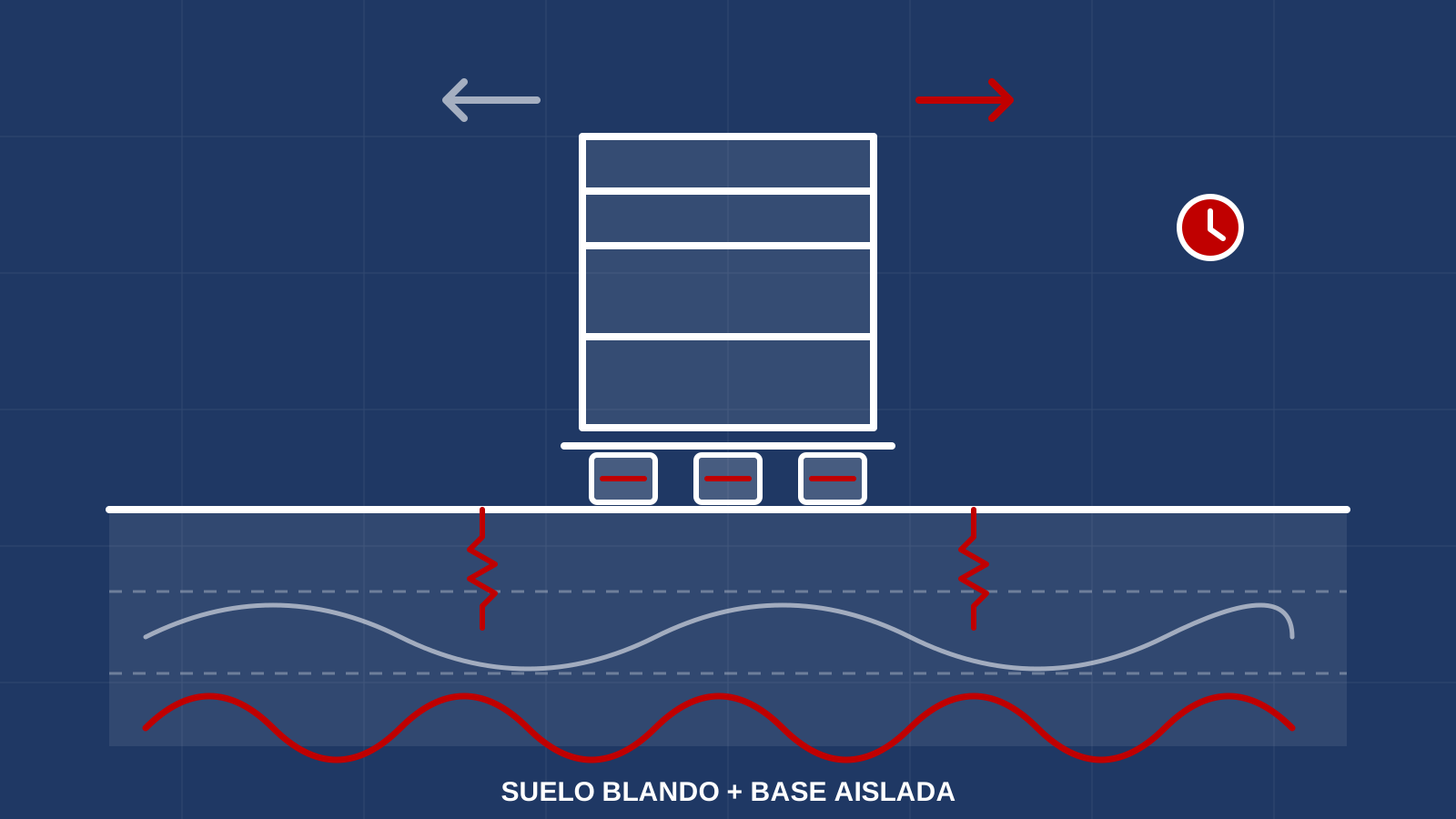
Al diseñar un edificio aislado se suele suponer que la cimentación es firme y que el movimiento del suelo llega tal cual a la capa de aislamiento. En suelos duros es una buena aproximación. En suelos blandos deja de serlo: el terreno se deforma, cambia el movimiento que recibe el edificio y puede coincidir con los periodos largos en los que el aislamiento trabaja. A ese intercambio entre terreno, cimentación y estructura se le llama interacción suelo-estructura (ISE).
Qué es la interacción suelo-estructura
El informe NIST GCR 12-917-21 la define como la respuesta conjunta de tres sistemas ligados: la estructura, la cimentación y el suelo que la rodea. Se distinguen dos efectos: la interacción cinemática, porque una cimentación rígida no sigue exactamente el movimiento del terreno libre, y la interacción inercial, porque las fuerzas de inercia de la estructura deforman el suelo y se disipa energía en él. En un edificio convencional el resultado típico es un periodo algo más largo y un amortiguamiento algo mayor que con base empotrada.
Por qué importa más en edificios aislados
El aislamiento alarga el periodo a propósito para salir de la zona del espectro donde el sismo tiene más energía (véase cómo leer un espectro de diseño). Eso funciona bien cuando el suelo es firme y su contenido de frecuencias está en periodos cortos. Un suelo blando filtra los periodos cortos y amplifica los largos, y la literatura técnica advierte de un posible riesgo de resonancia cuando el periodo del sitio se acerca al periodo del edificio aislado. En la Ciudad de México esa amplificación en la zona de lago es parte de la historia de los sismos de 1985 y 2017 (véase lecciones del 19 de septiembre y NTC-CDMX y aislamiento).
Efectos a vigilar
- Resonancia con el sitio: el periodo dominante del suelo cerca del periodo efectivo del aislamiento puede amplificar la respuesta en vez de reducirla.
- Periodo y desplazamiento: un suelo flexible bajo los aisladores suma deformación y puede alargar aún más el periodo; el desplazamiento de diseño y la junta de separación deben revisarse con ese escenario.
- Giro y levantamiento: en edificios esbeltos, el suelo blando permite que la base gire; los aisladores pueden recibir tracción o cargas desiguales.
- Asentamientos diferenciales: inclinan la capa de aislamiento y cambian la carga en cada aislador.
- Efecto de la ISE sobre las demandas: no siempre es desfavorable; algunos estudios la encuentran reductora de derivas y aceleraciones, pero ignorarla deja el diseño sin ese dato.
Resumen: suelo firme frente a suelo blando
| Aspecto | Suelo firme | Suelo blando |
|---|---|---|
| Contenido del movimiento | Predominan periodos cortos y medios | Se amplifican periodos largos |
| Hipótesis de base rígida | Suele ser razonable | Puede quedar del lado inseguro |
| Riesgo de resonancia | Bajo | A evaluar con el periodo del sitio |
| Estudio recomendado | Geotecnia estándar | Respuesta de sitio y modelo con ISE |
Qué revisar en un proyecto
- Estudio geotécnico completo con velocidad de onda de corte y periodo del sitio, no sólo capacidad de carga.
- Movimientos de sitio específicos cuando el suelo es muy blando; las normas remiten a estudios de respuesta de sitio en esos casos (revisa los requisitos de ASCE 7-22 y de la norma local aplicable).
- Rangos de rigidez del suelo (cota inferior y superior) en lugar de un solo valor, y modelo con resortes y amortiguadores bajo la cimentación.
- Comparar periodo del sitio y periodo efectivo del aislamiento para detectar cercanías.
- Revisar desplazamiento, giro y tracción en los aisladores con las condiciones más desfavorables.
- Rigidizar la cimentación en el nivel de aislamiento para que los aisladores trabajen con un apoyo uniforme.
El aislamiento puede seguir siendo una buena opción en suelo blando, pero la decisión se toma con el análisis del sitio, no con una regla general. Si hay dudas, la alternativa de aislar o reforzar se compara con los mismos datos de suelo.
En VELATOPH®
VELATOPH® fabrica en Manzanillo, Colima, aisladores elastoméricos LRB y LDRB, aisladores de péndulo FPS y DFP y disipadores DEF y DVF.
Si tu proyecto está en un suelo blando y quieres saber si el aislamiento aplica, te ofrecemos una evaluación técnica gratuita. Escríbenos por WhatsApp.
Fuentes
- Stewart, J. P., Crouse, C. B., Hutchinson, T., Lizundia, B., Naeim, F., Ostadan, F. Soil-Structure Interaction for Building Structures. NIST GCR 12-917-21, NEHRP Consultants Joint Venture (2012). nehrp.gov
- Soil-structure interaction (resumen general). en.wikipedia.org
- Efectos de la ISE en un edificio de concreto de 13 niveles aislado sobre suelo blando. Civil and Environmental Engineering (2026), doi:10.2478/cee-2026-0115. reference-global.com
- Estudio sobre ISE y movimientos de periodo largo en estructuras aisladas. Applied Sciences (2023), doi:10.3390/app13169090. doi.org
- Estudio sobre edificios aislados esbeltos en suelo blando. Buildings 14(10), 3198 (2024). mdpi.com
- Naeim, F., Kelly, J. M. Design of Seismic Isolated Structures: From Theory to Practice. Wiley (1999).
- ASCE/SEI 7-22, capítulos 17 (estructuras con aislamiento sísmico) y 19 (interacción suelo-estructura).
When an isolated building is designed, the foundation is usually assumed to be firm and the ground motion is assumed to reach the isolation layer unchanged. On stiff soil that is a good approximation. On soft soil it is not: the ground deforms, changes the motion the building receives and may coincide with the long periods where isolation works. This exchange between ground, foundation and structure is called soil-structure interaction (SSI).
What soil-structure interaction is
The NIST GCR 12-917-21 report defines it as the combined response of three linked systems: the structure, the foundation and the soil around it. Two effects are distinguished: kinematic interaction, because a stiff foundation does not follow the free-field ground motion exactly, and inertial interaction, because the structure’s inertia forces deform the soil and dissipate energy in it. In a conventional building the typical result is a somewhat longer period and somewhat higher damping than with a fixed base.
Why it matters more in isolated buildings
Isolation lengthens the period on purpose to leave the part of the spectrum where the earthquake has the most energy (see how to read a design spectrum). That works well when the soil is firm and its frequency content sits at short periods. Soft soil filters short periods and amplifies long ones, and the technical literature warns of a possible resonance risk when the site period approaches the period of the isolated building. In Mexico City, that amplification in the lake zone is part of the story of the 1985 and 2017 earthquakes (see lessons from September 19 and NTC-CDMX and isolation).
Effects to watch
- Resonance with the site: a dominant soil period near the effective isolation period can amplify the response instead of reducing it.
- Period and displacement: flexible soil under the isolators adds deformation and may lengthen the period further; the design displacement and the separation joint should be checked for that scenario.
- Rotation and uplift: in slender buildings, soft soil lets the base rotate; isolators may receive tension or uneven loads.
- Differential settlement: tilts the isolation layer and changes the load on each isolator.
- Effect of SSI on demands: it is not always unfavorable; some studies find it reduces drifts and accelerations, but ignoring it leaves the design without that information.
Summary: firm soil versus soft soil
| Aspect | Firm soil | Soft soil |
|---|---|---|
| Ground motion content | Short and medium periods dominate | Long periods are amplified |
| Rigid-base assumption | Usually reasonable | May be on the unsafe side |
| Resonance risk | Low | To be assessed with the site period |
| Recommended study | Standard geotechnics | Site response and SSI model |
What to check in a project
- A full geotechnical study with shear-wave velocity and site period, not only bearing capacity.
- Site-specific ground motions when the soil is very soft; codes refer to site-response studies in those cases (check the requirements of ASCE 7-22 and the applicable local code).
- Soil stiffness ranges (lower and upper bound) rather than a single value, and a model with springs and dashpots under the foundation.
- Compare site period and effective isolation period to detect closeness.
- Check displacement, rotation and tension in the isolators under the most unfavorable conditions.
- Stiffen the foundation at the isolation level so isolators work on a uniform support.
Isolation can still be a good option on soft soil, but the decision is made with site analysis, not with a general rule. If in doubt, the choice between isolating and strengthening is compared with the same soil data.
At VELATOPH®
VELATOPH® manufactures in Manzanillo, Colima, LRB and LDRB elastomeric isolators, FPS and DFP pendulum isolators and DEF and DVF dissipators.
If your project is on soft soil and you want to know whether isolation applies, we offer a free technical assessment. Write to us on WhatsApp.
Sources
- Stewart, J. P., Crouse, C. B., Hutchinson, T., Lizundia, B., Naeim, F., Ostadan, F. Soil-Structure Interaction for Building Structures. NIST GCR 12-917-21, NEHRP Consultants Joint Venture (2012). nehrp.gov
- Soil-structure interaction (general overview). en.wikipedia.org
- Effects of SSI on a base-isolated 13-story RC building on soft soil. Civil and Environmental Engineering (2026), doi:10.2478/cee-2026-0115. reference-global.com
- Study on SSI and long-period ground motions in isolated structures. Applied Sciences (2023), doi:10.3390/app13169090. doi.org
- Study on slender isolated buildings on soft soil. Buildings 14(10), 3198 (2024). mdpi.com
- Naeim, F., Kelly, J. M. Design of Seismic Isolated Structures: From Theory to Practice. Wiley (1999).
- ASCE/SEI 7-22, Chapters 17 (seismically isolated structures) and 19 (soil-structure interaction).